Have you eaten an apple without a sequence? Can you recognize one if it is upside down? How different would an apple taste without a crunch when you bite into it?
These are just some of the unusual questions raised in a new booklet about the apple, and how its ‘design’ shapes our experience of eating it.
Authors Clara Koh and Alvin Ho were curious about what eating an apple entailed besides its taste. Through observation, the duo who work under the studio name Atelier HOKO found that the fruit’s less noticed features — or what they term “secondary” — are just as important too.
Cheaper, faster, and a new aesthetic — this is what Risograph printers can offer to the local creative scene, says two new presses offering this technology in Singapore.
This year, Push—Press as well as Knuckles & Notch launched separately to offer printing services based on this Japanese invention. Both press founders discovered Risograph printers in the West, where it has become popular amongst designers and artists, and wanted to introduce this tool to Singapore.
While this printing technology has been around since 1980, it has mainly been used inside schools and churches as a cost-efficient high-volume printer for documents of just one or two colours. In recent years, however, graphic designers and artists have caught on to this technology, introducing them into design studios as well as setting up independent presses. Both Push—Press and Knuckles & Notch claim to be pioneers in offering Risograph printing as a service in Singapore.
It’s all about you, me, and them, at this year’s Archifest. Singapore’s annual architecture festival turns to the “Crowd” for its eighth edition as it looks at the impact of communities and collaborations in the built environment.
From a pavilion created by two architecture teams to “crowd pricing” workshops that demonstrate the economic benefits of purchasing as a group, this two-week long festival organised by the Singapore Institute of Architects will address how individuals can work with one another to affect change in the city from the ground-up.
This year’s focus on people is not just apt for a festival which aims to bring architecture closer to the public, but also reflects the beliefs of a new team. Taking over from previous director Adib Jalal and his team is PLUS Collaboratives, a two-year-old design collective who say they are all about working together to making work that the common man can appreciate.
“We feel creating programmes out of thin air is not something that a short festival should do. Instead, the programmes created should have a lasting reference,” said member Mervin Tan who is also this year’s Archifest director. “What we tried to do is to collect parallel voices to sing the same tune, and to sing louder together for this festival. We aim to show to the public the idea of ‘crowd’ does exist amongst the creative industries and is something real.”
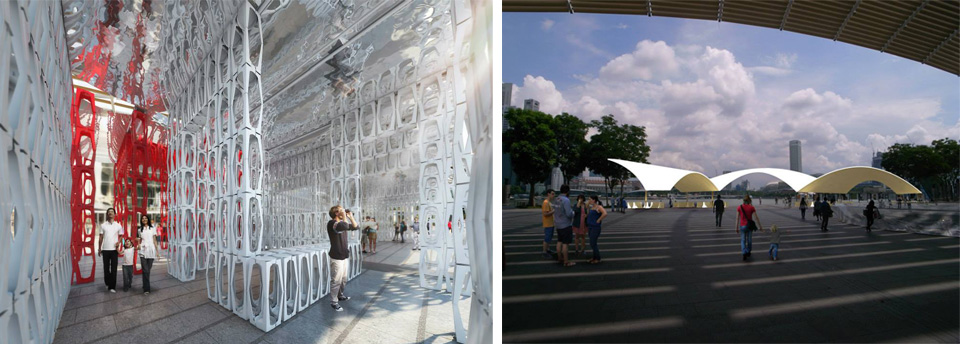
New to this year’s festival is working closely with students from various design schools to create projects that address this years’ theme. The students of Ngee Ann Polytechnic designed spaces for Little India to promote interaction and integration between the users of different social and cultural backgrounds in this ethnic enclave, while the architecture undergraduates of the National University of Singapore (NUS) studied appropriate materials and designs to better shade the city’s public spaces from the sun. These projects and more will be showcased at Marina Bay Sands where Archifest has erected a pavilion which is a design collaboration between HCF and Associates as well as Agfacadesign and the NUS. Both teams were winners for this year’s pavilion design competition, an unexpected decision made by the jury.
This year’s Archifest pavilion will be designed by HCF and Associates as well as Agfacadesign and the NUS, whose respective concepts “Fugue 1357″ (left) and “Cloud Arch” (right) were picked as joint winners for this year’s design competition. | ARCHIFEST
“This year we experienced the highest number of entries (28) since the beginning of the competition (in 2012) and the final shortlisted entries were really outstanding in their own rights,” explained Mervin. “Although it was not conventional to commission two winners, the jury decided to go ahead with this decision, which also bolts well with the overall theme of crowd and collaboration.”
Even as Archifest continues to make architecture relevant to the Singapore public, the festival has also not forgotten about the industry. From this year on, the festival will be launching ArchXpo, a new tradeshow component. Unlike other industry-specific events in Singapore such as the recent International Green Building Conference or the upcoming World Architecture Festival, Mervin said their show will be less topical and “a direct showcase of new ideas, future, projects” instead. More importantly, it is part of an effort to make the home-grown Archifest internationally relevant, as the Singapore Institute of Architects has partnered event organisers Conference & Exhibition Management Services for this event.