Singaporean design is beginning to rise with a new generation of creative talents including Creativeans.
They have had stints as designers in Italy, Japan, United Kingdom and Australia, but when they started their design practice, the Creativeans chose to be in Singapore, the country where four of them started out.
Kimming Yap, Yulia Saksen, Khairul Hussin and Sharina Bi, first met in the industrial design programme of Singapore’s Nanyang Polytechnic (NYP) a decade ago. In 2011, they created ‘Treasures of the Little Red Dot,’ their debut collection for Milan’s SaloneSatellite, which has won accolades and established the Creativeans as one of Singapore’s up-and-coming design collectives. But it merely started on a whim, when they came together after a class gathering in 2010 to design products for fun. “We didn’t intend to start a company. To be honest, we were quite bored with our work, so we decided to do something on our own,” says Kimming, who has a Masters from Domus Academy and was then working for Studio ITO Design in Milan.
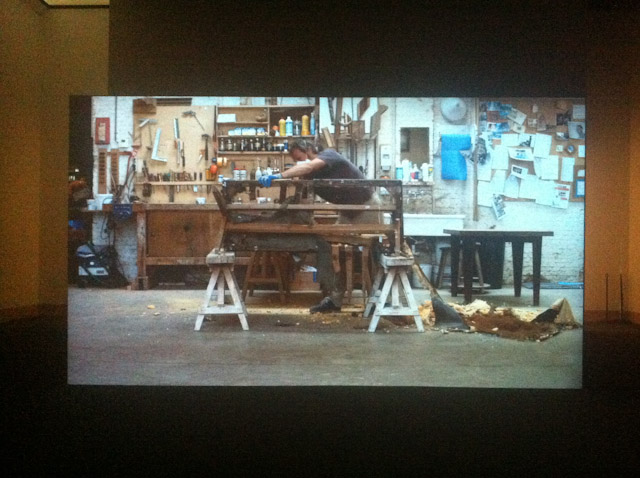
Watching the furniture restorer tear apart a Pierre Jeanneret chair to nothing more than its wooden skeletal frame, I was left with the question of what is an original design. That this eventually restored chair was auctioned off for tens of thousands of dollars as a collector’s item only made it more perplexing.
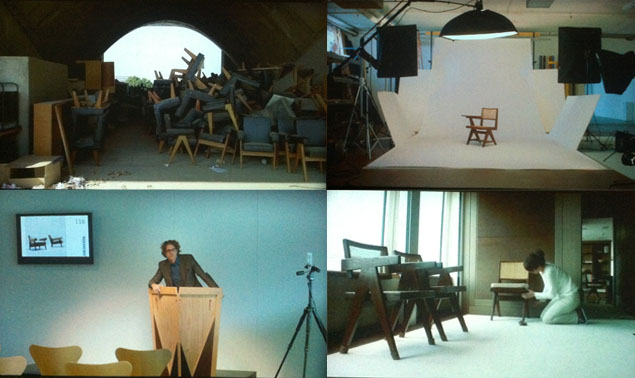
This hyper-inflation of mid-century modernist furniture is the subject of Amie Siegel’s “Provenance” (2013), a haunting 40-minute film that traces backwards the origins of a series of furniture designed by Swiss architect Jeanneret in the 1950s. Beginning from wealthy, stylish homes in the West where many of these furniture pieces now reside, Siegel takes us through the auction houses, furniture restorers, a cargo ship, and finally ends up in Chandigarh, the Indian city in which Jeanneret first conceived these utilitarian furniture for use in the modernist government buildings by his cousin, Le Corbusier. Amidst the now decaying buildings, we see these much sought after furniture pieces still being used as office furniture or even strewn in corners forgotten as they have been replaced by the generic wares of modern cubicle life.
Siegel’s cinematic journey — lingering tracking shots and without any dialogue — reveals the construction of “value” in such furniture today. Taken out of their original context, restored, glamorously photographed, and finally paraded at auction houses, these pieces of design are bestowed an aura of legitimacy and originality by what has become an industrial performance. Though beautifully shot, the film unveils an ugly truth: what do people really value in these pieces? The distance it has traveled? The restoration efforts? The myth of its origins?
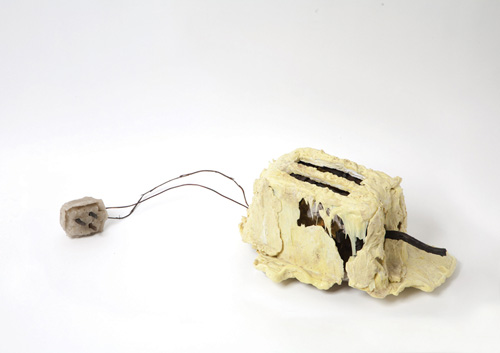
A separate journey to uncover the source of a design by Thomas Thwaites for The Toaster Project (2008), however, travels an entirely different route. The proposal is equally simple: to build a cheap chain-store toaster, costing just £3.49, from scratch — starting from acquiring the necessary raw materials. It turns out be both frustrating and hilarious, and the distance an individual in London has to travel to replicate what has essentially become a global industrial process today shows the hidden gap between a designed product and the world we live in. While Thwaites succeeds in building a barely functioning toaster eventually, it costs him £1187.54 and looks like a complete meltdown — all signs of the unseen external costs and environmental consequences created by the production of cheap consumer products.
The toaster built by Thwaite. | DANIEL ALEXANDER
Despite the huge disparity in value between Jeanneret’s restored furniture and the chain-store toaster, they are but two endpoints on a continuum of the capitalistic global economy. Both have been designed for profit, but how they attain it differs. While auction houses play on scarcity and the original myth, big-chain stores flood the market with anonymous and cheap products. By traveling to the sources of these products, we open up what is often presented as complete and closed so as to take a critical look at the larger forces that shape and give form to these things we so easily call ‘designed’.
In cities across Asia, design is largely understood with a capital ‘D’. A professional service that raises the economic value of things through the language of style. A modern high-end product only for those who can afford it.
But what about traditional crafts and vernacular creations found in everyday life? Are these also not designed? In his delightful book, “lesser designs” (揦西設計) (2013), Siu King-chung calls the inclusion of everyday inventions of ordinary people in his city of Hong Kong as part of our understanding of contemporary design. From modified street trolleys to simple pamphlets advertising money-lending services, the professor at The Hong Kong Polytechnic University School of Design picks out ordinary things found around the city and unveils the design wisdom behind each through photographs and casual explanations written in Chinese and English. In all, close to 30 collections of objects are divided into four themes to illustrate what “lesser designs” are and where to find them.