Category: Design

The 24-Hour Kopitiam: More Than Just Food

Below is a cultural report of the 24-hour Kopitiam in Plaza by the Park. It is posted here for an assignment as part of COM412: Journalism Reimagined.

In between the fringes of Singapore’s shopping belt and its civic district is this 24-hour food court, Kopitiam, that is part of a chain of similar stores island-wide that houses the “True Singapore Taste”. Indeed, traditionally, kopitiams are a general reference for the many independent-run shops locally that served food and coffee, but this store in Plaza by The Park, is an outlet of a corporation set up in 1988. On the evening of 14th of February 2009 I made the following observations at three different locations between 930pm to midnight.

kopitiam

While there is a wide array of food choices, 17 different stores, they are all run under one corporation. Regardless of the stores, all staff wore a uniform — a blue cap, white top with pink mandarin collar and a blue apron with the “Kopitiam” logo. This uniformity extended to the cleaners, hired from another company, who were decked out in yellow polos with a blue collar and some wore a blue cap. Such uniformity suggests a system was being implemented in this space.

A system of efficiency
As you can see in my map, efficiency was clearly in order in this Kopitiam. Distinct walkways for consumers sat next to lined up stores and were marked with different floor tiles from the sitting area. In order to maximise space usage, rectangle tables for two were placed right next to the glass panels that bordered the Kopitiam and tables for four were arranged orderly in areas A and B. Only in a small area of B did I find round wooden tables that were more common in kopitiams but were less efficient because less people could be packed into the same space.

All stores used a common cutlery pool — green trays and off-white bowls, spoons and chopsticks. Only the Minced Meat Noodle and Dessert stalls used different sets, the former had bigger black bowls and the latter blue bowls. Such uniformity justifies and aids a centralised cleaning service, and this is unlike traditional kopitiams where each stall usually cleaned their own dishes.

Efficiency pervaded right down to the cleaners who patrolled the place with a trolley that had separate compartments for food waste, dishes, cutlery and trays. At 11pm, the cleaners and many of the stalls had a change in staff, possibly marking the start of a new shift too.

Reclaiming the kopitiam
While Kopitiam tries to create an efficient dining experience like McDonalds — self-service, food is served quickly on trays that one can easily handle and cleaners constantly patrol the area to ensure that customer turnover was quick — the stall owners and customers defy this system in various ways.

Stalls like the Zi Char, Hokkien Mee and Handmade Noodle often got their customers to come back for their food instead of lining up as planned. The food they served probably needed some time to prepare, and when it was ready, customers were summoned back with the distinct sound of a bell.

While customers are free to sit anywhere, community enclaves were identified. Tables of Indians gathered around Jaggi’s North Indian Cuisine while men, mostly Africans, sat at section C so they could watch the soccer game projected on a screen over bottles of beer. Even the cleaners claimed the corner next to Bao Luo Wan Xiang to take short breaks.

Couples usually took up seats of four instead of two, putting their bags on the other two seats. When groups bigger than four came in, they rearranged the furniture to accommodate their numbers. Food here was usually served just for one, but a family of five foreigners created their own feast by buying from different stores and sharing them.

Some customers, like me, bought only a drink and sat down with their newspapers and books for hours. Two uncles sat through the whole time I was there, finishing over 6 bottles of Heineken beer — a common sight in kopitiams.

Rebel of consumption — ‘Dessert man’
After 11pm, the place was visibly less crowded and instead of customers, vagabonds started appearing. A few of them bought only a drink and were eventually slumped over the tables at the ‘sleeping corner’ near the North Indian cuisine. One example was ‘Dessert man’ whom I sat right next to for 1.5 hours. The middle-aged man armed with two big plastic bags bought a bowl of noodles and ordered a cup of tea. He had also asked for an extra empty cup.

After his meal, instead of ordering desert from the stall, he took out his own. The man had brought his own bottles of juices and biscuits and was very particular about the way he ate. He began with a bottle of Bickford’s Blackcurrant juice that he poured into the cup he had meticulously cleaned before with his own kitchen towels and started eating Munchy’s biscuits, making sure his hands never touched the biscuits as he ate them one after another from the packet. Next, he opened a bottle of Gerber Apple Juice, but not before cleaning the cup with water and tissue again. For the next half an hour, he finished nine packets of Cowhead biscuits, eating only the filling and spitting out the biscuit into a waste plastic bag he had created. By the time I left at midnight, he was done with his desert and was engrossed in reading his copy of Lianhe Wanbao, not looking like he was planning to go anywhere else.

Despite being a private space of food consumption, many of the customers at Kopitiam used it more than that, often as a gathering point for a community, a private space for people to read and even a home for the vagabonds.

——

If you’re interested, read a similar, but more imaginative study I did of Yangtze Cineplex here.
Redesigning newspapers and why it matters

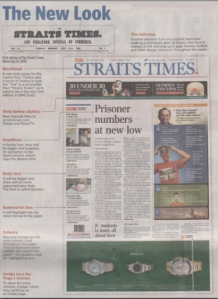
One point, or approximately 0.04 cm, was all it took for readers to find the recently redesigned Sunday Times a comfortable read again. After its redesign in April 2008,several readers complained that it was hard to read the paper’s body copy so designer Peter Thomas Williams increased its leading (amount of space between lines of text) from 11 point to 12 point and to his delight, the week after, a reader sent in an e-mail saying it was much easier to read it.

This is why Peter, who has redesigned ST (twice), The Sunday Times and designed tabla! and my paper, starts every project by working on the typography of its body copy. My Paper proved a challenge for the Irish because he had to design a newspaper that incorporated both the English and Chinese language. He did this by using similar colours and grid system, and picking matching typefaces that unified the disparate languages on to one paper.

stredesignwhy1While he says that “proper” redesigns usually take up to a year, the recent ST redesign was done in six months, partly to coincide with the launch of ST’s new video news platform Razor TV.  A redesign should not be rushed because it is not just a matter of deciding on a new look but it takes time to introduce it to the sub-editors and into the computer systems, “You can’t just redesign a newspaper and walk away, the hard part is implementing it down the line.” he said.

But didn’t ST redesign in 2004? Peter said that newspapers today redesign every 2 to 3 years in an effort to stay relevant to its readers. In fact, in the most recent redesign, they considered reducing the nameplate to just “ST” because it was known to most of its readers as that.

On a daily basis, one of the biggest challenge in designing a page is working around advertisements says Peter, “The less ads the more beautiful your pages are going to be… SPH (papers) are full of ads.”. He pointed out that the winning designs awarded annually by the Society of News Design rarely have any advertisements on them, but the design editor of my paper is realistic, “That’s where we get our bonuses and your paycheck, so we can’t really complain that much.”

In the previous part of this interview, The Paginator asks Peter the importance of typography in news design and how the papers of Singapore Press Holdings chooses its typefaces

Review: Finding A Home In This City

cover-of-city-of-small-blessingsThe cosmopolitan youth and the old man ask what is home in Simon Tay’s City of Small Blessings

In this poetic but tranquil collision, the City of Small Blessings brings together a father and a son, two disparate elements of Singapore society – the greying population and its cosmopolitan youths – to question the common loss of home in the young city-state of Singapore.

Bryan is a retired school principal who recently returned home after a failed migration to Canada, where his only son, Peter, immigrated to a few years ago. Together with his wife, Bryan rents a house in an old airbase in the north of Singapore when it is announced that the area is to be redeveloped and the house repossessed. In a way, this mirrors Singapore’s plans for its former Seletar airbase where author Simon Tay and his family are currently renting a colonial house. While this was part inspiration for the book, unlike Bryan, Tay’s house is not facing demolition.

The book follows Bryan’s vain attempts to save his home and the neighbourhood from the wrecking ball. He rallies his neighbours, going about the official channels of protest: writing letters to the newspapers, government agencies, MPs and organising events to attract the public’s attention, but in typical Singapore fashion, to no avail. Desperate, Bryan even personally appeals to his former students who have rose to the highest echelons of the public service for help – Tay’s subtle hint to the lengths one must take for the ordinary man to be heard in Singapore.

And the beauty of this book lies in such questions and issues about the values of Singapore that Tay hints at throughout the book as he collides people, places and time: Bryan and Peter, Canada and Singapore, a father’s history and a son’s future. While the theme of preservation versus progress dominates the book, it is really life in the city and the little things that Tay details, like a neighbour explaining why the government did not allow her to keep cat as pets and how Bryan felt when he stopped receiving invites from the Prime Minister’s Office to attend National Day Parades after retirement, that we get a sense of why people struggle to find a home in this city.

This collision comes out best in the prose as Tay breaks away from linear story-telling and the book not only shuffles between perspectives of father and son, but also time, as we are brought through the back story of a father’s friendship with a Japanese soldier during World War II and the uncertain future that this city holds for Bryan and Peter.

While the book would have easily became a retiree’s rants against the merciless tide of progression here, “This is a story of a city I do not know”, Tay shows restraint and even introduces a new victim in Peter, the cosmopolitan youth who feels estranged from his birth place, “This used to be a home, our home. Now it is just real estate.” It is here where one can feel Tay speak. The 47-year-old has after all spent considerable time overseas with the Singapore International Foundation and as the current chairman of the Singapore Institute of International Affairs. And it is through a father-son conversation about alienation that we are brought through the jittery psyche of the young and elderly Singaporean as they try to make sense of where is home.

Thus, one wonders if the book was inspired by Tay’s background. His late father, Tay Seow Huah, was formerly a permanent secretary in the public service while Tay, a law lecturer today, represents a generation of young Singaporeans that can comfortably jet set from city to city.

But this book suffers from Tay’s restraint too. Bryan is never angry but always measured, riding away from his problems on his bicycle, taking the reader on a ride but never going fast enough. And as it marches to its ending, the sophistication and subtlety in Tay’s earlier prose gives way to a burst of didactics as if fearful that the reader might have taken this as a mere leisure ride.

But it is not. While Tay maintains that this book is “not autobiography nor a political tirade”, it does continue the themes of alienation from home that have ran through his two earlier books — Stand Alone (1991) was his first novel of 12 short stories and three poems about Singapore that he wrote during his 1½ year travels in Europe and South America, while Alien Asian (1997) was an account of his time in America as a foreigner. Instead, Tay hopes the book, first written some 12 years ago, remains art that will allows us to survive the truth as Nietzsche once said, an optimism that makes his Singapore, truly, a city of small blessings.

A review I wrote for my assignment in COM419A:Arts and Cultural Reporting