Category: Design

Singapore’s 3G Graphic Designers

As with any community that has been around long enough, there are several generations that lie within it. Identifying this is useful in understanding why they act and think differently, and helps us predict what future generations of this community could be like.

In my latest book INDEPENDENCE: The history of graphic design in Singapore since the 1960s, I’ve categorised the graphic design community here to three generations, each having different values and thoughts about graphic design and its roles. Briefly, they are:

ZERO (prior to 1980s): These were the graphic artists working in advertising agencies, sign-makers, and freelance commercial artists. Many of them were artists trying to make a living or trained as technicians in Singapore’s first design school, Baharuddin Vocational Institute. Designers of this generation were essentially craftsmen who sold their artistic skills to businesses, usually for advertising purposes.
Examples: Hagley & Hoyle · Central Design 

ONE (1980s-1997): Graphic designers of this era understood the role of good design in good business, and not just for advertising, but also in crafting a corporate image. This expanded role encouraged designers to professionalise so that they were taken seriously. These ideas came from several designs who received training overseas and returned to Singapore and started their own studios. Around the same time, the Singapore government also pushed local businesses to adopt design and take on a global market. The design industry in Singapore boomed during this period, until the 1997 Asian financial crisis.
Examples: Design Objectives · Su Yeang Design · Viscom Design 

TWO (1997-???): The arrival of the computer in the 1990s and the the Internet in the 2000s accelerated the progress of young designers who bypassed the existing Singapore design scene, and hence a generation gap. They got ideas from overseas faster and could now easily carry them out on their own. By then, Singapore had embraced globalisation, and loosened up at home as a consequence. This created new opportunities for designers to work on a very different genre of design besides corporate work, and designers became part of a growing Singapore creative community. When the government acknowledged the importance of the creative industries for its future economy in the early 2000s, the torchlight was shone upon these young creatives who became recognised as the new face of Singapore design.
Examples: :phunk studio · Asylum · H55 

————

At this point in time, I’m unclear if we’ve seen the end of a second generation of Singapore’s graphic designers. In the last few years, many new design studios shave started up, but are they very different from their predecessors? It’s too early to tell.

Based on the age of studios, we could consider FARM (2005), silnt (2005), Couple (2007), Foreign Policy Design (2007), pupilpeople (2008) and Hjgher (2009) as one group, but how different are they from generation TWO? And when we compare these with the bumper crop of new studios last year — Somewhere Else, Studio Kaleido, ACRE, Roots, Relay Room, Terrain, STUDIO VBK, Swarm, Tofu  — are they another group? I’m very keen to find out.
Straits Times 2012 Redesign: More blue, less fuss

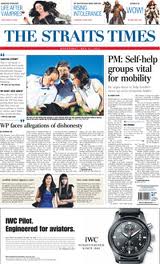
The Straits Times (ST) unveiled a new look last week, the second time it has redesigned within a period of just four years. The 167-year old paper overhauled its look back in 2008, but unlike the previous change where it cited the need to stay attractive as it faced pressure from the Internet, this latest redesign seems to be at the orders of its new editor Warren Fernandez, who took over  from Han Fook Kwang in February. Fernandez gave the in-house design team just six weeks to create a new look that was “more modern and contemporary”.

The result is a much cleaner-looking paper that does away with much of the fussy elements in its previous design such as special motifs for its bylines and coloured dividers. The section headers and liveries have also been reduced significant and simplified, probably to give more space for editorial and advertisements. Overall, the paper has adopted a more muted colour palette. The colour red, especially, has been dropped, and even when retained, is of a darker shade. This is probably to distinguish itself from its rival in the Singapore newspaper market TODAY, whose corporate colour is red. ST will instead be a pre-dominantly “blue” paper.

ST 2012 cover

The 2012 front page.

Another significant change is the paper’s return to a six-column grid like in its 2004 redesign. It’s also a format that its weekend edition The Sunday Times has had, which probably simplifies life for the designers. Also marking a return is a new section “The News in 5 Minutes”. Such an attempt to provide a quick overview of the news came in the form of “In Summary” in the ’80s and “News Flash” in the ’90s.

Perhaps the biggest, but also the least inspiring change, is the paper’s masthead. It’s the third time it has changed its look since 2004, a frequency which some may see as a clear lack of an identity. The latest masthead design uses a typeface that looks like it is harking back to the 1970s when it was typeset in Bodoni. That design stayed for over three decades before this cyclical masthead revamp began.

Masthead (2012)

Masthead (1973)

As a whole, there has been very little change in this redesign. If anything, the redesign seems more like an effort to shore up its brand colour and an opportunity for the new management to reach out to advertisers. After all, that’s what most redesigns are really about, an effort to stay attractive as an advertising platform. It’s why when there was a preview for the latest design, it was the advertising agencies and media professionals who were invited, and it was their positive views that were broadcasted when you read the new look ST the next morning.

For a more detailed examination of ST’s newspaper design since 1959, do check out this article I wrote for The Design Society Journal two years back.

CORRECTION: I had incorrectly said that the current masthead is typeset in Bodoni, so I’ve changed that bit. But I still don’t know what typeface it is.

Division of Industrial Design Grad Show 2012

Here’s one upcoming exhibition I’m looking forward to next weekend: The National University of Singapore’s Division of Industrial Design Graduation Show 2012.

This division, Singapore’s first university-level course in Industrial Design since 1999, has been producing a stellar group of graduates in the last few years including members of STUCK,  triggerhappy, one half of studio juju, one half of Lanzavecchia + Wai, and half of the quartet outofstock. The school is also home to the Design Incubation Centre and its commercial label d.lab, which under its director Patrick Chia, has produced various innovative products with new materials and approaches.

This year’s show will present works from this year’s graduation batch as well as projects accomplished in the past years with collaborators such as World Kitchen, HDB, Osim and Origins.

Opening Night: 24 May 2012, 1830 – 2100 hrs
Exhibition: 25 – 27 May 2012, 1030 – 2100 hrs
Venue: The Plaza, National Library of Singapore

You can already preview the works at their website here.

