Category: Design

The return of craft in design?

Been interviewing graphic designers from the 1970s, 1980s and 1990s recently for a project. One thing that always lights up their eyes is when I ask about how design was done before the era of computers. Their hands suddenly come alive as if to animate how design was done via traditional craft. Though they love how the computer has made life so much easier for them, they all insist how important it is to start sketching ideas with just a pencil and paper so as to not be limited by what the computer can do. Craft, they fear, is increasingly lost on a generation who grew up only knowing how to design through computers.

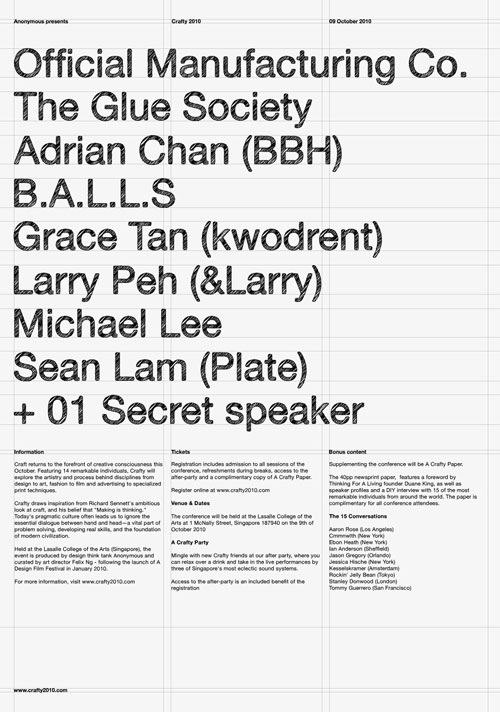
An upcoming conference in October plans to bring craft to the forefront of the creative process again. Crafty 2010 brings together nine creatives to share the role of craft in their designs. The speakers include Portland-based The Official Manufacturing Company,  The Glue Society from Australia, as well as local creatives such as B.A.L.L.S and Plate Interactive. To add suspense to the conference, there is even a secret speaker, whom according to one of the hints given is friends with Jay-z.
crafty2010


Those who sign up for this conference will also receive A Crafty Paper, a 44-page newsprint paper featuring interviews with 15 creatives such as Aaron Rose, Jessica Hische and Stanley Donwood. Crafty 2010 is organised by Anonymous, the research practice of local design agency SILNT. The team led by Felix Ng is also behind the recent Design Film Festival held earlier this year.

Conference tickets are going for $250 each till October 1st, after which it goes up to $300. The price seems to have put off some people, and the latest post on Anonymous Facebook post seems to suggest they may lower the price, so keep a look out there!

Crafty 2010
9 October 2010 (Saturday)
Conference: 0930 – 1700
Party: 1700 – 2100
Lasalle College of the Arts
When Two Universes Collide In A City


eccentric city

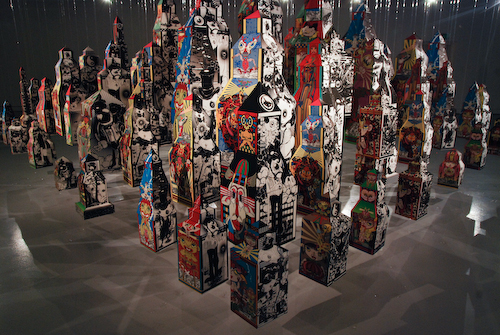
Take some time out on Sunday to catch the last day of Eccentric City: Rise and Fall, a paper city created out of a collaboration between Japanese artist Keiichi Tanaami and Singapore design collective :phunk studio. This “eccentric” city was built out of paper buildings created using the traditional Japanese paper craft of “Tatebanko”, and each one of the buildings brings together the distinctive illustrations of the two collaborators and their vastly different cultural upbringings. On one side is Tanammi’s psychedelic works that are heavily influenced by his traumatic childhood experiences of World War II and growing up as part of the countercultural movement in the 1960s. In stark contrast, is the black and white work of :phunk whom depicted the technological city of Singapore they grew up in. Though the exhibition is small, the paper city is quite a sight to marvel at.

TanaamiTimesABesides the paper city with :phunk, Tanammi has also worked with local design agency WORK to produce two free issues of The Tanaami Times, a beautifully crafted newspaper that profiles all three collaborators and some of their work. The agency’s latest issue of its limited run WERK magazine, issue number 18, also features the work Tanammi as well.

Finally, here’s a video shot by the team that shows how each of the buildings in Eccentric City was built using Tatebanko:

A TATEBANKO (ECCENTRIC CITY : RISE AND FALL) from ferdi trihadi on Vimeo.

— — —
Eccentric City: Rise and Fall
19 Aug – 19 Sep, 10am – 6pm
ICA Gallery 1, #B1-04, LASALLE College of the Arts

Talking Back To The State

National campaigns are a big part of life in Singapore. Even before independence, the government had began using all sorts of campaigns to create model citizens and to shape the city to its vision.

In the 1960s, Singaporeans were exhorted to eat wheat when rice was in short supply. The 1970s a Speak Mandarin campaign was introduced to encourage the Chinese community to use Mandarin instead of dialects. This was then followed by the National Courtesy Campaign in the 1980s where Singaporeans were told to be courteous to one another. Campaigns died down a little from the 1990s, but a significant one in recent times was after the 2003 outbreak of Severe Acute Respiratory Syndrome (SARS) when Singaporeans were encouraged to ‘Step Out’ and resume their daily lives.

A Straits Times article in 2003 counted some 200 documented campaigns between 1958 and 1995, and anyone in Singapore since the 1980s would have been exposed to an average of more than 10 national campaigns a year! But such campaigns have largely been a one-way communication from the state. A new exhibition, Campaign City: Life in Posters, finally gives voice to the target audience. Ten local artists were asked to re-interpret a national campaign that they remembered in the form of a poster, an essential marketing collateral before the day of television and the Internet.

Campaign-city-Ian

Ian Woo’s response (left) to the 1970s campaign against the hippies culture (right) that even saw musician Kitaro sent home when he came to perform in Singapore with long hair.

While artists like Michelle Fun, :phunk studio, eeshaun, and Ian Woo re-appropriated old campaign posters, others like Messy Msxi, Zhao Renhui and Clare Ryan created new work in response to the original campaign slogans. The 1970s ‘Two is Enough’ campaign, which encouraged Singaporean families to stop at two babies, was the most popular campaign as Justin Lee, ampulets, and Randy Chan each did a poster for it. This campaign is arguably one of the nation’s few successes, so much so, that low fertility has become a problem for Singapore today.

While the posters are personal responses, when read as a collection, there seems to be an underlying sense of ambivalence and pessimism about these campaigns. Randy’s poster (below) was especially memorable, visualising the many campaigns in the form of a condom — a critique on how a protective nanny state not only denied fertility but life in this city too.


Campaign-city-RandyYet, one cannot deny the iconic value the old campaign posters have left in our visual culture. They may never have been very effective in moulding society and its people in the way it was meant to, but it has certainly helped shape how we see this city.

Campaign City: Life in Posters
9 Sep – 15 Oct
Tue-Sun, 2pm-8pm
Evil Empire, 48 Niven Road