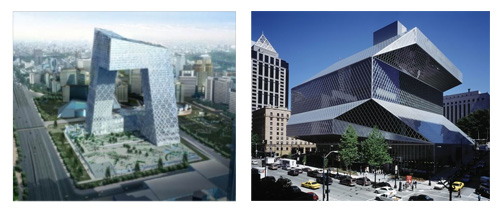
His buildings are instantly recognizable design icons. From the “twisted pretzel” CCTV headquarters in Beijing to the “melting iceberg” Casa da Música theatre in Porto, the Dutch architect Rem Koolhaas is synonymous with his out of the box buildings around the world.
But this man stands out differently in the streets of a city.
Tung Walsh | SMITHSONIAN MAGAZINE
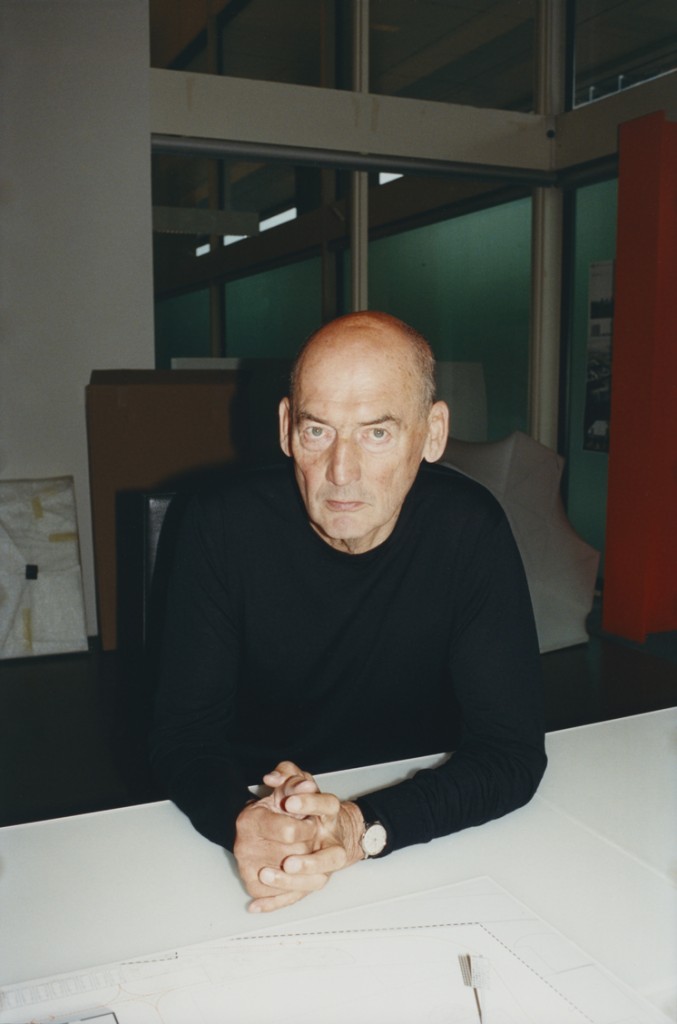
His architecture is complex. His fashion is simple. His designs are asymmetrical. His self-styling is typical. His buildings are unconventional in shape and form. His clothing is uniform and austere.
A long-sleeve round-collared shirt and dress pants — only available in monochromatic black, gray, white, green or blue. Accessorize with jet black leather shoes and a classic white-faced watch with black straps. There you have it: the formula to dress up any lanky bald man as avant-garde Koolhaas.
It’s a shockingly basic fashion construction — a way for one of the world’s most famous architect to deflect attention? Koolhaas once lamented that celebrity architects like him are taken less seriously, and journalists seem mostly interested in what brand of shoes he wears.
While it’s unclear if he ever revealed his footwear choice, they are certainly not just any pair. This former journalist is not anti-fashion. He has designed runways and showrooms for high-end fashion brands including Prada and Coach. A typical Koolhaas architecture is derived from rethinking how a building is used, and that includes its function as a symbol too.
The twist and turns of his CCTV headquarters not only aid television production for the Chinese state broadcaster, they also defy the stereotypical skyscraper. While it was groundbreaking to restructure the Seattle Central Library after the Dewey Decimal System, which is used to organize books, it was equally radical to shrink-wrap this public institution with the gloss of a commercial building.
CCTV Headquarters and Seattle Central Library
Koolhaas is keenly aware of how architecture has turned into a spectacle in today’s market-driven society. At the same time, he has also astutely observed how globalization has led to generic cities around the world.
Such contradictions abound in the Koolhaas universe. Don’t be fooled by the seemingly plain dressing of this man who once told Spiegel magazine, “I like fashion, whether or not it’s overpriced, because it creates a sense of the sublime with relatively few means.”
The effortless and minimalism of Koolhaas’ fashion is a foil to inspire awe too. Think of the creative uniforms — black, bland, and brand — of other modern design monks such as Steve Jobs and Massimo Vignelli. Like them, Koolhaas wears his body of clothes less as form but as a frame for his intellect, that white Zen-like genius of a head that sits above it all.
When all dressed up, Koolhaas evokes a mash-up between Auguste Rodin’s nude “Thinking Man” and Captain Jean-Luc Picard in his Star Trek uniform. His attire is at once nothing and the futuristic everything. In true Koolhaas’ fashion, the architect becomes a contradiction of the generic and spectacle all rolled into one.
———– Written for Andrea Codrington Lippke’s Criticism Lab at D-Crit on the fashion construction of a designer.
Exhibition Review: Out of Hand: Materializing the Postdigital
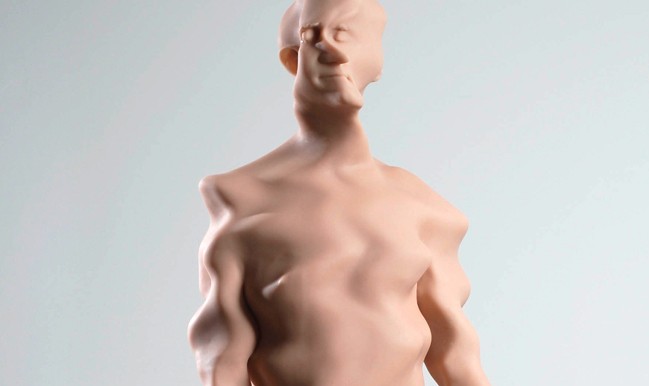
Untitled #05 (2008) by Richard Dupont
Who would have thought the day would come when your printer could produce a real live gun.
Three-dimensional printers are becoming a staple of many homes, allowing people to print anything from jewelry they can wear to edible ravioli. And as this technology becomes more affordable — some models are already going for under $1,300 — it is only a matter of time before a 3-D printer joins the computer and microwave as just another home appliance.
Now the Museum of Arts and Design in New York City is taking a look at how 3-D printing and other digital fabrication technologies are changing the way artists and designers make. The exhibition, “Out of Hand: Materializing the Postdigital,” features over 120 works by contemporary artists, architects and designers that were either designed or fabricated using computer-assisted production.
Given the hype that has accompanied such technologies, the collection of objects from 2005 to the present makes the “postdigital” era seem far from groundbreaking, and even familiar. Works such as a white nebulous-looking lamp by Bathsheba Grossman and a red ribbon-shaped rocking chair by Ron Arad will not look out of place at a design retail store. Both were created almost a decade ago and have been available for sale for several years now. It is a reminder that digitally fabricated objects have been in our midst for some time now, and the technology is not so new after all.
Most of the objects assembled across almost three floors of the museum show how the technology has freed artists and designers from the constraints of traditional production techniques. This is playfully suggested in Richard Dupont’s sculpture of himself, whose mirage-like form would take forever to sculpt by hand. The work aptly fronts the exhibition’s publicity materials as an icon of how digital fabrication is re-shaping human life. Another work by Michael Hanseyer demonstrates how intricate digital fabrication can get with a column made from a stack of 2,700 sheets of laser-cut one-millimeter board. However, the work like several others sees the creator give up creative control to the novelty of what digital fabrication offers instead. Rather than create new forms and ways of making, many of the exhibition’s works simply show off how they can outdo current methods of making.
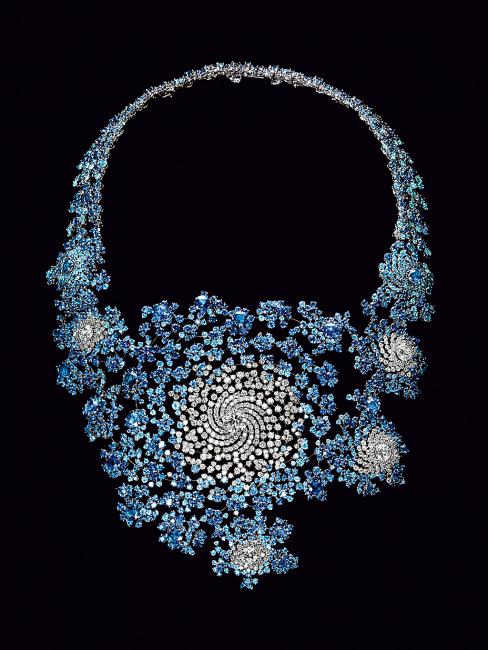
Doudou Necklace by Boucheron (2009). Design by Marc Newson
A similar wide-eyed fascination with the effects of digital production can also be said of the works in the show that curator Ron Labaco regards to have been inspired by nature and geometrical forms. Marc Newson created a necklace resembling a galaxy of stars that if one did not know its digital origins would simply be seen as an elaborate piece of jewelry design. Similarly, German designers Wertel Oberfell and Matthias Bär simply visualize the mathematical concept of fractals in the form of a broccoli-like chair with a honeycomb top, a design pattern that will look regardless if you create bigger or smaller versions of it. In both these works, and many others in the exhibition, an aesthetic formula for digital fabrication emerges: a complex mosaic of basic geometric units. Considering the different starting points of the works, the lack of diverse forms reflects both the limitations of current digital fabrication technology and how practitioners are using it.
To be sure, some objects produced by 3-D printers may seem ordinary because we’ve already grown used to them. As the wall text explains, “the amazing digital achievements of the last few decades are now taken for granted.” To judge the works only by their aesthetics is to overlook the time and material savings of making in this way. Compared to using the hand or traditional production, digital fabrication techniques are precise and easily controlled via a computer. But this process is not evident as each work is only tagged with the digital production method they are made in. Visitors unfamiliar with them or the history of production will have no sense of how these techniques democratize the process of making.
A small set of more experimental works, however, offers a more tantalizing glimpse of the potential of the digital process. In objects by Anish Kapoor and Jan Habraken, one begins to see how new technologies offer more than just new aesthetics. Kapoor’s set of sculptures resembling real coral rocks blurs the distinction between the creation of nature and something digitally-made, and one is left to wonder what cannot be designed by man anymore? Habraken uses digital fabrication as a kind of biological womb to “breed” the ideal chair out of existing ones. Digital technology allowed him to single out unique elements of chair designs, which he then easily mixed, matched and modified to create something entirely new. This is similar to the desktop publishing revolution over two decades ago when computers allowed people to design and print whatever graphics they wanted.
This freedom to make things will be the lasting impact of digital fabrication and was evident in the exhibition’s works that people spent the most time with. While some got their hands “dirty” sculpting on a virtual pottery wheel by Unfold and Tim Knapen, others made noises or whistled into François Brument’s installation that digitally generated vases whose shape and size varied depending on the kinds of audio input. These works demonstrated how technology was changing the act of making, but the visitors’ creations — pots and vases that simply differed in shapes and sizes — suggest a lot more work is needed in thinking about the possibilities of making with digital fabrication.
The technology is clearly fascinating people given how the most popular feature of the exhibition is a booth sponsored by Shapeways, a 3-D printing company. Visitors can design their own objects on computers provided, and even line up to get scanned and printed for a miniature 3-D self-portrait. This is an apt ending for one of the first exhibitions on a set of technologies that is becoming increasing common in our everyday lives. What better way to introduce it to the masses than by letting them take home their first digitally fabricated product: an image of themselves?
———– Written for Robin Pogrebin’s Reporting Tools workshop at D-Crit.
No medals for guessing what Singapore’s mascot is when it hosts the upcoming 2015 Southeast Asian Games (SEA Games): the lion.
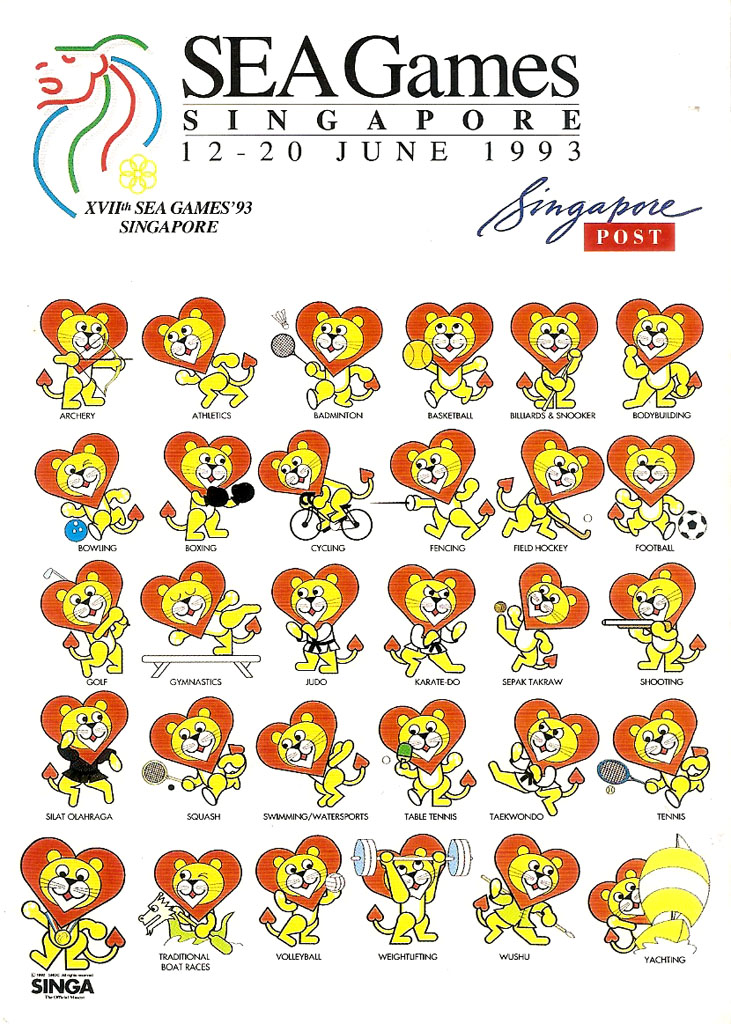
When it comes to showing our sporting prowess, the Lion city has always enlisted this animal from its founding myth as its representative. While Singapore had no mascot when it hosted this biennial multi-sporting event in 1973 and 1983, it introduced Singa when it organized the 17th edition of the games in 1993. A creation of The New Paper’s illustrator Lee Hup Kheng, Singa (who shares the same name and fashion statement of wearing no pants as Singapore’s iconic courtesy lion mascot created in 1982), welcomed athletes to the city with lots of love, as it had a heart as its mane, snout and tail.
SEA Games 1993 Poster
It would take till 2009 before Singapore hosted another major multi-sport event, this time the inaugural Asian Youth Games. Perhaps because it was an event for the young, this mascot designed by illustrator Quek Liwen looked cartoonish and even wore sneakers. Its name “Frasia” meant friends of Asia and came about from a competition.
When the city hosted the Youth Olympic Games the next year, it had not one, but two lions. Actually, it was one-and-a-half. While Lyo was a male lion, Merly was actually a female Merlion, a half-lion and half-fish creation that is also Singapore’s official tourism symbol. Again, the youth-oriented games probably explains those cartoonish doll eyes drawn up by the team at Cubix International—the same company that produced Singapore’s first 3D animation feature film, “Zodiac: The Race Begins” in 2006.
Singapore (1993) by Lee Hup Kheng, Frasia (2009) by Quek Liwen, Lyo and Merly (2010) by Cubix International, and Nila (2012 & 2014) by Beatrice Cho.
Some two decades since our first sporting mascot, it seems two-dimension (and the heart-shape) is back in fashion again, judging by the latest lion mascot for the upcoming SEA Games. Nila (named after Sang Nila Utama, the prince who named this city) was the winning entry by first-year design student Beatrice Cho for the Singapore National Games’ mascot design competition in 2012. For reasons unknown, it is being re-used for next year’s SEA Games when it is hosted in Singapore.
Why does Singapore always turn to the lion as its sporting hero? Besides its obvious connotations as the king of the jungle, one can also link it back to the fact that the national football team—the most popular sport in the city—has been called the Lions traditionally. Curiously, it seems the Lions never had a official mascot though.