Neighbourgoods is a new product label by six-year-old Singapore graphic design studio ampulets that seeks out the beauty and honesty of everyday life. I recently e-mailed co-founder James Teo to find out more about what this label started in May is all about, and its upcoming product launch at the end of November.
How did Neighbourgoods come about?
Every year towards the Christmas season, we try to make a little something to share with friends and clients of ampulets design. Over time, these independent projects became more and more ambitious… they went from T-shirts to a lamp, something involving an axe, origami turtles, to an embroidered handkerchief. That was when we realise that these projects and their stories can have a life of their own. Plus we wanted an excuse to make friends and collaborate with the many talented people around us! And so Neighbourgoods was born .
Tell us about how your first product, “Goodbyetime”, came about.
 “Goodbyetime” << started as a short short story Yvonne (my wife) wrote many years ago. She had always wanted to make illustrations to go with it, but she finally asked me instead to come up with my own interpretation. And it is exactly as described on the “Goodbyetime” bellyband; the photographs that I took from my studio’s windows are my witness to time passing – but in contrast to the fast disappearing time in the story, they are a witness arising from slowing down to look and enjoy the world around us. We made it into a “calendar”, although there is no indication of days on it, only months – so if you wanted, you could very slowly savor the story, one page a month. And with the French fold and the newsprint, I kind of envision them like pages of a wall calendar flapping in the breeze, revealing images we otherwise would not see.
Even before Neighbourgoods, you’ve created “objects” annually under ampulets. Can you tell us a bit about each?
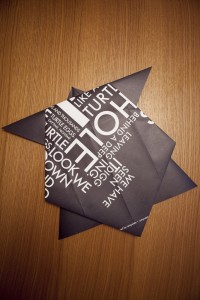
“Turtle Time” (2009) >> is like a companion piece to “Goodbyetime”, but about how time crawls. It is a poster made up of 12 illustrations by Yvonne on one side, and a typographical representation on the other. It came with instructions to fold your own giant origami turtle, either with the illustrations or the type as a pattern for the shell.
“Good Sweat” (2010) came about when a young man asked us for our advice on his career plans. He was torn between what seemed practical (what his parents wanted for him) and what he was passionate about. As we listened to him, the first thought that came to our minds was this phrase: “做甚麼都好,用心做就好” (‘It doesn’t matter what you do, as long as you put your heart into it’). We decided to embroider this piece of advice on handkerchiefs, an object you would keep close to you to wipe away your sweat (or tears) as you work hard towards your dream.
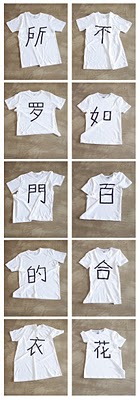 The things we made were all somehow related to text, and they are sort of preachy. For example, a project we really liked was << “Folded Verse” (2009), a series of 10 T-shirts with each bearing a word from this Chinese couplet “所羅門的衣,不如百合花” (Solomon’s clothes are not more splendid than the beauty of lilies). We made two to three folds on each T-shirt before painting the Chinese character. For the wearer, the pattern is a puzzle of a Chinese character, yet even when you can decipher the character, its full significance is only realized in the context of the phrase. We wanted to mimic a parable, whose meaning is only revealed to the listener who seeks the truth. It is a reminder to not worry about what we eat or wear, but to trust in a God who created this beautiful earth.
It seems to me some of these earlier products can easily go under the Neighbourgoods label. There’s a common thread about honest values in life, e.g. hard work and enjoying a slower pace of life. Why do you want to communicate such values?
Because they are important! There’s a “get-rich-quick” and a “short-cut” mentality, not only in Singapore, but in any city where an oppressive materialism prevails and efficiency is mistaken as good. As a result, people often forget to take pride in what they do, the values they stand for, how we live. Whatever is created from this kind of environment does not last. In contrast, the best things in life are created through time, by investing love and commitment. And the best things in life, what is beautiful and good, are also not far from us – the people we love, and the environments we choose to care for. We just have to slow down and appreciate them. We wanted to make things that will inspire and encourage the user with this simple fact. As you can see, we are preachy!
As primarily a graphic design studio, has it been challenging to create your own products? What are some of the issues?
Definitely challenging. As a graphic designer, we are not as familiar with people or companies in the manufacturing side of things. It’s especially difficult finding folks in somewhat lo-fi/craft areas, people who can or want to bend wood, weave fabric or sew a pocket square. Even if it can be done, cost and affordability for a small-scale production becomes an issue. We hope to ferret out more such crafts people in time and welcome any “lobang” that people may know of in Singapore.

For example, for the first “Good Sweat” project, even after we finally gave up creating our own printed textile, it was some time before we found the right fabric and someone willing to go that extra mile to sew and embroider 100 handkerchiefs. He was an old friend who had made the radical switch from the bio-sciences industry to bespoke tailoring. Another friend in manufacturing had sourced factories in China, but we wanted to make it all in Singapore. We also wanted to be 100 per cent sure of the quality. Graphic designers are anal lah. Haha.
It seems part of the label’s mission is to revive craftsmanship in Singapore. Why the interest in this?
We are not so ambitious! But people who work with their hands need intelligence, perseverance, and character. It is humbling work. And we respect people who take pride in doing something well, however humble that work may seem.
There is a hyper-local ethos in the label: wanting to look at what is around us and choosing to work with people in the neighbourhood. This is in contrast to the more “international outlook” that many Singapore brands aspire for. Could you talk more about how this came about and why you are heading in this direction?
We live in Toa Payoh and even after 10 years, we are still discovering things about the place and our neighbours. But Neighbourgoods is not really about a specific local geography. We are not closed to working with people outside of Singapore, or promoting Neighbourgoods overseas. In fact, there are so many people in Taiwan and Japan we admire for how they take pride in their work, living, heritage and community. So I would say Neighbourgoods is not against an “international outlook”. It’s about taking the time to know, appreciate and make better your immediate environment and community, where you are or where you have come from, instead of constantly wanting to be someone or somewhere else.
There is also a very practical consideration. I am claustrophobic and really dislike plane rides!
Can you tell us more about the upcoming Good Sweat No. 2-6. What can we expect? How did you pick your collaborators?
We had positive response about “Good Sweat” (2010) and its message, including people who asked to buy it. So in the spirit of Neighbourgoods, we decided to bring back Good Sweat!
The goal is the same. “Good Sweat #2-6” aim to give a little encouragement and inspiration to people whenever they feel tired, lost or disillusioned in their daily lives.
But this time, we invited four creative individuals in Singapore to share something that they live by. They are people who have inspired us with their values and attitudes towards work and life. So we thought it would be great if they could also encourage or inspire others through Good Sweat.
There are altogether five handkerchiefs (including one from ampulets, we couldn’t resist) made from high quality Egyptian cotton. Each design features an embroidered phrase, and is produced in a limited edition of 100 only.

Look for the stories and five handkerchiefs featuring words from photographer Bob Lee; Rebecca Toh (aka. Casual Poet); Yah-Leng Yu of Foreign Policy Design; Jackson Tan from Phunk/ Black Design; and ampulets. We won’t say too much – you can read about their inspiration and phrase on the website and on the packaging, when they are launched soon.
The handkerchiefs are available for $30 each starting 7 December, and $28 if you pre-order or purchase it at the 29 November launch. Write to us at info@ampulets.com if you are interested, and look out for the launch details on the Neighbourgoods Facebook and site. All of us involved agreed that after covering the cost for the fabrics and bespoke tailoring, we would donate the remaining proceeds to a worthy cause.