Category: Design

Highlights of Singapore Design in 2012

Here are my five trends of the Singapore design scene last year, which I think could possibly impact what we see in 2013.

1. The continuing rise of craft and Singapore designs
From coffee to bags, homeware to letterpress and even haircuts, these are just some examples of what young Singaporeans are getting their hands into nowadays. The interest in craft and the Do-It-Yourself culture started before 2012, but last year we saw many of such initiatives blossom and even more new ones join in the fray. This has since hti critical mass in the form of “Handmade Movement“, a fair for independent craftsmen and women that will be held in Singapore in January this year.

With more Singaporeans crafting a career, means more designs and products inspired by this city, as witnessed in the growing collection of Singapore design products — so don’t be surprised if we see our own MUJI or G.O.D soon.

2. Singapore design is entering mainstream
My confidence that Singapore might one day see a ‘national’ design label  is fueled by the growing awareness of the business of design here. Supporting our local designers is an emerging network of shops, online stores, flea markets, and even neighbourhoods such as Tiong Bahru, that sell Singapore design products as part of an assortment of lifestyle goods ‘curated’ from all around the world.

One interesting Singapore retail project is Outeredit, which not only sells designed T-shirts, but the creation process too. For each collection, customers are introduced to the designers, get to see them cross-collaborate, and finally vote for the designs to be printed.

Such avenues are exposing and defining local design to the Singaporean consumer, and if they grow and take off, that can only mean the same for Singapore design too.

3. ‘Designer’ cafés and restaurants
Who hasn’t visited or at least heard of one of these ‘designer’ cafes and restaurants that have sprouted up across the island? This has to be one project type that will define portfolios of the 2000s of Singapore design studios when we look back one day. While they all serve all-day breakfast, artisan coffee and indie magazines (ranging from just one to all three), one is amazed at how many different ways designers have come up with to brand and package their interiors! They have certainly introduced the dimension of design to the dining experience for Singaporeans, but as William Chan of TMRRW and PHUNK fame tweeted last year: “Nice to know that cafes here are paying proper designers for interior & branding. now they just need to hire proper chefs to do the cooking.”

Remember bubble tea and ice-cream parlours? I think this trend will go bust this year and we’ll be left with only those have the best design taste.

4. More Documentation of Singapore Design
With publishers turning their sights to Asia for new revenue streams, Singapore’s design scene has started receiving attention too.  The architecture scene here, in particular, has seen the most activity. Pesaro Publishing this year published a guide to 21st Century Singapore Architecture, and is working on books for WOHA (its third), K2LD and Cicada Designs. Some design firms have even went into self-publishing, such as DP Architects, and Ong & Ong’s Three Sixty Review.

Graphic designers here also got into the act too. The Design Society published a book detailing the historical evolution of the scene (which I authored), and the studio Hjgher published Creative Cultures, a directory of 100 individuals and groups from Singapore’s creative scene. There’s also a growing buzz between the nexus of graphic design and publishing with Epigram and Studio Kaledio coming up with books that have given the Singapore literary scene a much more exciting face. Finally, if the rumour mills are to be trusted, we are looking forward to books in 2013 about d.lab, and the Singapore Institute of Architects, who celebrate their 50th anniversary in 2013.

Publications are important materials that represent a design scene. They provide potential clients a glimpse into the work of studios; researchers a documentation of the work of designers here, and fellow designers a reflection of the scene they are in.

5. International recognition of Singapore Design
From the Design & Advertising Direction (D&AD) to the SaloneSatellite, and the World Architecture Festival, Singapore designers received many accolades and awards this year. While we did not show  at the Venice Architecture Biennale, Singapore design still travelled overseas with Thesus Chan holding an exhibition for the latest issue of his two-decades old WERK magazine in Japan’s Ginza Graphic Gallery, and Hjgher’s Creative Cultures featuring  as part of DesignTide Tokyo. This year, I hear there will be a Singapore pavilion at the SaloneSatellite for the first time — we have indeed grown.

At home, it was relatively quieter last year. Even though we held the World Architecture Festival and 100% Design Singapore for the first time, these were trade shows that confined themselves to the scene. What was missing were public-centric design programmes, with the only two major on-going events being the annual ArchiFest and President’s Design Award exhibition. The Singapore Design Festival did not make a return in 2012, but at the end of this year we will see the launch of the National Design Centre. Hopefully, that will be more than just a business hub for design.
Seeing Asian Design through Books

One of the biggest issues I’ve always felt about my understanding of design (and even the world) is it has been largely from the view of the West. Living in Singapore where English is our first language, I’ve easily gained accessed to the tomes (and tonnes) of writing about design from Europe and North America. Most of these are not only from the West, but are also about the West, as English-language writers and publishers are only just starting to take notice of the Asian design scene.

A hint that designers from my neighbouring countries might have something else to offer first came when I attended “The Way of Asian Design” forum in Singapore a few years ago, featuring Kirti Trivedi, Ahn Sang-Soo, Lu Jingren and Kohei Sugiura. Then, I chanced upon Kenya Hara’s Designing Design, one of a select few English-language publications from an Asian designer. At the beginning of this year, I discovered Chinese translations of Japanese design books on a trip to Taiwan, and I immediately bought them—assuring myself that my rusty Chinese language I picked up in school would hold me in good stead.

It barely did, especially since the books were in Traditional Chinese script, and I learnt the language in Simplified Chinese. Nevertheless, I’ve trudged through a few volumes of these Chinese-language design books along with other Asian design books over the year and here are some things I’ve picked up, accompanied by interesting related links:


Asian-Design-Books
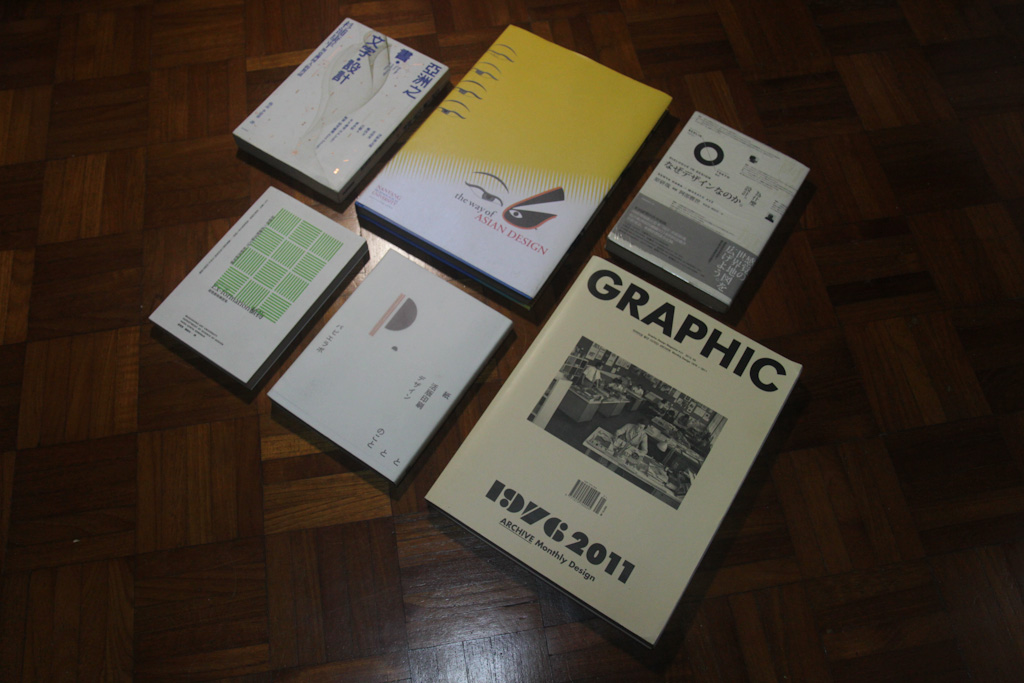
Clockwise from top left: Books, Text, and Design in Asia (2006), The Way of Asian Design (2010), Dialogue in  Design: Kenya Hara x Masayo Ave (2009), Graphic Design Magazine #21 (2011), Papier Labo (2010), and Ex-formation: Plants (2008).

Books, Text, and Design in Asia (2006) (亚洲之书。设计。文字)
This volume contains the conversations between Japanese designer Kohei Sugiura (杉浦康平) with his contemporaries from Japan (Tsuno Kaitaro 津野海太郎), India (Kirti Trivedi, and the late R.K. Joshi), South Korea (Ahn Sang-Soo 安尚秀 and Chung Byoung-kyoo 郑丙圭), Taiwan (Huang Young-sung 黄永松), and China (Lu Jing-ren 吕敬人).  Each of them have been picked by Kohei because he feels they dig deep into their cultural roots to design, particularly in their typography work and books.

The conversations mostly revolve around the history of craft and culture in the respective countries and how each designer has tapped into that for their design work. One becomes aware of the possibilities when designing in the language of a particular culture; and it struck me that the traditional Chinese character is both a graphic and word that represents what it means, which is unlike the Roman alphabet that makes up most of our modern-day languages.

The Way of Asian Design (2010)
This is the printed volume of the proceedings that went on during a forum held in Singapore in November 2007. Four Asian designers—Kohei Sugiura, Ahn Sang-Soo, Lu Jingren and Kirti Trivedi— shared their design philosophies and showed how their work were underpinned by the region’s cultures and beliefs. Like during the forum, the speeches have been  translated into English, which makes it very useful for those who can only understand Asia through this language.

A standout speech was Kohei’s design philosophy of “one in two, two in one” and “one in many, many in one”, which he attributes to how ancient sages in China and India thought how the universe works, thus the concepts such as  Yin and Yang. In Kohei’s case, he compares a book to a universe, which hosts a multitude of characters, stories and elements in a single form, thus  “one in many, many in one”. The structure of a book can also been seen as many pairs of pages that extend left and right to top and bottom; and this he says represents sky and earth, beginning and end, past and future. Yet, when the book is closed, this duality becomes one, thus “one in two, two in one”.

Summa Cosmographia (1979). Click on the image to see how Kohei has designed, literally, the entire book.

Kohei then extends this design philosophy to the reader too. He says, “…We readers of books have bodies that reflect this same duality, with the left half and right half. When we pray we join our hands together. In doing so, we unite the right and left sides of our bodies into one. Our body hosts one heart, and this one heart is what we offer together with our prayers.”

It is in this view that guides how he designs his books, which unlike contemporary zen-like Japanese designs are full of colour, details and possibilities—and got me re-thinking what I thought I knew as Japanese design.

Dialogue in  Design: Kenya Hara x Masayo Ave (2009) (为什么设计:原研哉 对谈阿部雅世)

Moving from an older Japanese designer to two contemporary ones, this is another conversation-drive book that revolves around Kenya Hara and Masayo Ave, who travelled between their bases of Berlin and Japan to chat about design in the two countries, society and their personal lives. There is certainly a thread here amongst these Japanese designers regardless of generations: how they see design as integral to the way they live. They don’t see it in terms of its “value-add” or how well it sells, or whether it is aesthetically beautiful. To them, design is an expression of values, which makes it such a personal and powerful endeavor.

Reading the conversations between the duo, I found it curious that the Japanese feel design in their country is too insular and needs to make itself understandable to the global arena to survive. Ironically, this is the reverse of what I have been thinking about Singapore, where design is so attuned to globalisation that it has no voice of its own.

GRAPHIC #21 (2011)
Papier Labo (2010)

These two books are really photo books for me because both are in languages I do not understand.

GRAPHIC is an independent South Korean design magazine started in 2007, and is now trying to reach out to the world by publishing both in Korean and English. The issue I got was Korean-only because it is an “archive” of another Korean magazine, DESIGN, which it regards as a pioneer of the community, having been publishing since 1976. It’s a fantastic flip through 400 of DESIGN’s covers and a selection of Korean works that together paint how the scene has evolved. Unfortunately, I ‘m not able to read the essays, which I can only imagine help to make this issue of GRAPHIC, a significant one in understanding its country’s design history.

As for the Japanese-only Papier Labo book, I gathered from online that it is a custom printing press formed in 2007 in the Sendagaya area of Tokyo, and this is a book that documents the work that goes into this studio. I was simply struck by how beautiful the book is as an object, as well as the photography of the works they have created and studio life.

Ex-formation: Plants (2008) (Ex-formation 植物)

This is essentially a report of the 2007 edition of Kenya Hara’s Ex-formation project, an annual research he conducts with students at the Musashino Art University in Tokyo to understand how little we know, to question what we think we know and understand. For this edition, the group explores the theme of “plants” and they design a series of projects that present us new ways of looking at them as silhouettes, food, products, and colours—which makes the book a delightfully unexpected page-turner.

———–

If you know of other Asian design books worth checking out, do drop me a comment. I understand Jamie Winder and Iain Hector from Where You Going? are already working on a book about Southeast Asian design after traveling through this area, so that should be something to look out for.

A Pioneer of Singapore Graphic Design

Two years back, I wrote about Mr William Lee (李秀镌), a graphic designer who has created corporate identities and logos for many Singapore companies and organisations. Since then, I’ve chanced upon more material that gives a fuller picture of his contributions to Singapore’s design scene.

Before William set up Central Design, an independent advertising and design agency in Singapore,  in 1969, he is said to have attended a Chinese-language school here before heading to Australia to be an architect. However, he dropped out of it to study graphic design, spending 12 years learning the profession via work-cum-study in Australia, Amsterdam and London. He began by obtaining a Certificate of Art in Australia before heading to Holland where he got a Diploma of Advertising and Typographical Design. William then left for London to study in St Martin’s College of Art, eventually receiving a National Diploma in Design. For the next seven years, he worked in a leading advertising agency in London as an art director before finally returning to Singapore to set up shop.

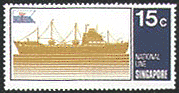
He seems to have started out by designing stamps for Singapore. Soon after setting up Central Design, he was invited to submit stamp designs for a commemorative issue on ‘Shipping Development’. This series of three stamps issued in 1970 were his first of many designs.

52j 52h (1) 52h
Singapore Shipping (1970) from CS Philatelic Agency

In an interview with the magazine Stamp Monthly, he said his motivation to design stamp  came from a meeting with a philatelist in London who commented that Singapore stamps lacked colour and attractive designs. The shipping stamps he did led to his first big break: a commission to design an issue of stamps for the Commonwealth Heads of Government Meeting held in Singapore in 1971. This was perhaps one of the most significant events held in the young Republic, which had barely turned six years old. Such high-profile work brought him much attention both internationally and locally, and it became an accolade that would be brought up again and again in his career. In an interview, he said, “This series gave me personal satisfaction as it brought Singapore stamp designs to international standards.”


1971 Commonwealth Heads of Government Meeting from CS Philatelic Agency
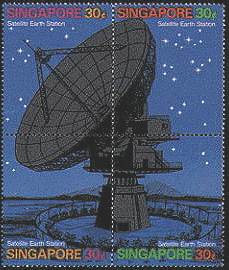
Satellite Earth Station – Sentosa Satellite Dish (1971) from CS Philatelic Agency

But from a creative standpoint, another stamp design he did that year was much more worthy of attention. For the opening of Singapore’s first Earth Satellite Station, he used a full illustration of it over four stamps of different values—something never done before in stamps issued in Singapore.

With the memory of the Commonwealth stamps barely faded, the soon to be launched Singapore Airlines (SIA) came knocking on his doors in July 1972 with a job to flesh out their corporate identity designed by Walter Landor of San Francisco. William became the first local designer to handle creative work for the national carrier, SIA, and in over two months, his  agency of 30 workers churned out over 600 items including brochures, tickets, baggage tags, office signs, passes, letterheads, etc.

Having worked on arguably the two biggest design jobs available in the ’70s within just three years of setting up, William became known as the Singapore graphic designer. He was regularly in the news on design-related matters, and even his sojourns to to Europe to study “the latest advertising techniques” were reported in the press. His clients over the years have reported to be multi-national companies from England, Japan and America. These include Akai Sound Systems, a Japanese electronics firm, as well as Mark Holdings, a wholly Japanese-owned trading company that brought in Swiss watches including Longines, Eterna, Ulysee Nardin and Rotary.  In 1974, Longines of Switzerland even presented him a special award for outstanding creative work on their account!

As the Singapore economy boomed though the ’70s, William built up a body of logos for a variety of local and international businesses as well as government organisations. These include the Post Office Savings Bank (1972),  Shangri-La (1975), Singapore Bus Service (1978) and United Overseas Land (UOL) (1979).

SBS

POSB, Shangri-La, SBS and UOL logos from Singapore Visual Archive

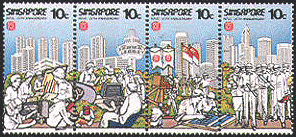
As his business grew, William did less and less stamp designs, eventually stopping completely around 1980 after designing 16 series of commemorative stamps. However,  he made a comeback for the 25th anniversary of the NTUC in 1986 because he loved the challenge of designing stamps.

25th Anniversary of NTUC from CS Philatelic Agency

To honour his design services for the state and community, William was decorated with the Public Service Star by the late President Sheares in 1975, and the Friend of Labour medal by the National Trades Union Congress (NTUC) in 1982.

Given the period of his design education in the ’50s and ’60s, it seems William was a designer trained in the modernist way of thinking. When asked what defined a good logo, he said it had to be simple, yet striking as it is international. He was also known to advocate the use of white space. In the early 1970s, he observed that local designers often copied designs they saw in magazines and newspapers, and his advice to them was, “They must learn to be original.”

Not much is heard of William or Central Design after the mid-1980s, which by then would have been close to two decades old. Perhaps his agency was affected by the 1985 recession?

William is believed to be alive and well today, but has not made himself contactable. He once said, “I like to be alone but I’m never lonely. I have so many other interests like fishing, music and antiques, to keep me busy.”