Only one way out,
Eight numbers —
Call to unlock.
See the full set here.
Only one way out,
Eight numbers —
Call to unlock.
See the full set here.
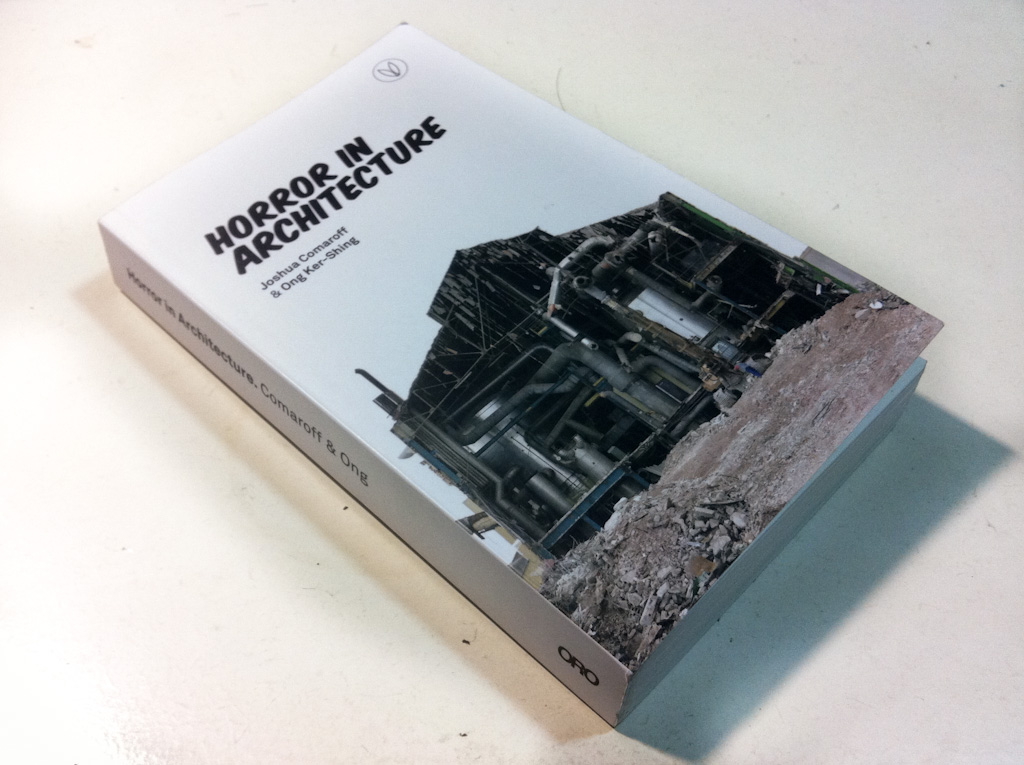
Horror in Architecture, a new book by Singapore-based architects Joshua Comaroff and Ong Ker-Shing, is not a book about horrible architecture. While it may be filled with examples of architecture most would not consider beautiful, its does not aim to measure their aesthetic value but rather to critique, categorise, and ultimately explain their existence.
The authors propose to look at “horror” in architecture as instances of failure that one can learn from, and in their 225-page book they have assembled a lens built upon fields including history, literature and even pop culture to examine this phenomenon. The result are nine typologies ranging from “Doubles & Clones”, and “Partially and Mostly Dead” which provide a framework to understand such diverse work ranging from the Pompidou Centre in Paris, the Pullman Building in Chicago, and even a pair of semi-detached houses along Singapore’s Jalan Haji Alias.
Despite the sometimes complex and conceptual language, this book manages to use the terms of horror to present an entertaining and often enlightening reading about architecture. However, the real punch of this paperback publication comes when it examines how some of these architecture have come about. As Comaroff and Ong conclude: the horrors we are presented with today are by and large driven by what they identify as “the geography of unevenness” or economic inequality.
The book can also be read as a kind of manifesto of what the authors represent in their architecture practice, Lekker Design. They have elsewhere talked about their fascination with informal architecture as well as buildings which most architects would find “disgusting”, and this book is a full-blown exploration of this interest.
Despite examining an “unpleasant” aspect of architecture, and warning practitioners of the bleak conditions the practice exists in today, Comaroff and Ong ultimately find hope in “horror” and how it embraces the problems of modern architecture, rather than attempt to hide it. This ultimately creates interesting buildings and suggests that there is a future for architects after all.

Try calling the old National Library a “monstrous monument” and “a picture of total failure” today, and one can only imagine the uproar it will cause amongst nostalgic Singaporeans. But that’s exactly what architect William Lim and others of his generation had to say about this now extinct building after it was unveiled in 1960.
“A visit to the inside confirms without any doubt the complete and absolute failure of the architect to create the necessary atmosphere and delight for both the readers and the library staff.” — William Lim (1960)
“Aesthetically, the design and exterior materials used, which are in juxtaposition to the soothing, pleasing National Museum, constitute what might be harshly termed a major architectural abortion.” — Cecil K Byrd (1971)
Similar sentiments were shared when the government announced in 1999 that the library would be demolished to make way for the development of the Fort Canning Tunnel. The Urban Redevelopment Authority felt the library did not deserved to be conserved because “it was not of great architectural merit”.
But the outpouring against the library’s demolishment and declarations that it was a national icon shows how insignificant design is when compared against how it was used by people and remembered over time. While the criticisms of its architecture are fair and justified, but in this instance, those who supported the library’s conservation saw its value beyond architecture.

This also explains the struggle with buildings like Golden Mile Complex → ,in which sentiments are reversed — the architecture community thinks it is a gem, but the public find it an eyesore because it is seen as a home for a foreign community.
Granted that the quarrel is not about the criteria to assess design, but rather what is the value of a building. However, should our critiques of design be purely based on its design? Or should it be broadened to include non-design factors, in this case its value as a piece of Singapore’s social memory? Even so, there is also the question if such feedback be meaningfully incorporated into a design process or practice.
One recent project that addresses some of these issues is FARM’s effort to remember the National Stadium through “bench“. Designers were given old planks of the stadium seats to “recapture and rethink this piece of memory” of the stadium. The result are 30 benches inspired by the stadium’s architecture, its role as a sports centre, and also a community space. Most of the pieces are visual translations of these messages, and often at the expense of the seating experience. The designs also turned out looking rather similar, which could either hint at how narrow the brief was or how unifying the National Stadium was as a memory.
A side project of bench, WOOD, was much more interesting. Hans Tan led a design studio where 18 students from the Division of Industrial Design explored the materiality of the planks and essence of the stadium to greater detail. Freed from the need to create piece of furniture, the students pushed the experience of memory beyond visual objects and instead engage other senses such as smell and interaction. Do check out the exhibition of their works in The URA Centre till 31 May 2013.