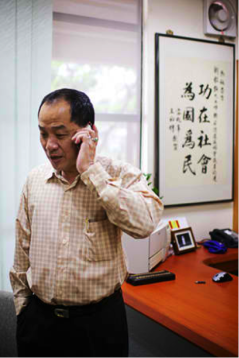
For someone who is critical of the government for being deaf to its citizen’s opinions, especially in the past, the leader of Singapore’s largest opposition political party, The Workers’ Party (WP), is ironically half-deaf himself.
As Mr Low Thia Khiang puts on his hearing aids at the start of the interview, the 52-year-old said he lost 50 per cent of high frequency hearing in both ears probably from not wearing earplugs at the shooting range during his National Service when he served as an instructor.
The severity of the problem did not hit Mr Low until he realised he could not hear during Parliament. He was seeking clarification but then-Speaker Tan Soo Khoon told him to sit down and wait for the others to finish. “But I carried on, and he thought this guy was trying to be funny,” he said.
At first Mr Low wondered why the Speaker was so angry and it was only after the session that he realised what had gone wrong.
As if being hard of hearing is not bad enough, Mr Low has problems with his English too. At the last general election, Minister Mentor Lee Kuan Yew had questioned if an apology letter written in English for Mr Low’s party candidate, Mr James Gomez, was really written by him.
While MM Lee was accurate in his observation—Mr Gomez had written the letter while Mr Low only edited it—the latter found it nothing to be ashamed of. He even told the press, “Of course, my English is not as good as MM Lee’s. But, his Chinese is definitely not better than mine.”
And Mr Low readily confesses that he got an F9 for English in both his A-Levels and O-Levels. As the last batch of students from the former Nanyang University (Nantah), he belongs to a dying community of Singaporeans educated in the Chinese medium at a time when the country was switching to English as its medium of instruction in schools.
Then Prime Minister Lee had made a speech at Nantah where he labelled it a third-class university as compared to Cambridge, Oxford and then University of Singapore (SU), Mr Low recalls. This was why in 1980, during Mr Low’s final examinations, it was announced that the National University of Singapore would form by merging Nantah with SU.
“They call it a merger, but to me it’s a closing down of Nantah,” he is quick to correct.
The young Mr Low was outraged with the decision, and so were many of the other students. Together with some friends, they put up protest posters around the Nantah campus, wrote letters to the press and even snagged an interview with a journalist from a Chinese paper.
“Amazingly, nothing came out… the whole public opinion was so one-sided,” he boomed. For the first time, Mr Low saw how public opinion in Singapore could be engineered to favour those in power. “I asked myself as a citizen of Singapore, if there is something which I feel that is unjust, something that is not right, probably people will not know because if press don’t report, who knows?”
The Final Straw
Mr Low grew up in a family of five and his sisters brought him up after their parents passed away when he was only in secondary school. As a student in Chung Cheng (Main) he almost got expelled for disciplinary problems.
Fortunately, his principal was merciful and Mr Low eventually enrolled in Nantah, majoring in both Chinese Language and Literature and Government and Political Administration.
It was his interest in the latter and the desire to read Western political thinkers like Plato and Max Weber that spurred Mr Low to brush up his English in university. But by the time he was to pursue honours in the newly opened NUS, he was still not confident enough in his English.
Thus, the political science department’s warning that theses would be marked down for poor English coupled with the discrimination he felt from the department towards the Chinese-educated pushed him to do his honours in Chinese Studies instead.
After graduation, he became a Chinese-language teacher at Pei Dao Secondary where he encountered the final straw that led him into politics. “To face a student everyday, knowing they are not slow learners but they will not make it because of the system, I can’t tell the student that,” he said.
Seeing his normal stream students demoralised by the system frustrated the young teacher. “Are they slow learners? Today, after so many years, I am proven right because many of them are very successful.” he said.
But Mr Low could not wait to be vindicated and quit teaching after only two years. By then, the contracting business he started while teaching had taken off and he was already a member of the WP led by the late Joshua Benjamin Jeyaretnam. One of the earliest things he did was to push the party to make streaming an issue in the 1984 elections.
Today, that education system that finally drove Mr Low to join the WP in 1982 has changed for the better. “Of course, the ruling government will never admit that this is from pressure from the ground, from the opposition… you can’t claim credit, but it’s ok, at least you can see some changes.”
And it is seeing his efforts improve the lives for Singaporeans that keeps him going after over 20 years in politics.
Apathy is not an Issue
While he has not thought of his retirement plans, party renewal is not far away from the party chief’s mind, “I will have to give up one day, will there be people who will move the party forward or that’s the end?”
Mr Low’s biggest concern is that the party still does not have enough people—quantity and quality —to form an alternative government today and he admits that to join opposition politics takes a certain breed of people who are willing to toil away.
”But he is quick to rubbish the myth that it is dangerous to be associated with opposition politics, “Not true what, my life has never been difficult, whether in business or in life. People use it as an excuse.”
He recalls that he joined WP while still a teacher and his vice-principal used to keep newspaper cuttings of him and his colleagues speculated when he would be sacked. “To me, I deliver, I do my job… what is there reason for you to sack me?” he said.
The apathy of the youth towards politics does not worry the father of three either. He keeps an open mind on the issue as he thinks the youth have diverse interests and it may simply not be the right time for them to be interested anyway. For those who want to take up politics, his advice is to join a party with “eyes open”, understand the party and its objectives and be prepared for any possible outcome.
Now or Never
Mr Low himself had much to deliberate before he joined the WP. His children were young and many like him would have waited a little longer. Moreover, it was a time of uncertainty for opposition politicians as people were arrested under the Internal Security Act.
But for Mr Low, it was a case of now or never, and he candidly told his wife before joining the party, “One day I might have to go to jail.”
But he never did.
After losing his maiden elections in Tiong Bahru GRC in 1988, Low won the single-seat ward in Hougang in 1991 and has not looked back. In the last elections in 2006, he even won with his biggest margin ever.
A big factor of his success lies in Mr Low’s style of politics that has earned him praise even from the ruling People’s Action Party as the kind of opposition acceptable to them.
Perhaps, one of the three calligraphy piece that adorns his office wall best describes the Buddhist’s approach to politics. Inspired by the Chan Zong teaching, it loosely translates to read that no matter what happens in the surroundings, one should not be distracted and stay calm inside.
Such a Zen-like approach differs sharply from his predecessor, Jeyaretnam’s fiery-brand of politics. Mr Low is terse when speaking about the man whom he took over as WP’s Secretary-General in 2001 in less than amicable terms.
Mr Jeyaretnam had then accused the WP and Mr Low for not helping him out with his debts incurred from the defamation suits he had to face from the PAP leaders.
What Mr Jeyaretnam went through showed Mr Low the political traps that he had to avoid to survive. And as if to distance himself from the man, he adds, “Being a leader to me is about responsibility, when the party entangles, you demoralise everybody, you also discourage people who may be interested.”
For critics who say the WP is not aggressive enough and too similar to the PAP, he assures them that the party is confident of its approach and why they are doing it.
The WP acts as a check on the government to make it accountable and provides Singaporeans with a choice to make sure the democracy here work, says Mr Low.
This is especially important when the government here often makes decisions with little consultation, and this was the biggest problem he saw when he entered politics.
“There is no compromise, even though people feel it is not in interest of the nation, but you can’t say anything, who is going to hear you? Not even the news. So best way is to get into politics, so that when I ask question in Parliament, you have to answer, and you better answer!” he said.
Since his days at Nantah, he remains sceptical of the local press and is selective to the journalists he speaks to. When Mr Low first got elected he told the press an important reason why he won was because he was never interviewed by them. He thinks that journalists need to have a sense of mission and has met only a few who dare to push the boundaries.
Mr Low sees himself as the voice of the voiceless and despite his plain, and at times broken English, one hears a man who wants to speak up against the injustices in the Singapore system. “I was born here, this is my country. If I think there is wrong, I will fight,” he said, thumping the table to bring the point home.
