For the second year running, the graduating students of the Wee Kim Wee School of Communication and Information held Filament ’08, an annual showcase of the students’ audio and visual projects. Just a little history for the uninitiated, the school does not have a strong tradition of showcasing student’s works. Other than a public screening held some years ago, most final-year showcases have been small affairs held in the school’s auditorium and largely attended by its own students. It was only last year that the graduating batch decided to organise a screening of a grander scale to better promote themselves to the public as well as industry players.
This year’s projects were generally of a much higher quality and one reason for this could be the willingness to engage external help to give the films a more professional touch to it. This included hiring equipment instead of depending on what was available in school as well as engaging crew and talent from the growing film industry here. A good production needs more than the maximum number of four students allowed in a final year project so kudos goes to the graduating batch for looking beyond themselves and the school for help.
The strength of the school lies in the area of journalism so it was no surprise to me that the better films were documentaries. These were some the films that stuck on my mind for various reasons:
Health, Peace, Happines
This documentary followed the dying days of two ladies diagnosed with cancer. Its biggest selling point was that it was actually filmed during the dying days of the ladies so they really died. It had all the elements to tear-jerk the audience, even scenes at one of the ladies funeral, but this was also where I thought it was set up to exploit the situation they had access to. I did not come away learning anything more about cancer or these two ladies. From the beginning to the end, it was set up such that here are two people dying and here is how it is going to happen – dying is sad. It would be interesting to hear the film-makers talk about the ethical dilemmas they had to contend with and how much effect it had on the making of the film.
H.O.P.E
The documentary was about kidney trading in the Philippines was the gem of the first night of the screening. The interviewees were engaging and its environment very layered. It even had a dose of reality-tv in it when a scene of a patient going for his kidney removal operation was furtively filmed entirely by the patient’s friend because no filming was allowed in the hospital. Some might argue that this film works because the subject matter is “exotic” to us as an audience, and I would add that it lacked other voices as it only contained the voices of the people selling their kidneys. However, I’ve been told that there was just too much footage to fit in the 24-minute limit but a feature-length of this documentary was in the making.
Platform 1932
This was a nostalgia film about the Tanjong Pagar Railway Station and it being a “platform of memories” for its various users. While it was interesting to see how the lives of the railway personnel, former hotel owner, provision shop owner, railway enthusiasts and train users revolved around the station, a element totally left out of the film was its contentious place in the bilateral relations between Singapore and Malaysia. I thought this film had a lot more potential in connecting the people of these two countries if more attention was given to this aspect of the film. Alas, it went down a road of nostalgia, showing Singaporeans an interesting landmark that many might not be familiar with.
Love, Your Son
A very powerful film about the death penalty for drug trafficking in Singapore, this fictitious piece follows the live of a young Thai drug trafficker who writes letters to his mother while awaiting his turn to be hanged. The piece is set up to portray the drug trafficker as a victim of such a harsh policy and it even borrows a line from a similar film, “Dead Man Walking” to end it. This film did arouse me emotionally, but then I was left empty after, wondering “So what?”. I was disappointed that the film did not give me a hint of what to do but simply left me hanging, but maybe that was the point of the film?
downstairs
This documentary attempts to trace how the common space of a void deck holds different functions and meanings to different Singaporeans. To me, it came across as a corporate video for “Uniquely Singapore” or HDB, because it had more beautiful shots than substance. At times, it felt like the film-makers simply spent their day at different HDB areas to shoot whatever they could find, not knowing what to look out for. To some, it worked because it was simply a snapshot of what happens in a day at your HDB void deck, but I thought it lacked something more that could hold these snapshots together.
I have to say again that this year’s works was probably one of the best I’ve seen so far. I only hope that the respective filmmakers will work hard to push their works to other platforms that can showcase their works to more people. There is good work coming out of the school but it just needs to be seen!
 Reality exists because it can be constructed and over the weekend, I encountered various talks that de-constructed this process and I was totally blown away by how empowering it felt.
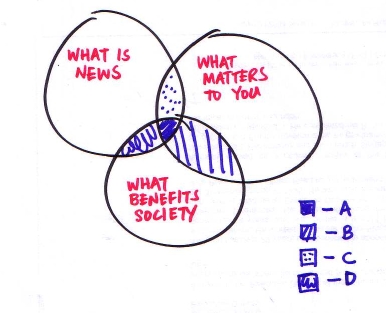 So The Sunday Times unveiled its redesign today and what made me completely flip wasn’t anything design-related but simply that its biggest story was about the fallout after the breakup badminton star, Ronald Susilo and his fiance, table tennis star, Li Jiawei.