News values, your values, my values?

newsvennSo The Sunday Times unveiled its redesign today and what made me completely flip wasn’t anything design-related but simply that its biggest story was about the fallout after the breakup badminton star, Ronald Susilo and his fiance, table tennis star, Li Jiawei.

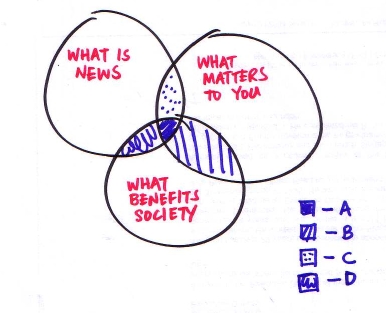
I refused to read the story but it made me reflect upon what is considered news. My argument is that news values, what matters to you as a reader and what benefits society for having news are three separate entities that do not always coincide. Based on the Venn diagram on the left, it becomes clearer.

A – This is the ideal function of news, it is information that I think is important to me and also benefits society. An example is news on the government stock-piling enough rice to last us through a food crisis.

B – This is an instance where useful information slips through newspapers. This is often due to lack of depth and the fact that the issue is something old. The alternative is usually books and things you encounter in education. For instance, information on how CPF works or how to file taxes are useful information for society to function but unless there is something new to highlight, the assumption of news values is that it is not responsible in ensuring you know something it already knows.

C – Such news is a bit more reader-centric. In fact, I would say this is better served in specialised-interests publications like magazines or newspapers that aim to serve only a certain community. An example of such news are those covered in Lifestyle, or even the fact that The Sunday Times is published in English means it matters only to those who know the language.

D – Such news usually don’t matter to you because you are not directly affected. For instance, as a Singaporean, it might not make much sense to read about what happens in the US or North Korea. But in the larger picture of things, one realises that such information is what drives foreign relations and has an impact on your society and you.

So where does the Susilo story fall into? It’s probably C or simply “What is News”. It will interest those who want to indulge in the affairs of others and is news because it is about famous people in society. And that’s why it does not matter to me, because I do not see how knowing about this piece of news benefits anyone or society.

The main story speaks volumes about what its editorial team thinks matters. Moreover, together with the launch of its redesign. I wished The Sunday Times had not pandered to such news but I think I represent a minority of its readers; this decision was about getting maximum eyeballs. It could have given more prominence to its “Think” pages, but I suppose that’s not what it thinks matters most to society nor would have appealed to most of its readers.

Show a little love to the local

I did not want to eavesdrop on the conversation, but the lady was very distressed.

Amidst the noise of the train, the book in front of me and her on the phone, I could not help but give her all ears. It seemed she was a model involved in the Singapore Fashion Festival and was heading home after auditions of some sorts and she was bitching to her friend about how the day had been tiring and the set-up of the audition horrendous. What really piqued my ears was when she lamented how some manager apparently restricted the number of Singaporean models to get on the runway, saying something like “That’s enough Singaporeans.” when the designer was picking his or her models.

And she added, “That’s what I hate about Singapore, I so want to leave.”

Her story may be grossly exaggerated, but I think it highlighted a problem in our society — we don’t give our local talents enough love. It is not about blindly supporting whatever is local but showing the support and the critique they need to improve and continue producing local works.

This lack of love has consequences on the creators that only result in massive disconnect between the audience and creator. While some of these talents, continue to improve with or without it, those who turn negative to this lack of support either completely give up on Singapore or their talent or turn inwards in their outlook.

The latter is something that I think is less explored, but what you essentially see are artists who create works that do not resonate with society (here, I mean beyond the arts community for instance) because he or she has been abandoned by it. In turn, when it goes on display, the average Singaporean cannot appreciate the art and does not even give it enough love to criticise it. This institutionalises into a vicious cycle and what you get are two distinct communities, those who support local and those who don’t, who are in their own conversations that never meet.

Nostalgia versus Progress – The battle for the Singaporean psyche

As I watched the series of video interviews at the Singapore 1:1 exhibition it struck me how the older generation of architects, especially those outside the bureaucracy, displayed a deep longing for nostalgia. On the contrary, the bureaucracy’s planners being pragmatic, lived in the present and looked forward to the future. It was set up such that the story of the development of Singapore’s landscape hinged upon this overarching battle of nostalgia versus progress.

It made me reflect on my own fascination with the past. A friend once said that it would be very sad if we only lived in the past because what would the future hold then? I do not feel alone in my love for nostalgia and I think many other young Singaporeans seek out this country’s past because it moves so fast. We are fascinated by the discovery of abandoned places like Woodneuk House, because it is like an oasis that resisted the rapid pace of urban renewal.

Places that do not change stick out like a sore thumb. From a planners perspective, it only accelerates their desire to carry out urban renewal, and from my perspective, it means I better document it before another one bites the dust. Again, we seem to return to this age-old battle that has remained in the crux of Singapore’s development.

So this battle wages on, and the nostalgia camp has come up with various tools to further their case:

The nostalgia film and assorted media
This topic is common fodder for local film-makers and photographers who want to project their love for nostalgia to others. Seletar Airport: Singapore’s Secret Garden and Diminishing Memories are two films that come off my head right now.

Flea markets and the rise in retro fashion
It’s not common to see young Singaporeans decked out in attire paying homage to an era gone by and trawling the flea markets, buying memories of the older generation.

Taking part in policy-making
When it was announced that the old National Library would be demolished, many Singaporeans wrote into the newspapers and started initiatives to try to resist the decision. The recent opening of Old School also seems to have nostalgia in mind, taking over the premises of  a former secondary school and re-converting the space to a design haven. Apparently within the building, there are elements that integrate the building’s history to the current premises.

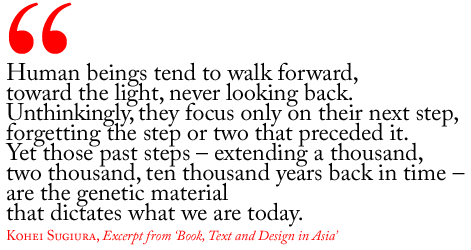
What is the golden ratio for conservation and development? I’ll say enough of the past so that the present has some bearing of their future. As I’ve quoted Kohei Sugiura, a Japanese designer, some time back:

kohei