Of conversations and postmodernity

The complexity of our postmodern times

I’ve spent the last few days immersed in the topic of postmodernity preparing for my final examinations on Monday and I still find myself constantly amazed by it. For me, postmodernity helps me make sense of what I see as a complex world and advocates the agency and creative capacity of a person. What it is is hard to pinpoint and often even refuses to be characterised because it opposes the reductionist tones of modern times where things are often addressed in universalistic and absolute terms. Yet, pitting it in this way against modernity might not be totally agreeable because some see is as an extension of modernity rather than rupture from it.

In any case, one of the better ways I’ve learnt about this is to read outside my text and talk to people about it. It is amazing to observe for yourself the contradictions and complexities that people have in their views and stories. In a sense, postmodernity celebrates diversity and difference but more importantly attempts to engage them rather than be ambivalent about it.

Such an engagement leads to the opening up of possibilities that could be good or bad, but like one says, that is the “tragic beauty” of it all.
The rewards of the long tail

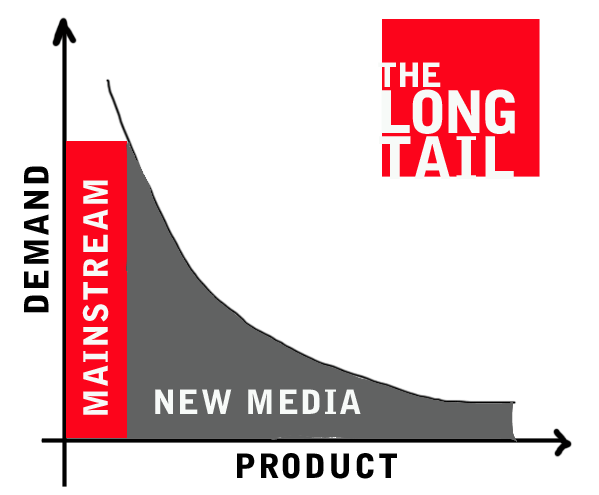
longtailThis semester I had to take a module in media management and one of the biggest things affecting it today is without a doubt the digital age. Unfortunately, I think the class failed terribly to address this development and in the midst of studying for the exam, I found a Economist.com podcast interview with Chris Anderson, editor-in-chief of Wired magazine, the best half-an-hour lesson on the future developments of the media market.
In essence, the changes in the media market can be explained by the long tail (see left), a demand curve for products. Mainstream media’s revenue currently mainly comes from a select group of products or hits such as the music industry earning most of their revenue from a pop star like Britney. In the new media landscape however, as costs and barrier in producing and distributing media decrease, the market can sustain a greater variety in products and creates niche markets such as indie music. Thus, in order to maximise revenue, media companies should go for volume instead of specialisation, offering greater variety to its consumers and thus earn the new media revenue too.

On another note, here are a list of great events coming up (the rewards of a long tail economy?) that I plan to attend for my own reference and so that people can find out about them too. Most of them are related to design and architecture because theSingapore Design Festival 2007 (coincidentally, similar colour scheme with this site!) and ArchiFest 2007 is happening these couple of weeks.

  • Signature Singapore… Old Forms, New Options | 6 Dec, 10am – 8pm |
    This one-day conference shall discuss and explore the notion of “Signature Singapore”. What makes Singapore unique from other world cities? What is Singapore’s signature urbanscape? How best could planners and the development industry contribute to strengthening Signature Singapore?
    <http://www.archifest.sg/web/fringeevents.html>
  • Singapore 1:1 Island | 17th Nov – 31st Mar | URA Centre
    A look at architecture in Singapore from 1965 onwards to tracks its economic and social progress.
    <http://www.ura.gov.sg/spore1_1/>
  • Screening of “Opera Jawa” by Garin Nugroho | 4th Dec, 730pm | National Museum
    As part of the Singapore International Film Festival Fundraiser, which has no main sponsor for the upcoming festival, this particular screening is a musical film inspired by the “The Abduction of Sita”, a classic found in the Ramayana. [Error corrected]
  • The Way of Asian Design | 30th Nov, Fri, 930am – 530pm | NTU ADM
    A 1-day Panel and Seminar on design from the Asian perspective
    Find out more >
  • Have you ever smell the rain | 20th – 30th Nov | Forth Art Gallery
    A 3rd solo painting exhibition by Tay Bee Aye. In this series of works Tay examines the notion of happiness and belief, questioning whether our senses are being corrupted, on how information are being process and use as a gauge to measure our happiness.
    <http://www.forth.sg/exhibition.htm>

Why we should create

gohpohseng-1

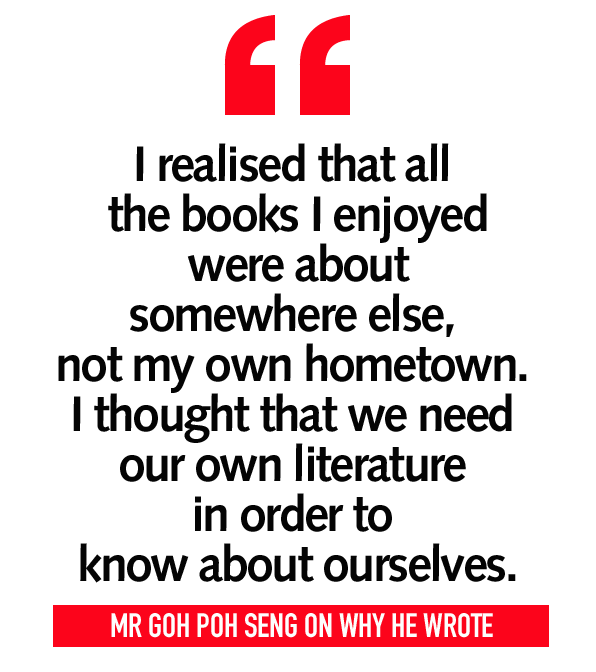
Today’s Sunday Times lifestyle had an article about Mr Goh Poh Seng, a “cultural maverick” of early Singapore who wrote If We Dream Too Long in 1972 about a young man’s quest for identity in the newly independent nation. I have yet to read the book, but this sense of the importance of culture creation is something that I find increasingly lost amongst our generation.

While the need to build a sense of nationhood for a young was imperative to this drive for culture creation then, it is the effects of globalisation today that drives this need to build a Singapore culture. Another intellectual of Mr Goh’s generation, architect William Lim wrote in his book Alternatives in Transition that culture creation was vital against the tide of globalisation. “The most effective instrument to handle this cultural intrusion is the strengthening of our own cultures, values and identities in order to provide a strong filtering mechanism.”

DON’T LEAVE IT TO THE GOVERNMENT
Another issue with regards to culture creation is that we cannot leave it to the government to do it alone. By letting the government dictate cultural production in the last 40 years, it has only resulted in apathy because its products are viewed with suspicion or totally ignored as propaganda. It is not the government support but more its tight regulations that has stifled interest on local culture and also a whole generation of local culture producers. This is one reason why many Singaporeans today do not support local products or feel it is inferior to foreign ones and also why we have only been seeing the same few faces in the scene.

Ultimately, we should create culture that we can call our own because it is how we can empower ourselves and the community. Rather than let the government or globalisation dictate the form of our culture, we can only truly relate to culture if we all engage in its creation rather than just be recipients of it.