In the three years since S u p e r m a m a opened in 2011, it has expanded from a design retail store to an incubator for Singapore designers and designs as well. It recently re-opend its original store at Seah Street, which had been turned into a workspace for designers and artists for over a year. We spoke to S u p e r m a m a founder Edwin Low about the renewed vision for his store, and how it will stand out in an increasingly crowded market of Singapore design products.

Why is Supermama@Seah Street re-opening as a store after it was turned into a residency space in November 2012?
We shifted our retail operations to the Singapore Art Museum (SAM) after running our flagship store at Seah Street for two years. While the retail store at SAM creates a greater awareness to local and international audiences, I find the customer’s pace of interaction (people-people, people-object, people-space) within the shop pretty rushed. I kinda missed the pace in Seah St where customers literally slow down just by stepping into the shop — which creates a more intimate and natural setting to form conversations over the products we carry.
There is also a practical reason as we are transiting from the current shop space at SAM’s 8 Queen Street to the official SAM shop within the main building. We will be taking over the official SAM shop from September and re-opening Seah Street allow us to reframe our approach, and create a better retail/gallery experience before embarking on the next one.
How is the re-opened Supermama@Seah Street different?
Previously, we ran it more like a select shop where we curated a range of labels within a space — a credible, but not exactly sustainable model for a shop. In the past year, we have gained significant access to many craft facilities in Japan and also created our own label, Democratic Society (DS). Currently, we are focused on presenting our labels and the maker’s production capabilities to our customers.
We have also retained the residency space, and I think it is pretty refreshing for customers to actually have a glimpse into the work studio of artists and designers.
Who has taken up residency in Supermama@Seah Street and what were some projects that have come out of it?
So far, we’ve had Dawn Ng (artist), Olivia Lee (industrial designer), Melvin Ong (desinere), Tiffany Loy (parasol bags),Jotham Koh (photographer). Their projects include collaborations under our DS Label, e.g. Dawn created a collection of tea towels using fabric made with a textile company based in Nagoya, Japan. Melvin was one of the designers who took part in our “Singapore Icons” project, a collection of porcelain produced with a label in Arita, Japan. Tiffany did an exhibition on “textile embroidery machine,” while Jotham’s is currently presenting his first public work, “Craftsman,” for our re-opening.
You’ve been involved in creating Singapore design products for some time, beginning from “Singapore Souvenirs” (2009), a speculative proposal on what gifts from this city-state could be. Is the Democratic Society label you’ve started a successful implementation of these early ideas? How is it different?
For DS Label, it is strictly about stories (past or current) that can be communicated through objects. I’m intrigued by the study of material culture in our social context — I like the fact that objects which surround us are an extension of who we are, which ultimately defines us. For instance, I visited Arita, a porcelain town in Kyushu, Japan, and I was totally bemused by how a material — porcelain — plays such a huge role in defining the culture and lifestyle of the people living in the town. So for DS Label, I wanted to introduce a new material typography in Singapore and see the reaction to it. Can it be accepted? Can I create a new identity? Can this collection go into the daily lives of people? How would they fit in, etc.As industrial designers, it is only natural for us to want to create a label much like Muji, however, there is not much context for us to do so. Not until the Singapore Souvenirs (SS) project. I would say that the DS Label is a progression from SS. For SS, it was a pretty green attempt by a local design collective to create meaningful content, and many of the ideas were one-off, almost random, and across many mediums — which is probably the beauty of the project.
How have DS products been received by both Singaporeans and tourists? Are they selling well?
Pretty overwhelming, I must say. As I wrote this reply, I met a customer who tore out the page with a writeup of our products from the Singapore Airline in-flight magazine to look for us. To be blunt, the DS Label is possibly the only label and collection of products I have in my shop that is commercially viable.
DS is not the only producer of Singapore design products these days. What differentiates your products from others?
Personally, I find most producers still skimming the surface, mostly playing up on bold colours and nostalgia to sell. I think we can go beyond that.
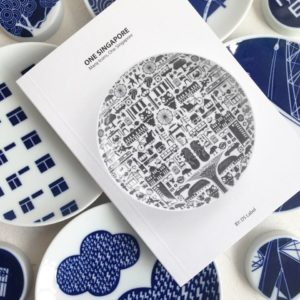
For DS Label, I think about longevity — both in its artistic direction and as a business model, which is why the tie-up with multi-generational craft facilities in Japan plays a vital role in the setup. We also spend considerable amount of time researching (sometimes with support from the National Archives of Singapore (NAS)) and communicating the rich content behind every artifact. Take our recently launched “OneSingapore” porcelain piece for example, we did not just provide a writeup on the icons, but worked closely with NAS to sift out archival images to create a story booklet that communicates the stories behind the icons — so much so that I have customers requesting to purchase the booklet too.
Another approach I take is to involve as many designers as possible. This is why I decided on the name “Democratic Society”, it is a label defined by many designers and artists. That is when the design language for the label become “democratised.” It’s a language owned by many people. With this, I can potentially reach out to a wider audience.
The DS model of applying concepts by Singapore designers on to Japanese crafted products seems to play to the strengths of both countries’ design capabilities. As an industrial designer yourself, do you think this is the best model forward for Singapore’s design industry or should we also develop made-in-Singapore products too?
I think it differs from industry to industry. For an industry which involves years of training or requires a large amount of space, we have to take a collaborative approach. Porcelain is one such product type/ industry. The facility in Arita is so massive that it’ll not make sense (cents) to have it in Tokyo, let alone Singapore. However, if you are looking at a trade such as leather making, letter press, etc., then it makes sense to develop the capabilities of making in Singapore.
We do also need to look at production volume. Personally, I feel that it is good to develop artisanal facilities in Singapore.
You’ve run a business retailing Singapore design for three years now. What are some challenges and issues you continue to face?
I do not want to sound pretentious, but I was completely dumbfounded by this question. I enjoyed what I do so much that I don’t see challenges as separate from the joy of running the business. I wish to say high rental cost blah blah… but these issues are not unique to my trade, everyone is facing the same thing, so it’s not exactly an issue when everyone is facing the same issue, isn’t it?