Category: Culture

A look back into the future

“A Brief History of the Future” was a series of three films by Finnish artist, Mika Taanila, that explored the recent historical perspective of predictions about the future as part of the Singapore Fringe Festival ‘08.

Conceptually, it is very interesting, considering how quickly things become a part of history today and the amount of archival information out there that can be collated into a documentary. In a sense, the future is not simply looking forward, but we are challenged to look further back to see further ahead.

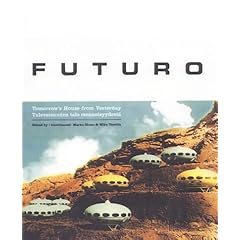
Futuro — A New Stance for Tomorrow (1998) traces the development of a plastic weekend cottage (left) that was meant as the homes of the future but ended up becoming a novel toy that has since been forgotten. In fact, after I first saw it, I was not sure if it was actually a documentary or a piece of imaginary art. The design of the homes seemed surreal yet never that far out of place from reality.

Optical Sound (2005) explores the development of an electronic music instrument which was a tad draggy at times. But it was interesting to see how the hippie culture drove a lot of its development and what they seemed to be doing was an attempt to translate human movement into electronic signals.

The Future is Not What It Used to Be (2002) follows the life of Finnish nuclear scientist/artist Erkki Kurenniemi in his massive project to collect everything revolving around him — from receipts, to photos, recordings — in an attempt to re-create his human soul. He extends this concept of body-mind duality and suggests that it is this soul which should be preserved such that it can fill any artificial form (body) that we create in the future. At one point, he says something along the line, that if science fails to awake a frozen body, at least we can re-create the human soul with all the things he is collecting.

These works by Tannila really depicted how the predictions of the future in the past turned out today and give a better picture of where we might or should not be heading. The video of Kurenniemi got me thinking and he seems to suggest that the creation of the artificial container of the human is inevitable and the last frontier we have is what we term the “soul”, and at times it seemed like he was on this one man battle to either preserve the last frontier or really create a resource that can be used in the future as the creation of an artificial “soul”.

Deschooling society

I’m reading this book now by Ivan Illich, “Deschooling Society”, thanks to a friend who bought it for me in London. The cover says enough for and about me, “Good radical stuff”.
Coincidentally, I am also in the midst of my internship and I just wrote a logbook about my experience in the first month and I suddenly seem to draw parallels with what the book is saying and what I am writing in my report.

In the book, Illich argues the school has become an institution that has monopolised “learning” and made it into “teaching” and the “professionalisation” of education simply means that whatever skills we pick outside of these institutions are just not recognised by society. However, more often than not, the skills and things we actually learn are obtained out of school. He then goes on to outline a “new world order” for learning where a lot of the impetus in learning is returned to the student who basically charts his own learning path backed by devices and resources that are built to be open and encourage a sense of curiosity in learning. For instance, machines, where we can actually see and understand how it works encourages inventive minds.

Essentially, writing my log report helped me to reflect on the amount of work I have been involved in less than a month, but more importantly, spell out the skills and points I’ve noted in relation to my work and it is pretty exhaustive. I think compared to school, this has been a very different experience. I mean you can progress from primary school to tertiary education, and there exists a relatively similar system of “teaching”, while when you head out to work, the impetus is to teach yourself, or “learn”.

I suppose at the end of the day, it is about empowering yourself to choose to “learn” rather than just be taught. That is a way of resisting Illich’s idea of school.

On idols and charity

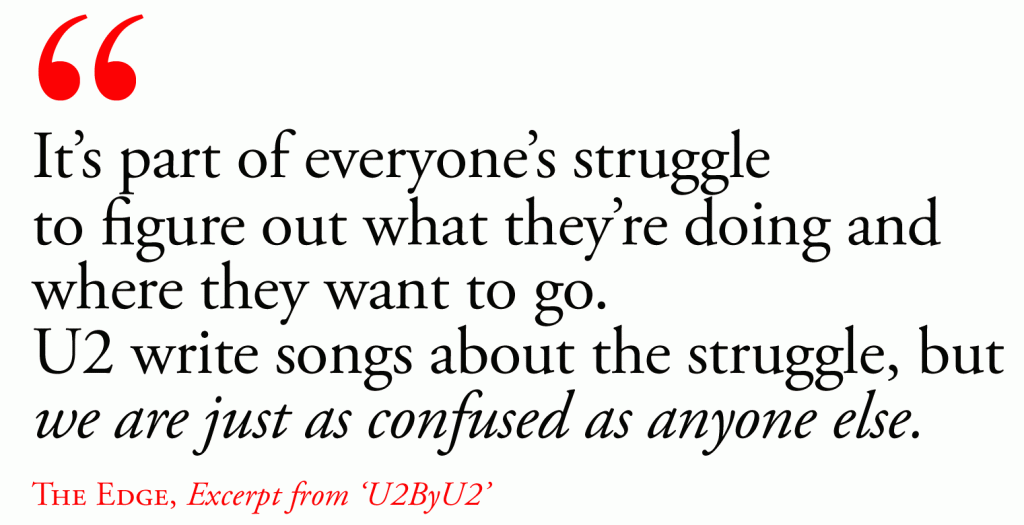
u2quote

Thanks to a friend, I’m reading a biography about U2 now and getting inspired by how much I agree with this band. I think this quote from The Edge really sums up my feelings about being in awe by famous people or having idols in general, that we are all equally confused about lives and we have to listen to ourselves to decide on the life we want.

My personal journey with U2 began really superficially, I have a U2 iPod because I liked the colour combination. Then I started hearing U2 songs and I got captivated by its messages of brotherhood, patriotism and passion. It certainly helped that Bono is the poster boy of idealism, helping the fight against poverty and aids in the Third World.

But true to the spirit of the quote, Bono gets confused sometimes too. His campaign to fight HIV and AIDS in Africa, (Red), got a lot of debate amongst my friends recently. One felt it was bad because it only encouraged consumerism, another felt it was the only way to get big corporations to cooperate (after all, what’s in it for them?). In fact, there is a campaign that attempts to correct the failings of (Red), it’s called Buy Less!

There seems to be a trend of selling idealism as a way of life nowadays and (Red) is one instance of this and others include magazines like GOOD and Monocle. It shows that everything can be commodified and I am worried that its original intentions would be diluted.

In a sense, it adds another layer between the donor and the needy. It used to be charitable organisations, now that has enlarged and comes in some form of “social enterprises” — businesses that attempt to have some social good component. People start thinking that they can continue with their normal lives and somebody else will take care of those who need help. Apathy arises when its always somebody else taking care of it, and it seems to complicate matters like how to sustain these people and what values they stand for. Most importantly, there is the death of the personal relationship between the donor and the needy and charity organisations try to simulate that by creating “personalised” greeting cards of gratitude when Christmas comes. It just feels… fake. Jean Baudrillard, a postmodern thinker who theorised that simulation would take over the original, would have felt so vindicated.