Category: History

Saving Pearl Bank Apartments

Architectural conservation or real estate investment? An essay on the fate of a 1970s style icon that has seen better times.
2016-from-penthouse-level

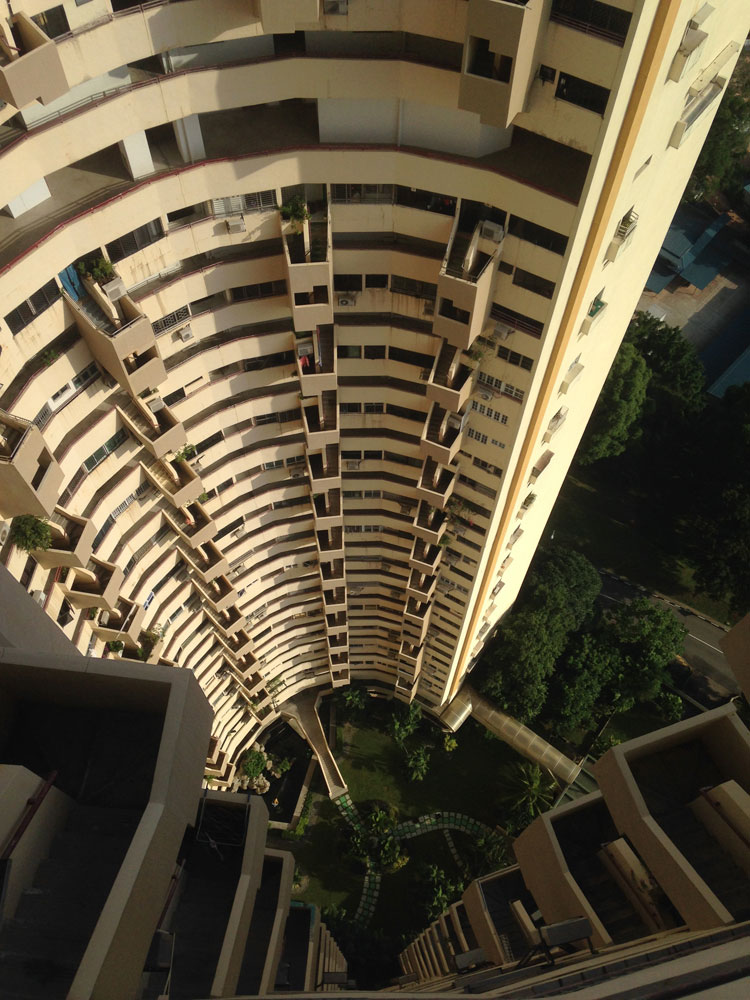
A 27-storey “green tower” of residences may one day rise up at the edge of Singapore’s historic Chinatown. It will boast the Outram Park MRT station at its doorstep and Pearl’s Hill City Park as its backyard. There will even be an infinity pool and a rooftop garden. But none of these will rival the most attractive aspect of this new development if it ever comes to pass: securing the future of the iconic Pearl Bank apartments and literally giving it a fresh lease of life.

This is architect Tan Cheng Siong’s unorthodox proposal to rescue what was once Singapore’s tallest block of apartments. Having witnessed the 38-storey building he designed over 40 years ago undergo three unsuccessful en-bloc attempts in the last decade, and faced with a 99-year land lease that is almost halfway used up, Tan and a group of residents have taken the unprecedented step of voluntarily applying to the Urban Redevelopment Authority (URA) for Pearl Bank to be conserved. Not only is this the first time a multi-strata private development has made such a request — almost all the 7,200 buildings given conservation status in Singapore thus far have been proposed by the government — Tan’s conservation plan would entail demolishing part of Pearl Bank’s existing five-storey car park to build a new block of 150 apartments.

In an interview in his office at Maxwell House, Tan made clear his views on conservation: as a result of a rising population and the pressure on land resources, high-rise living has become firmly entrenched as part of the societal, environmental and architectural fabric of Singapore. If people have come to accept this fact, why don’t they learn to conserve their ageing high-rise buildings instead of tearing them down?

While Tan understands the pragmatism of maximising land values in land-scarce Singapore, his idealism is tempered by the practical business of living. While Pearl Bank is a vital piece of Singapore’s architectural history, it is also home to the people who live there, many whom are retirees with dwindling incomes. As a result of high maintenance costs and shrinking sinking funds, the apartment building has deteriorated over the years — plagued by broken-down lift shafts, leaking sewage pipes, peeling paint and even rat infestations.

Given its failed en-bloc sales attempts, Tan came up with a radical idea to secure Pearl Bank’s future: seek conservation status for the property and then unlock part of its value by allowing a developer to construct a new block of apartments next to the original tower. The money from the sale of the new flats would then pay for the refurbishment of the ageing building as well as top up what is left of its 99-year lease.

The result would be a modern appendage on his modernist marvel – a concrete materialisation of how architecture, property and conservation intersect in Singapore. “We thought this conservation [proposal] would be a binding force because it would bring them an extension of lease, [and] … a new building,” he says.

➜ Read the rest of the essay in BiblioAsia (Vol 12, Issue 3) Oct-Dec 2016
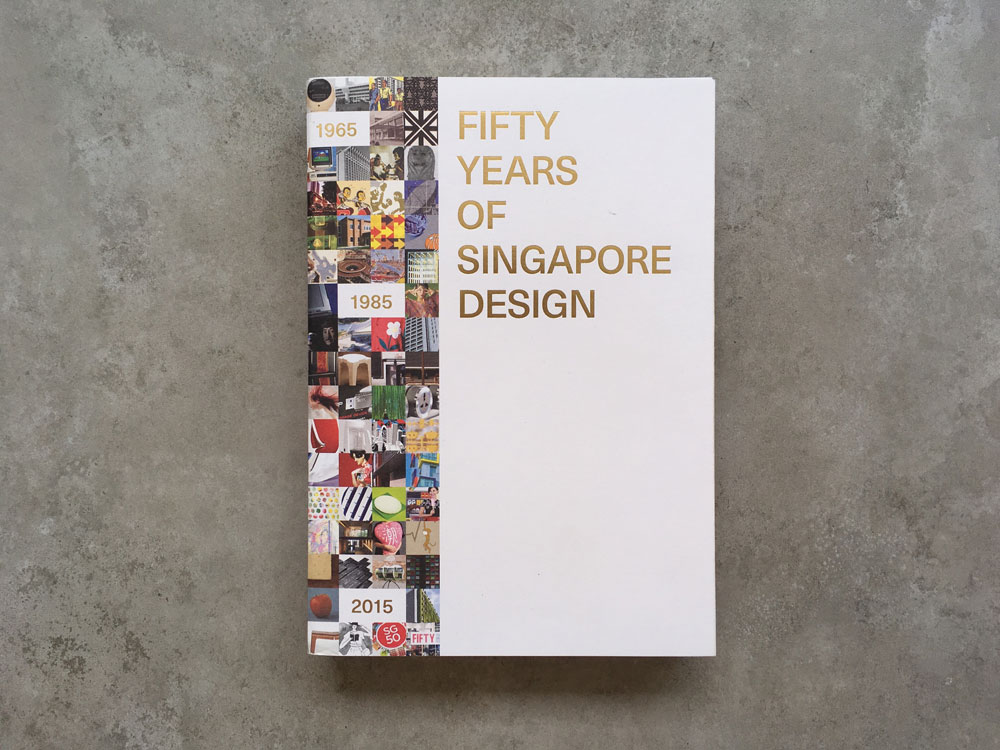
Fifty Years of Singapore Design Timeline

fifty-years-of-sg-design

Coming after Singapore’s golden jubilee celebrations in 2015 is this Fifty Years of Singapore Design book that I got to work on for the DesignSingapore Council. For four months, beginning late last year, the team—including Dawn Lim and Sheere Ng—worked on turning the 2015 exhibition of the same name curated by WY-TO into this 333-page book.

Working with the existing selection of designs that were “iconic, popular and pivotal” to Singapore’s national history, we researched and wrote about the growth of the local design industry from independence in 1965 to 2015. Each decade has its own historical overview and selection of objects that are organised behind certain thematic developments that emerged during the period.

fifty-years-of-sg-design-timeline

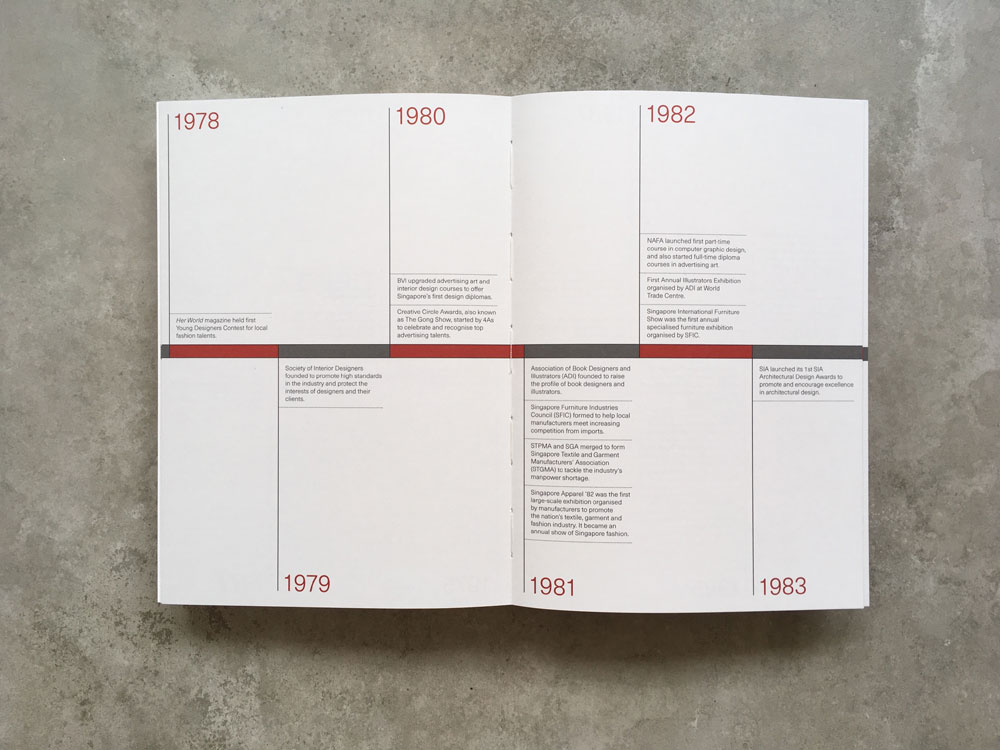
Of particular interest to those keen on Singapore’s design history is a timeline that actually traces back to 1932, when a seed of industrial design was sown with the formation of the Singapore Manufacturers’ Association (today known as the Singapore Manufacturing Federation). While the original timeline simply listed milestones in the development of architecture and design in Singapore—focusing on government design policies, design education and the founding of various design associations—we sought to elaborate on each to provide a bit more context. The timeline is a skeleton waiting to be fleshed out, and hopefully, more Singapore design histories will emerge from this.

From my understanding, this book is not for sale but will eventually be made available in Singapore design schools and the public libraries. More information can be found in this press release put out by the DesignSingapore Council.

fiftyindependence

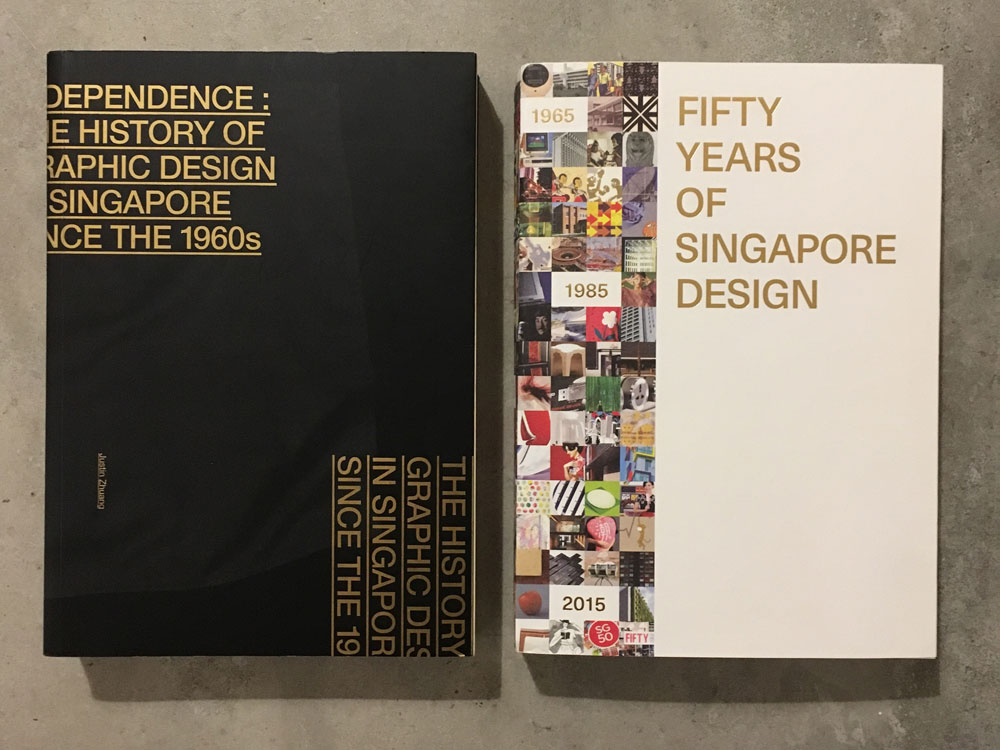
This book follows a 2012 publication I wrote on the history of graphic design in Singapore. While Fifty Years of Singapore Design was commissioned by a government agency, Independence: The History of Graphic Design in Singapore Since the 1960s was a ground-up initiative by The Design Society. Both books are designed by H55 Studio. For me, the books nicely bookend a period when Singaporeans’ initial curiosity for identity turned into a nationalistic hunger for nostalgia, as witnessed by the many projects put out for the SG50 campaign to commemorate Singapore’s 50th anniversary.

As a designer who came up to me at the launch said, “Thank you for remembering me.”

Championing for a Singapore creative industry: The Creative Circle’s Annual Advertising Award


GRAPHIC.SG

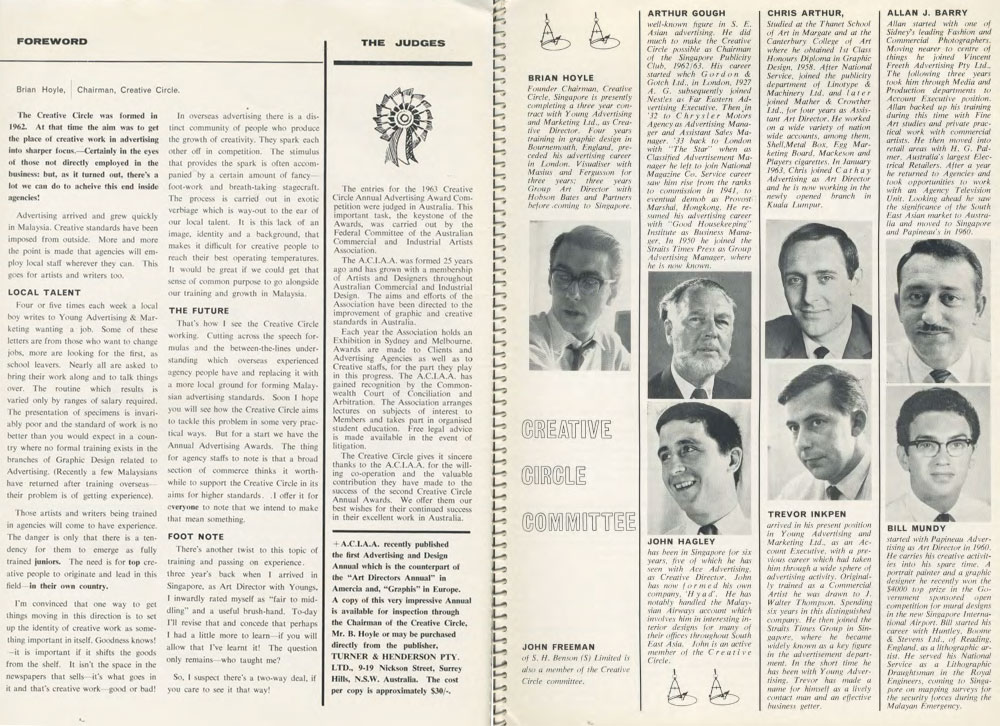
“The presentation of specimens is invariably poor and the standard of work is no better than you would expect in a country where no formal training exists in the branches of Graphic Design related to Advertising,” wrote Brian Hoyle in the 1963 Annual Advertising Award. This was what led the creative director of Young Advertising and Marketing Ltd to establish this awards—one of Singapore’s earliest prize for creative work in advertising—together with a committee of expatriates from the city’s various advertising agencies. Known as the Creative Circle Singapore, this group of the Singapore Publicity Club, was founded in 1962 to “stimulate an awareness of and a keener appreciation of visual creative standards in advertising”, largely through the awards.

The inaugural award received over 100 advertisements of “local creative origin” used during 1962  to see which were the best colour advertisement, black and white advertisement, photograph, publicity, radio commercial, and cinema advertising. There was also an overall winner. This “favourable response” led to an expansion of categories the following year, adding on best packaging, calendars, posters, brochures (including direct mail) and leaflets. All the entries for this second edition of the awards were judged in Australia by the Federal Committee of the Australian Commercial and Industrial Arts Association (ACCIAA). Of the 12 categories available in 1963, the Singapore and Malaysia branches of UK-based S.H. Benson International (which later became part of Ogilvy & Mather) swept up most of the awards with Hoyle’s Young Advertising & Marketing Ltd (renamed in 1966 as London Press Exchange (LPE) Singapore) coming in runner-up.

1963—Annual-Advertising-Award-Calendars-and-Posters

All the entries for the 1963 award were captured in the black and white annual printed by Cheong Press. Inside are also valuable profiles on members of the creative industry then and also essays on the standards of creative advertising and copywriting in Singapore and Malaysia. Contrary to the popular notion in these regions that “white men” came here to unfairly dominate the advertising industry, there were written pleas in the annual for locals to eventually captain their own industry. As Hoyle noted in his foreword. “The need is for top creative people to originate and lead in this field—in their own country.” (Bold emphasis are his). This was of course not entirely selfless. In another essay, Allan J. Barry from another agency Papineau Advertising, noted that “advertisements prepared for other markets are being used in Malaysia” but the country was a unique market that needed its own approach to selling.

“If you are prepared to accept this proposition you must also be prepared to accept the corollary that the people best suited to created the most effective approach for this market are the creative staff of local advertising agencies.”

1963—Annual-Advertising-Award-Foreword-and-Committee

In the course of my research for my book, Independence: The history of graphic design in Singapore since the 1960s, Brian Hoyle was kind enough to send over a copy of this historic annual advertising award. Thanks to designer Bernard Tan, a scanned copy of the annual is now freely available for download for research purposes. Do note that it is missing some blank pages and also one on the full list of winners.

References