Category: History

Design For The Dead

British designer and typographer Paul Barnes talked about how letter carvings on tombstones in his country’s graveyards inspired his typeface designs at a lecture organised last month by The Design Society. Well, maybe Singapore’s designers can take some inspiration from the over 80,000 tombs found in one of the last remaining graveyards in this city-state — Bukit Brown Cemetery.

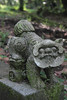
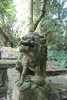
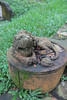
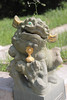
While doing research for a story about this cemetery that first opened in 1922, I discovered many highly decorated tombstones of the rich and famous of Singapore’s history. Most of these were tombs of the Chinese, so the designs reflected the rich symbolism of their culture. The stone lion for instance, is a very common statue that the Chinese believe will help to ward off evil spirits. You will find them outside temples and homes, and also next to tombstones. At the cemetery, there even a variety of designs of these lions.
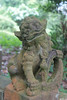
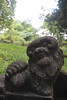
Lion Lion

Lion

Lion

Lion

Lion

Besides lions, there are also other statues to accompany the dead, including chamber maids, and this Sikh Guard below, who is also thought to be able to act as guards for the tombs. After all, the Chinese believe in afterlife and tombs are regarded as the homes of the dead.
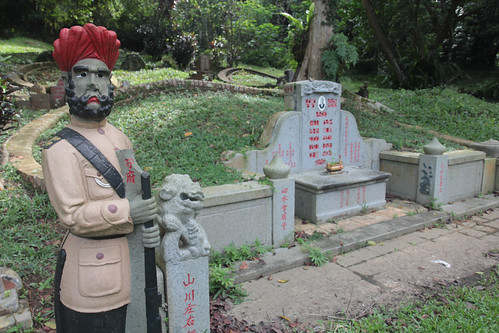
Sikh Guards

Another distinct local flavour to some of the tombs are the colourful Art Noveau tiles that were popular with Peranakans and wealthy Chinese of the past. They also decorated their homes with such tiles.
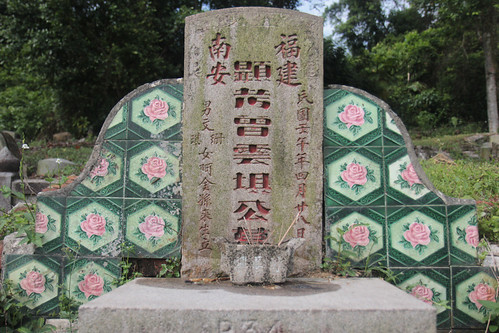
Peranakan Tiles

Another form of design that reflected a mix in cultures were in these tombs that had both Eastern and Western symbols.
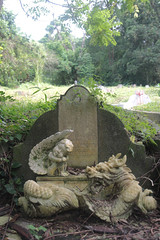
Angels and Dragons

Tomb of Mdm Lee Tuan Neo

These are just a small sample of the many intricately designed tombstones in the cemetery, and you can see more pictures I took here. Make a trip down as the cemetery, before it is eventually exhumed for future redevelopment. It’s pretty easy to walk around and explore the cemetery, but you can also use this map created by the Asian Paranormal Investigators, especially if you want to find out which of the tombs belonged to the many pioneers of Singapore’s history.

The most iconic moment of GE11?

I recently showed two strangers a copy of GE11: We Were There, a magazine of photo essays about Singapore’s recent General Election. None of them had seen this publication before, but as they flipped through it, one of them stopped at this very photograph and said, “I remember seeing that.”

This image of Workers’ Party candidate Chen Show Mao bowing while clutching on to his identity card and passport was taken by photojournalist Edwin Koo on the last day of the election rallies. According those who attended the rally at Serangoon Stadium, Chen had held up his IC and passport while declaring to the crowd that although he had been overseas for so long, he never forgot he was a Singaporean. Before he ended his speech, Chen then bowed to the crowd, a gesture that would have resonated with the thousands gathered that night.

Just two days before Chen’s bow, Prime Minister Lee Hsien Loong had also offered a humbling note to voters when he apologised at his People’s Action Party (PAP) rally for the mistakes his government had made in the last five years. This move, mid-way through the campaign, was seen by many political observers as PAP’s charm offensive to placate a frustrated electorate, many whom felt the party had forgotten that it was elected to serve the people. Fresh with memories of that apology, the crowd would have loved the bow that Chen made, affirming their belief that it was them, the people, who should be kowtowed to.

As someone commented on this photograph that was posted on Facebook: “The humility in this picture strikes me. A Harvard, Oxford, Stanford graduate, and corporate hotshot, bowing deeply to the common people.”

While the bow was seen by thousands at the rally, Koo’s photo has made the moment iconic by letting so many more see it. The very next day after the rally, Koo put it up on his Facebook as part of his series Notes from a Singapore Son, and it went viral on social media. Koo has also since said that Facebook helped many more see his photos as compared to if they were published on the front page of The Straits Times where he once worked.

Disseminating his photograph via the internet also made it iconic because it was part of the first election that Singaporeans participated actively online. As he wrote in a Facebook note accompanying this photo album:

“Because we have Facebook today, we can finally look at the uncensored truth. We can finally know how many people really attended the opposition rallies, and what transpired during the rallies and walkabouts. We finally have unlimited space to play our pictures, and no blind editors to tell us this picture is “not fit to print”.”

And as it turns out, the photograph has even made its way offline. Koo is exhibiting it together with others from his series Notes from a Singapore Son at the School of Photography (SOP) until 30th July. Do check it out, and you can even get hold of this iconic moment as a poster or a limited print too.

Singapore’s Pioneers in Advertising

I got to interview veteran creative director Allein Moore a couple of months back for a project to document Singapore’s design history. It turns out he too was doing documenting what went on in our advertising scene back then. Some of it is published in his online magazine ADAsia.

It is a collection of personal memories from the pioneers, beginning from the ’50s when Singapore’s modern advertising industry first began. Many of the personalities and company names will sound unfamiliar to most of us because of how much consolidation and merger the industry has underwent.

However, one name that is important from a graphic design perspective is Brian Hoyle. He first came to Singapore from the United Kingdom in 1960 to join an advertising firm. Two years later, he and other creative directors here started the Creative Circle Awards in 1962 to raise local graphic standards. Then, in 1969, he co-founded with another veteran ad man, John Hagley, a specialised graphic company known as Hagley and Hoyle — one of our earliest graphic design consultancy. The company is still around today, but no longer owned and run by either, who are both retired and back in Europe.

Find out more about Brian and other pioneers of Singapore’s ad industry here!