New York magazine’s architecture critic Justin Davidson shares how the trash can holds more than just garbage!
What does the NYC trash can look like?
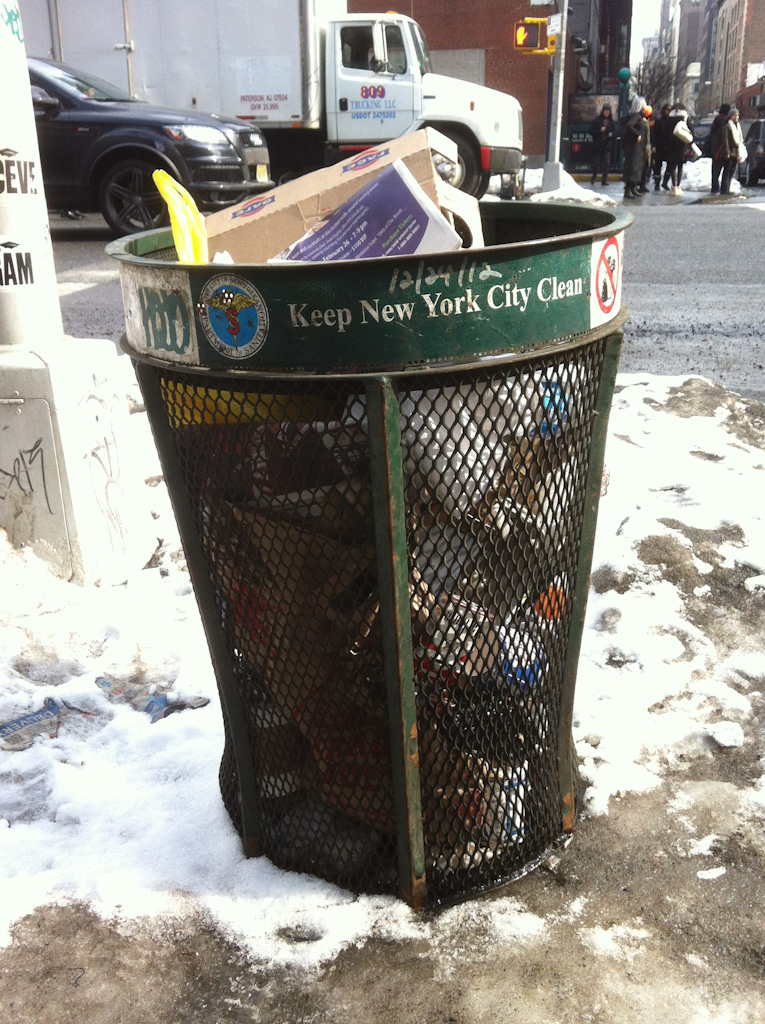
It’s a very efficient design, and you can see all of the decisions that went into making it as lightweight, rugged and efficient as possible. It is made of perforated metal so that it’s really made mostly of air. It is lightweight because the trash collectors have to pick it up, turn it over and dump it into a garbage truck. In order to minimize waste, it doesn’t have a big plastic bag inside that would become part of the landfill, so the perforations have to be small enough that the litter doesn’t fall out out. It’s really constructed like a barrel with ribs, and it takes up the smallest footprint on the sidewalk so that the top is wider than the bottom. It’s a conical shape. It’s got a wide rim that says “Keep New York City Clean”, so it’s got a place for a slogan to exhort people to use it and throw trash into it.
For all those reasons, it is a very efficient machine given how trash moves through the city. It’s the most basic low-tech kind of trash can imaginable. It’s elegant enough by virtue of its efficiency to take its place on the city streets, but it’s not so attractive a piece of high design that people would want to steal it. It’s just not that good looking. And I think for the purposes of a NYC trash can, it’s a benefit.
What are the trash can’s most iconic features?
Its simplicity and its really basic efficiency. The words prominently displayed on top of it are also iconic, although I’m not sure how many people if you blindfolded them would remember if it says anything at all, let alone what the slogan is.
It’s kind of forest green so it doesn’t assert itself, and yet you know what exactly it is for. It’s just that really basic design combined with its perforation that makes it really rugged and present, but not an eyesore. I don’t want to say it disappears, but it’s clearly meant to be self-effacing.
What is the role of the trash can in this city?
One interesting thing is the number of trash cans in the city and how people used them have waxed and waned. A couple of decades ago, this was a dirty city and there was trash everywhere. One reason was because there weren’t enough trash cans and they weren’t emptied often enough. So people got into the habit of throwing litter on the sidewalk or in the subway. The city increased the number of trash cans on the street and made sure there was one on every corner, throughout the subway system, and the parks. They were also picked up regularly. There was also a whole campaign to get people to stop littering. It was successful and the amount of littering actually went down.
The interesting thing was having habituated people to hold on to their trash or pocket litter just long enough to deposit it in a trash can, they realized that the habit was going to remain even if they saved some money by lowering the number of trash cans or picking them up less often. They counted on people’s habits, that they would hold on to their litter just a little longer — maybe an extra block — until they found a trash can. So there’s always this kind of pushing and pulling. It has been very effective in the subways and they managed to save a lot of money by lowering the number of trash cans without increasing track litter.
What does the NYC trash can say about the city?
One of the things a trash can tells you is a little about the trash once you put it in. A basic element of the trash can is the mechanism which the trash gets emptied. This is clearly an object that somebody is going to muscle up in the air, turn it, and dump the contents into a garbage truck. In this day and age, that is a completely primitive way to deal with trash. It’s also not necessary, and it’s not even common. Europeans use a lot more advanced trash can designs that lock on to the garbage trucks and get automatically turned over.
As basic as the NYC trash can is, it fits into a system that relies heavily on staffing and the running of trucks through the city on a regular basis. There is the spilling of pollutants when the trash is brought to the central sorting points. So one way this trash can is not efficient is its indication that in a city that presents gigantic amounts of trash — most of it household trash, and not the kind of street litter these cans are for — it still hasn’t figured out an optimal way of how to reduce the waste we produce.
Do you have a personal story to share about the NYC trash can?
Every morning, I go to either to Riverside or Central Park with my dog, and of course, you’ve got to pick up after your dog. So all these dog walkers have these plastic bags full of dog poop that they have to dispose of. It’s been cold and freezing, and there’ s been a lot of snow which has impeded trash collection. There is something amusing about watching people trying to diligently pick up after their dog, bag the poop, and try to dispose of that bag in a trash can that is at this point not conical but pyramidal because the cone has been reversed. It is now a structure that contains a tower full of plastic bags that is rising considerably higher. You see all these people circling the trash can trying to figure out where they can deposit this bag so it won’t roll off the side and onto the ground. So you can see how sensitive the trash can design is to the efficiency of the pickup. If it’s not done, even in a day or two, you start to have a problem.
Any thoughts on the increasing variety of trash can designs in the city?
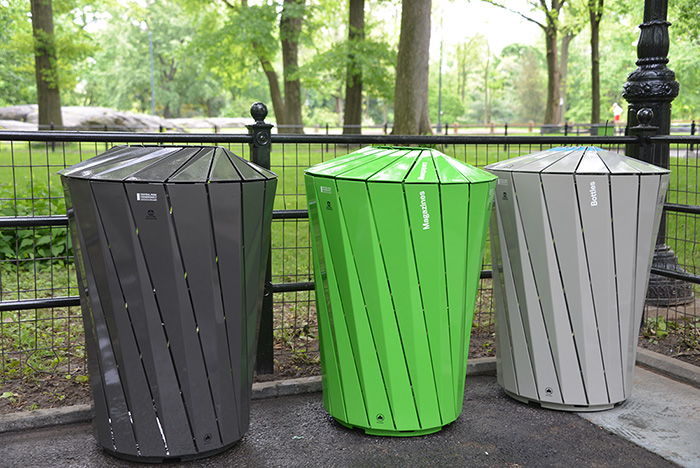
For most people, their experience of a New York City trash can is one of many New York City trash cans. There is really a lot of variety. There is the basic standard one we’ve been talking about, but business improvement districts have their own design, often with sponsorships on the side, so it’s a form of advertising. The Central Park has its own kind of trash can that was designed in cooperation with Central Park Conservancy. Bryant Park has a much more elaborate kind of trash can with higher design elements because they have the staff to deal with that. So really, as you move throughout the city, it’s not a standardized appearance. You can practically tell where you are just by looking at a trash can. It’ll give you a lot of information on location.
Should trash cans become beautiful design elements in a cityscape?
It really depends on the context. When you are dealing with something that has to work on an urban scale and be produced in large quantities, the priority is on increasing the ease of use and minimizing cost. The trash can we have, given all the constraints I was talking about — how the trash is picked up and what happens to it afterwards — is a pretty good set of compromises. It’s not beautiful, but it serves a good function. When you get trash cans that are supposed to represent the neighborhood or a particular park, and become a design element in a kind of landscape, that’s fine and great, but it requires there to be a maintenance force which is costly. What you are doing is undoing a citywide standardization so that the trash can becomes an element of pride in that locality. In areas where there is a private business improvement district or conservancy that can deal with the implications of beautifying the trash can, that’s fine. But if you are going to beautify a neighborhood and rely on the city to pick up the implicit costs, then I don’t think it is a good idea because any money you are spending to beautify the trash can is taking it from some place else. It’s zero-sum game. The city has the responsibility to spread out this functionality evenly. It’s important that the city has created a trash can design that is city-wide and instantly recognizable by everybody.
——————
Written and recorded for Leital Molad’s Radio and Podcast class at D-Crit. The Q&A is an edited excerpt from a longer interview recorded in February 2014 . Thank you Justin Davidson for allowing me to share this.