Category: Cities

The City is Her Playground

Debbie-Ding

Artist Debbie Ding invents games, solves mysteries and seeks adventures to cope with the banal everyday life her city of Singapore

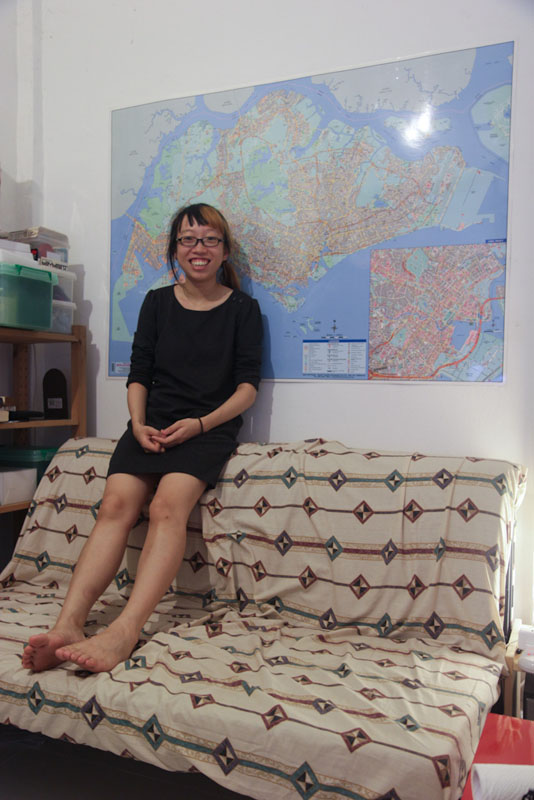
Daily travels in a city is a boring journey most of us endure. We distract themselves by catching up on sleep, reading a book, watching videos or playing games on our phones or media players. So does Debbie Ding, except the city itself is the text she reads and her playground for fun.

While working in a creative agency inside Singapore’s Central Business District (CBD), Debbie invented games to entertain herself during her lunchtime travels and when she needed to walk to her clients’ offices in the neighbourhood.

“I had a map where I outlined roads I walked before, and I would try to walk roads I had not every time I had to get to places. It’s kind of like the game Pac-man, where I had to walk through every single road,” she says.

It was during these walks that Debbie also began noticing circular symbols with random numbers and letters painted on the floors and buildings in the CBD. What began as a few random photographs grew into another “game” to discover what they were. Her search for these mysterious symbols even got her colleagues hooked, and they often reported to Debbie on new “sightings”. The “game” was completed when Debbie solved the mystery, correctly decoding the symbols as a language used by building contractors working on a new mass rapid transit railway line running underneath her work place.

Such playful views of the city has been a defining element in Debbie’s approach to her art and projects, which she has often described as “psychogeographical games”. These investigate the city, challenging how we see, understand and even navigate them. Her inventive nature has been with her since a child, says the English Literature graduate from the National University of Singapore says who made herself believe ‘green’ was her favourite colour when she was 10-years-old because she thought it was strange she didn’t have have a favourite. It was only when she started working in London in 2009 as a copywriter for a creative agency that she started taking an interest in cities. Despite London turning out like how the self-professed Anglo-phile had expected, Debbie felt the city was special and it while attempting to make sense of the place that she began devouring books and academic texts about cities, opening her eyes to a new way of looking at her surroundings. At the same time, she was also taught herself how to use multimedia tools like Flash.

In 2010, she brought this vision and skills back to Singapore and carried out her first major art project “\\:The Singapore River as a Psychogeographical Faultine, which explored a landmark of this city as a “site at which memories of spaces, fictional (imagined) spaces and dream spaces interact, merge or drift apart”, explains the exhibition catalogue. Held at The Substation, Debbie’s project had had drawings and an interactive multimedia booth that examined the shape or the river. There was also a game, “Here the River Lies, which visitors could write their memories — real or not — of the Singapore River on to a physical map, transforming it from a geography of the urban landscape to that of a community.

The game was inspired by a lawsuit happening then between the Land Transport Authority sued Streetdirectory.com. The latter had been sued for infringing the copyright of the transport authority’s maps, using them to run an online map service. Reading about the case, Debbie learnt that map makers often created fictitious locations on their maps as a way to protect their copyright. In the 1950s, one such location on a map of New York became real when someone set up a store there and named it after the location. “A place became real because of the map, which is quite a nice idea. That’s why I thought having people write on a map would be interesting,” explains Debbie. “It’s almost like things don’t exist unless you archive or write them down.”

As if to prove the city around her exists, Debbie has become its compulsive recorder, often walking around the city in search of her next game. While she used to draw maps of these travels on her notebook, she now does so with just her iPhone, snapping pictures and recording audio samples. Recently, she was featured in a short documentary by Singaporean filmmaker Tan Pin Pin where she talked about her discovery of a mysterious set of graffiti in a stairwell of the disused Yangtze Cinema in Singapore. What she chooses to record is largely based on intuition, she says. A fragment here and a fragment there, but eventually, Debbie puts together the pieces to make sense out of them, constructing a narrative for her projects. It’s a process she terms “psychogeoforensics” — another one of her inventions. This builds upon her playful approach to the city, turning it into a space of mystery encouraging people to let their imagination run wild, piecing together elements of the city to tell stories. It’s an approach she hopes more Singaporeans will take up, and she has set up the Singapore Psychogeographical Society and published a free guide online on how to look at the city in a manner that will help people have fun in the city again. “When you’re on holiday, you would think a place is fun, but when you’re living here, you don’t think like that at all even though a building is new,” she says. “But being able to imagine you’ve never seen something before, that would make the city interesting even if you’ve lived here all your life.”

It is at this juncture that Debbie reveals that this is how she has been coping with life in Singapore, a city which she feels lacks a sense of playful adventure and random possibilities. “Everything here is almost predictable, when you go out to meet people, they already band together based on what school they come from. I got friends who have settled down and you can almost trace their lives and chart where it is going. There’s a plan in life, and I feel like I need more than that,” says the 28-year-old. She herself was set to become of the Singaporeans she rejects now. Debbie was once enrolled with the rest of the country’s elite students in the Gifted Education Programme. But she did not do as well in her examinations and ended up in a junior college she had never heard of. It was there, without the weight of expectations, that she had the freedom to explore and think of other possibilities in life, beyond one measured by what school one was from or how good one’s grades were.

“I always thought that it is in spite of the education system that I became like that,” she says. “A lot of things I’ve done are all self-taught and I enjoy teaching myself more than being in school. So I guess the whole idea of teaching yourself is that you don’t lose the child-like curiosity of things and playing is a way of keeping it going.”

Although such a playful mind has kept Debbie occupied with Singapore all these years, she says it is become increasingly challenging to stay in such a small city.

So will there be a game over soon? Will she find another city to play in?

In what people who have spoken to her will recognise as classic Debbie-optimism, her eyes light up at these questions. “There won’t be a game over,” she says. “But there will be new games.”

———————————
A feature written for FIVEFOOTWAY magazine’s issue on PLAY
Bill-ing a united Hougang

BY ZAKARIA ZAINAL
BY ZAKARIA ZAINAL

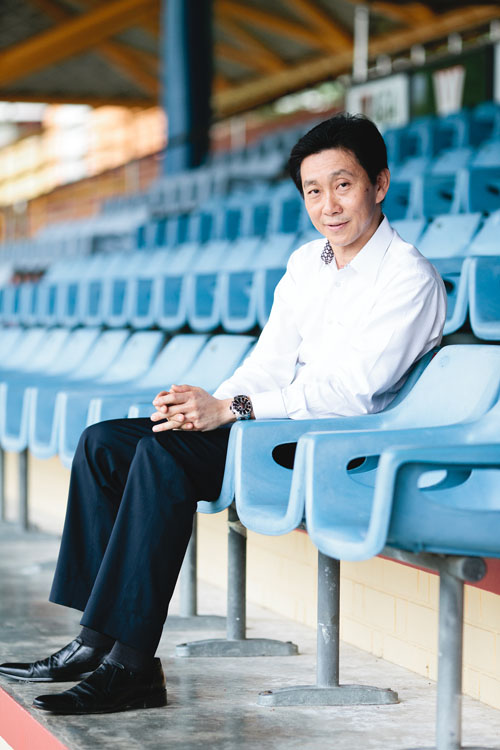
Bill Ng is building a community by making sure the bills are paid at his football club, Hougang United

Let’s get this out of the way: Bill Ng may have pulled out his bid for Scottish football giants Glasgow Rangers, but the businessman says he has not given up hope on buying it. The man, who has been making the news with a bid for the financially troubled club and suddenly dropping out of the race when he was the only contender left, says he is bidding his time to see how the club would respond to the latest developments.

Meanwhile, it is business as usual at Hougang United, the football club in Singapore that he took over as its chairman in the middle of 2009. Once perennial cellar-dwellers in the S-League for over a decade, the club’s fortunes have transformed since Bill took over. It is now a mid-table club that reached the Singapore League Cup final last year, and more than once during our interview, he declares Hougang will fight for top honours next season. Currently, the team is 8th out of 13 teams in the league.

The improved performance on the pitch has also been matched by what’s happening around it. Hougang United’s home is in Hougang Stadium, which sits inside a public housing estate. On most days, the stadium’s stands are empty while residents fill the tracks, jogging and walking to keep fit. This is reversed on match days, as residents turn up in orange and black, the club’s official colours, all ready to support their team, The Cheetahs.

Hougang’s residents didn’t always have a football team to rally around. When the stadium was set up in 1987, it was simply a sports facility for the neighbourhood. It was only two years after Singapore formed its own professional soccer league in 1996, the S-League, that a team was assigned to adopt Hougang as its home, Marine Castle United Football Club. Over the next decade, Hougang’s residents found little to cheer about for a club that struggled to climb out of the bottom of the league and changed its identity to Sengkang Marine then Sengkang Punggol Football Club.

By the time Bill took over as chairman in 2009, the club had a reported debt of $1.3 million dollars. But Bill had come in with a reputation of buying over another financially-troubled football club Tiong Bahru United and successfully bringing it from the third division of the nation’s semi-professional league to the first. Although, some were also wary of Bill’s of his motivations. “I came into football because I was influenced by the love my two sons have for the sport and I have to admit I’m not a football man,” he said during an interview with Singapore newspaper TODAY in December 2010. “When I came in, I didn’t even know what the offside rule was and my sons had to teach me.”

Throughout our interview, it was clear that Bill took up the job as yet another opportunity to successfully restructure another company — it’s what he does for a living in his private equity firm Financial Frontiers. He talks at length at how he has tried to get rid of excesses in the club and find new forms of revenue. To make sure the club would be self-sustaining, he also hired people whom not necessarily were football fans, but knew how to run it like a financial institution. At one point, he even throws out his sales pitch: “All businesses are good businesses. It only fails because of the human element.”

Despite speaking at length about finances, Bill says it is not enough to turnaround a club. Rather, Hougang United is enjoying a revival because it has gotten people involved in it. “Money is of course the necessary condition for running the club, but it doesn’t mean pumping in fresh money is sufficient, you need the people and the passion,” he says.

This he found in a batch of young players and a new coach, ex-national team footballer Aide Iskandar. As changes were made on the pitch, Bill also worked hard to reach out to the wider community. Last year, the club was rebranded Hougang United, giving the new owner an opportunity to start afresh. It also allowed the club to forge an identity with its stadium and its surrounding neighbourhood of the same name. The club also began working with the neighbouring town councils to promote the club’s matches to the residents, and the schedule of upcoming games started appearing on the lift lobbies of the nearby public housing estates. For its games, Hougang United also began inviting orphanages and nearby schools to attend their games to watch Hougang United play. This year, in June, the club is also holding its first-ever Junior Challenge Trophy soccer tournament for students under-10 and under-12, a way for the club to spot new talent and introduce itself to young children.

Perhaps the most significant outreach program for the club is establishing an official fan club, the “Hougang HOOLs” (Hougang Only One Love). It started as a grassroots initiative by friends of then coach Aide, but Hougang United soon recognised it as its official satellite organisation, giving it resources to organise events and promote the club. It is crucial to tap on the people’s passion to keep the resource-strapped club alive, says Bill. “We are only good at certain things. By giving these fans rewards and resources, they help to promote the club and they are the experts, helping us manage our websites,” he says. “Suddenly, all these guys are empowered over night.”

Over the last two seasons, the Hougang HOOLs have built up a noisy reputation, standing and singing throughout the game — a rare sight for a league that struggles to get supporters despite being a football-crazy city. Most Singaporeans would rather stay up late to watch their dose of European football games on television rather than turn up at their neighbourhood stadium to catch a live S-League game.

In a way, Bill wanted to acquire a European club so that he could bridge this disparity, and “fast forward” Hougang United and the Singapore footballing community to Western standards. He imagines exchanges of players and staff and even access to Rangers 5.5 million fans, slightly more than the population of Singapore. This dream of uniting communities of people via football all started with the now oft-heard story of how the man in his 50s fell in love with the game after watching Rangers win the 1972 European Cup Winners’ Cup. “It was really gorgeous, seeing the crowd cheer, the ‘wow’ factor really registered for years,” he says. “Football can bring people from all walks of life together, it’s a sports for the masses.”

At this point, Hougang United has yet to convince people in its community to fill even the 2,500 seater stadium during its matches. However, Bill is convinced all he needs is time. The original plan when he took over the club was to be an interim chairman to get it back in the black again, he reveals, but watching it grow and seeing the community’s response over his close to three years with it has convinced him to stay for the long-term. For a very brief moment during the interview, Bill shows a glimpse of how Hougang United means more than just a financial restructuring challenge to him. Now, he just needs to convince the rest of the community to united around his football club too.

———————————
A feature written for FIVEFOOTWAY magazine’s issue on PLAY

Singapore Artists Fight for ‘Old School’ Landmark

A tattered sticker on a lamppost greets visitors who have climbed up the 143 steps to the top of Singapore’s Mount Sophia with this question: “What is our culture?”

One answer may sit just beyond, at the former Methodist Girls’ School campus that now houses Old School, an art space that has been an important part of the city’s local art scene since it was established in 2007. But after four years, Old School is likely to become history. The government recently extended the lease of the space only until June, and the city’s master plan has designated the site for residential development, though no concrete building plans have been announced.

Read the rest at Wall Street Journal Scene Asia