When Microsoft stopped support for its Windows XP operating system in 2014, the corporation made an unusual tribute: to its desktop image.
For 13 years, the sight of green rolling hills and blue skies greeted new Windows XP users when they turned on their computers for the very first time. This default desktop image of Microsoft’s 2001 operating system was seen by so many millions of users that the corporation claimed it was the “one thing everybody will always remember of Windows XP.”
Regardless if it is a single color, an abstract pattern, or an actual photograph, all screen-based devices from computers to cell phones come pre-loaded with a default desktop image. Omnipresent, yet never the main presentation, these images in the background have gone beyond mere surfaces and become stages for technology companies to brand their devices instead.
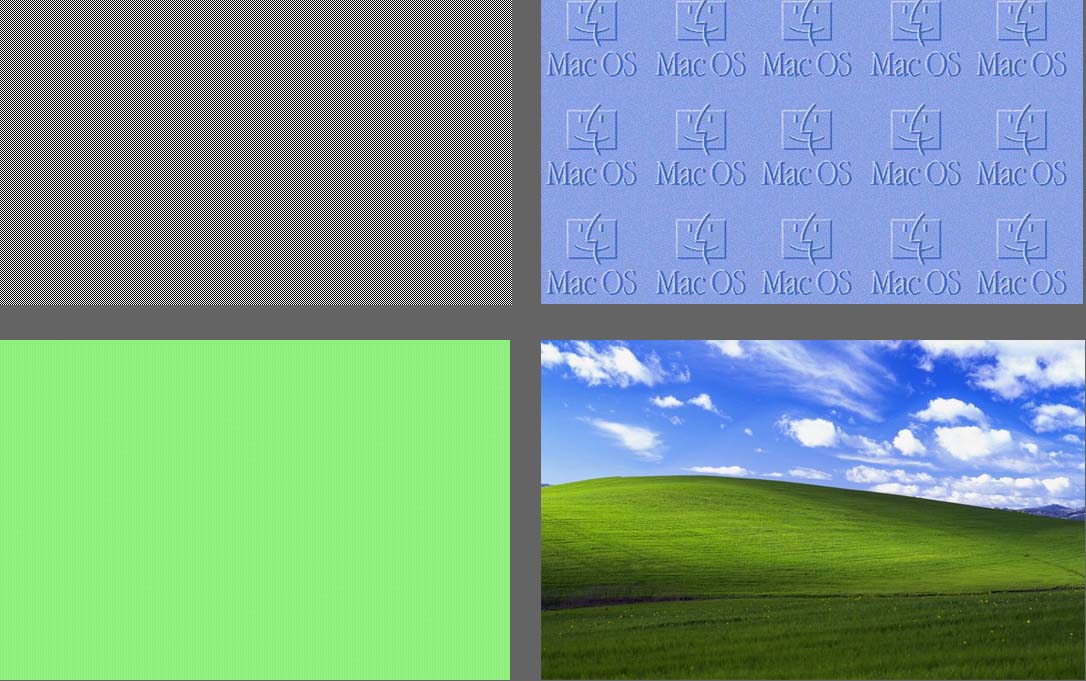
Early desktop images were limited by display technology, and the first versions of Microsoft Windows and Apple’s Macintosh operating systemin the 1980s featured solid colored backgrounds that were more functional than fun. Such unobtrusive imagery helped users fully immerse in the new worlds of graphic user interfaces by supporting what happened on them — just like desktops in real life.
The shift towards desktops as displays for branding arrived with Apple’s Mac OS 8 in 1997. The operating system’s default desktop image was a tiled pattern of a smiling Macintosh face — then the new icon of Apple’s software. This began the company’s tradition of branding every new version of its operating system with a unique desktop image.
Changing screens (Clockwise from left to right): Apple’s Mac OS 1 (1984), Apple’s Mac OS 8 (1997), Microsoft Windows (1985), and Microsoft Windows XP (2001).
In contrast, Windows users continued to be greeted by solid backgrounds throughout the 1990s, first in teal (Windows 95 and Windows 98) and then blue (Windows Millennium Edition). It was only in 2001 that Windows XP came bundled with photographer Charles O’Rear’s now iconic scenery shot in southern Sonoma County, north of San Francisco.
Yes, Microsoft’s desktop image is actually a real photo known as “Bliss” that the company paid O’Rear to bring it over himself because no courier service was willing to take liability of transporting such a highly valued package.
Calling such desktop images “default” belies the careful selection process undertaken. There seems to be a trend towards picking imagery of nature that will give a piece of technology a benign face. Apple went from blatant logotype patterns to abstract high-tech graphics, and more recently, photos of galaxies and stars. The default desktop picture for the newest Mac OS 10.9 is the photo of a wave, a homage to the software named after the Californian surf break “Mavericks.”
With the rise of a digital wave, our experience of technology is increasingly mediated through the virtual rather than the material world. When Apple and Samsung’s mobile devices look so similar to one another — essentially flat rectangular screens — it is what appears on them that matters. Default desktop pictures and lock screens become vital in setting the context for experiencing each brand’s device. While Apple favors documentary-style photos of nature that convey some kind of “authentic” truth, Samsung devices typically carry vibrant, colorful background patterns that hold the promise of endless creative possibilities.
While Apple’s iPhone 6 features the universe, Samsung’s Galaxy S5 showcases a more abstract graphic.
Our devices may come preloaded with desktop images, but we have the option to change them too. This simple act of personalization brings forth the background, reminding us that technology is full of “default designs” that guide users in how they experience the increasingly digital world we live in.
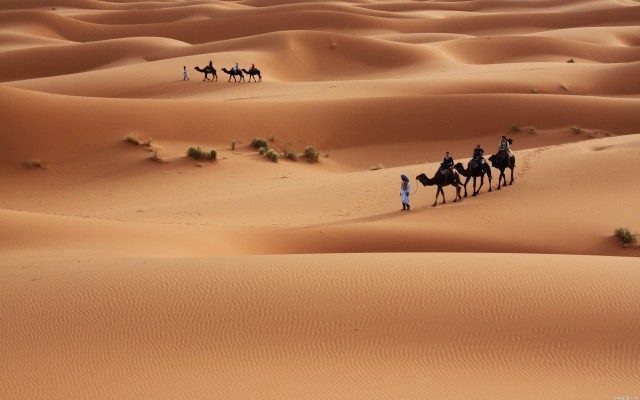
Picture waves of silky smooth sand and a herd of camels gracefully gliding through — this is the color “camel”.
It’s not a harsh sea of desert brown, but a sun-kissed hue that glistens before your eyes. Camel, you see, is not just a shade of brown, it’s exquisitely toned-down brown.
The color’s exotic nature parallels the animal it was named after. The camel has become visual shorthand for the faraway Arab Middle East. A desert looks bleak and placeless until a camel comes along. Suddenly, you’re looking at a setting for adventure and romance, à la a scene out of One Thousand and One Nights, more popularly known as Arabian Nights.
WALLPAPERICH.COM
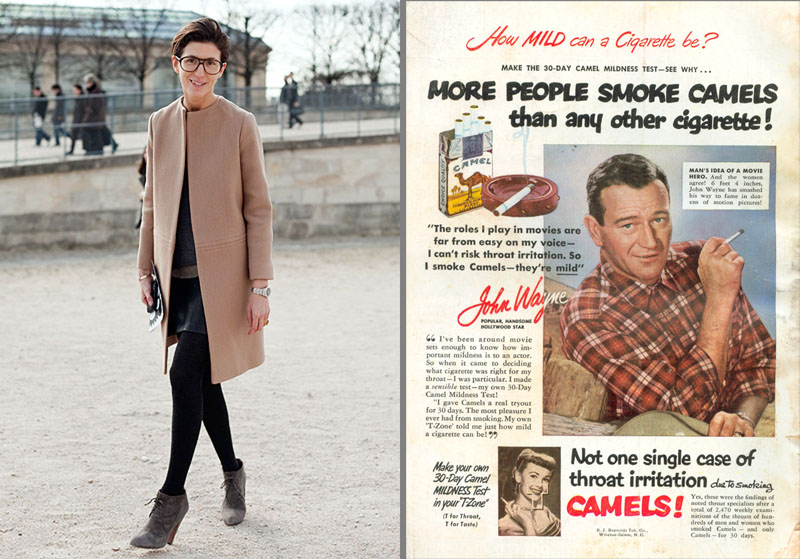
The color camel has that same power. Like how the once wild animal has since largely been domesticated, camel offers the beauty of the desert without a parched throat or having to break a sweat. What is more quintessential camel than the camel coat? Outlined by sleek cuts and nothing more, this piece of fashion lets the color speak for itself. On a chilly afternoon, a camel coat shimmers like the desert sand, providing not only a cloak of warmth but a mirage of elegance. It really doesn’t matter what you wear underneath — preferably something black — just throw on a camel coat and become an instant icon of sheikh. I meant, chic.
To wear camel is to adorn luxury. After all, camel hair is not the easiest fabric to come by as the animal has traditionally been prized as a means of transportation more than a vehicle for fashion. But the color turns out to be a great mover of class too. Not everything comes in camel — only dapper coats, posh bags, and the cigarettes favored by John Wayne. Even so, camel is never vulgar like gold or vermilion; the color is more sublime, probably closer to ash gray or nude. Like these neutral shades, the allure of camel is less in the color than in the lack of it. This is not a shade you can pick up in a box of crayons. People who wear the color know what camel is, and is not. For everyone else, it remains a pointless debate if it is simply light brown or dark beige.
THE FASHION PARTIZAN & POP HISTORY DIG
Somewhere between mud and skin is an imprecise way of describing camel, but it brings this color down to earth. What is the appeal of a shade that looks like dried earth when cannot be worn? Similar doubts have been shared about the animal, this creature with an elongated neck and a mountain permanently loaded on its back. The designer of the Mini car, Sir Alec Issigonis, once said, “A camel is a horse designed by a committee.” To most, both animal and color are strangely familiar things that nobody hates, but no one particularly loves either.
It is this bizarre and surrealistic quality that gives camel its color. It’s for people who love the fantasy of a desert, but will never truly survive it.
———– Written for Andrea Codrington Lippke’s Criticism Lab at D-Crit on a color.
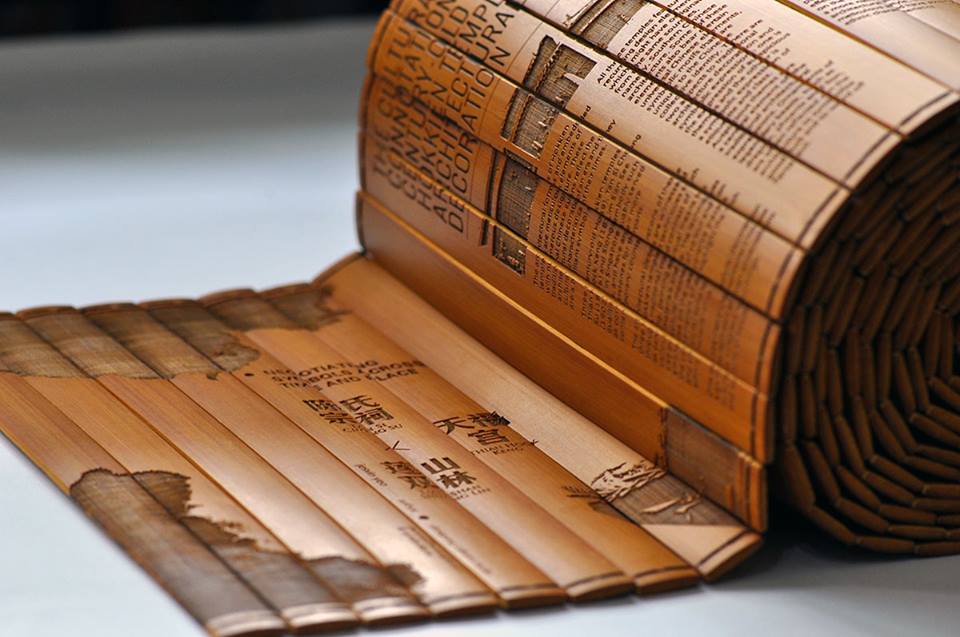
“Architectural Decoration: Negotiating Symbols Across Time and Place” examines the symbolic images of Hokkien architectural-style temples. | JESVIN YEO
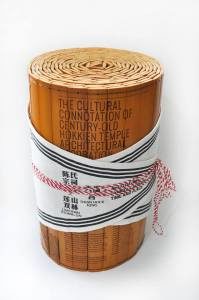
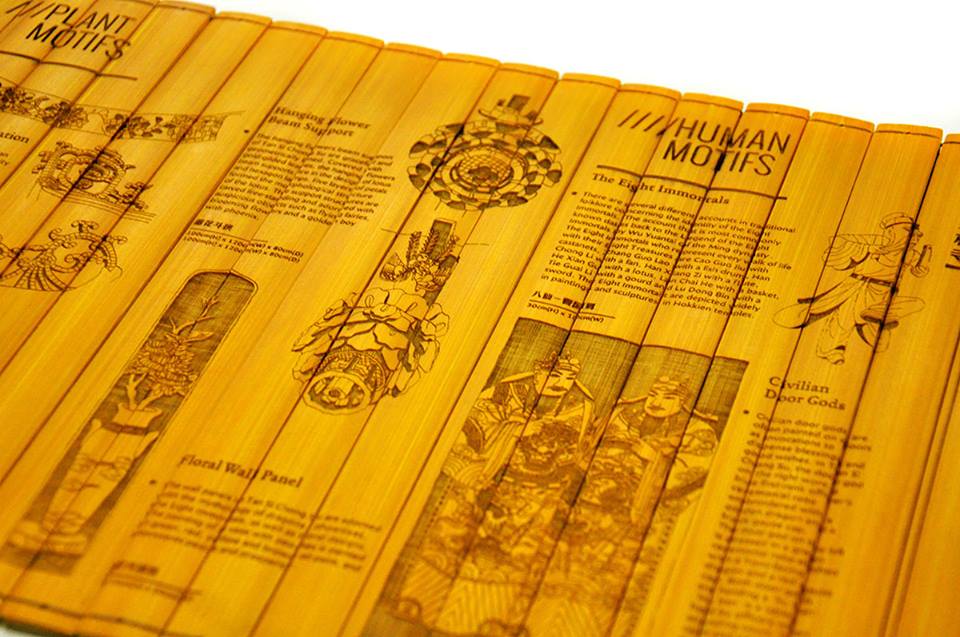
In the age of the e-book, this print publication offers a different take on “scrolling” through text. For her new book about the symbolic images of Hokkien architectural-style temples, designer Jesvin Yeo turned to ancient Chinese scrolls for design inspiration. Architectural Decoration: Negotiating Symbols Across Time and Place is a stunning 225 bamboo strips-long (4.35 meters) English publication examining the symbolic meaning of images found in three temples in Singapore built between the 18th and 19th century. Jesvin recently took us through her limited-edition publication (Only 40 were made and each selling at S$338) and her fascination with designing projects on Chinese culture.
How did this book project come about? The idea for this book derived from my experience of collecting data for my other published book, Choi! Touchwood!, which was in 2010. Through many visits to the oldest Chinese temple in Singapore, Thian Hock Keng, I discovered many unique and interesting symbolic images. When I researched further, it remained a mystery, and no one, not even the people who take care of the temple, could provide answers to the meaning behind some of these symbolic images. I decided to research and understand the meaning of these images through the lens of visual communication. Moreover, I am a Hokkien, therefore it is important for me to understand my own culture and roots. Especially, how my ancestors designed these symbolic images more than 1,000 years ago.
This book recently won a 2014 Red Dot Award in communication design. | JESVIN YEO
Why do a bamboo scroll book? This book is deliberately made in the format of a traditional bamboo scroll to:
1) Indicate the importance of these cultural images as bamboo scrolls were used to record the chronicles of ancient China.
2) Enhance the value of these cultural images as they display our ancestor’s expectations and pursuits of beautiful things. As the bamboo scroll allows for the depiction of a continuous narrative, the viewing is a progression through time and space.
3) Let our younger generation have a chance to read a bamboo scroll book — how fascinating!
What were some of the challenges in designing this book? I worked with a research team on this project with support from Nanyang Technological University and the Ministry of Education. The main members are Wong Wei Loong and Charissa Ho Jia En, with the help of others like Kent Neo and Kenneth Lim Zhi Wei. I start the project in February 2011 and we took over two years to take the photos, to archive and analyze, and to research on the meanings behind these symbols. The illustration, designing, and refinement took another year or so.
The main challenges in creating this book were:
1) Taking photos of the temples: some caretakers of the temples preferred us to send an email request before we shot and we were not allowed to set-up any equipment when photographing symbols on the roofs or ceilings. Of course, I totally understand this need for restrictions as these temples are Singapore monuments.
2) Researching on the meaning and mythology behind the symbolic images. I could not found any English books on the symbols of the temple then. Therefore I gathered information from Chinese references books and compared them with English articles written by scholars, especially on the name of the symbols and techniques used. At the end of 2011, I also went to Taiwan to interview caretakers of Hokkien-style temples too.
3) Illustrating the images: we hand-drew more than 150 illustrations of the symbols, and our eyes were seeing stars after a few images as they are very fine and detailed. Charissa started the first round and I continued from there and also refined all of them on computer later. It took us about eight months to finish.
Many of the images in this book were hand-drawn by Jesvin and her team | JESVIN YEO
How did you convince the client to commission such an unconventional book?
This is not the first time I have proposed an unconventional book form toBasheer Graphic Books. They also commissioned my other book, Choi! Touchwood!, which is made up of four parts and costs a lot to produce. LuckilyChoi! Touchwood! was well liked by readers, so Basheer was confident in what I could produce.
Was it difficult to find someone to manufacture this book? I checked with a couple of printers in Singapore and they were unable to produce the book as the bamboo material was a major issue. Moreover, their laser machines cannot achieve the details that I wanted. In the end, we had it produced in China by Neo Brands. But the Chinese printer did complain that the book was too time consuming as it involves hand work to tie the more than 200 bamboo strips to form one book and laser engraving is also done manually. They experimented with more than 10 different threads to find the right one to hold the weight of the scroll. Each book took about five days to complete.
You’ve designed several projects related to Chinese culture. Can you talk about your personal fascination with this subject? As a Chinese Singaporean, I am always very interested in symbol, totems and the visual culture of Singapore. I remember those fascinating stamp designs on the back of my T-shirts printed by Taoist mediums during my childhood. Studying and working in London allowed me to further realise and understand the value of one’s cultures and heritage. After returning from London, I came across a statement by Singapore’s founding leader, Mr Lee Kuan Yew, who said that the digital age was making it impossible to evolve a Singaporean culture even in a few hundred years. I decided to explore this statement through experiments in design and cultures.
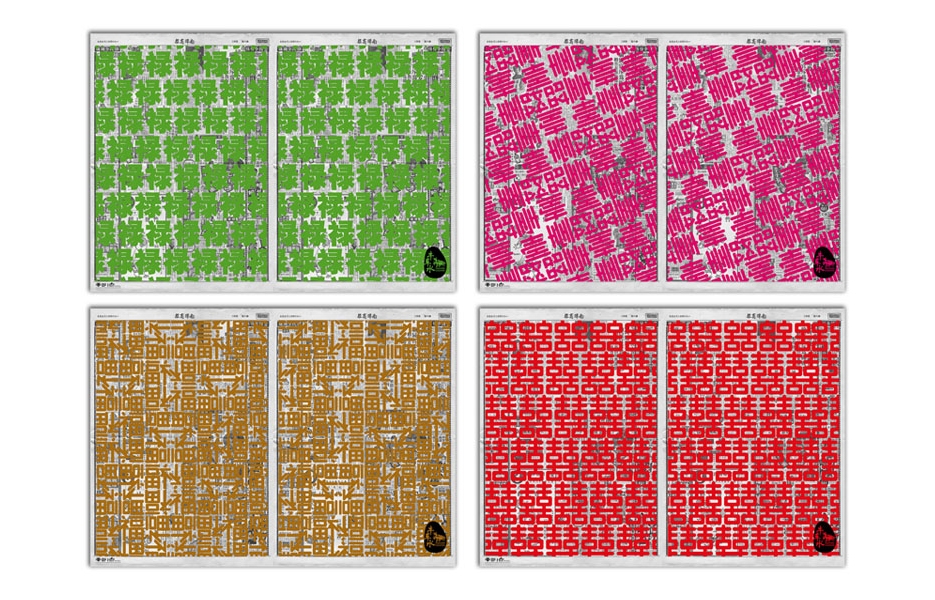
A set of wrapping paper designed by Jesvin which uses typographic elements from Singapore newspapers in the 1950s. | JESVIN YEO
It’s interesting that this book about Chinese culture is in English. Can you talk about navigating between two cultures as a designer? As a Gen X, I understand both English and Chinese. Therefore, it is not too difficult to navigate between these two cultures.
The book is in English because one of my aims in doing cultural projects is to bring as much knowledge and value of our cultures to the younger generations. And we know that our younger generation prefers English and they are not really interested in print. Therefore, my projects have to be in English, easy to digest, unconventional and visually appealing to stimulate interest their interest.
A lot of your work is also about bridging modernity and tradition. How do you approach such work as a designer without falling into stereotypes and cliches? A good and difficult question. I am not too sure whether my work are stereotypes and clichés. I just know that I am interested in the dialogue between tradition and contemporary, old and new. Although I work with tradition elements, I create my content with our younger generation in mind. I believe that tradition and culture are symbols of thought and it is important to pass them down. Hopefully our young people can continue to preserve it. Moreover, I feel that a product is made up by a combination of effort from many people, so it has to scream and not just sit subtly.