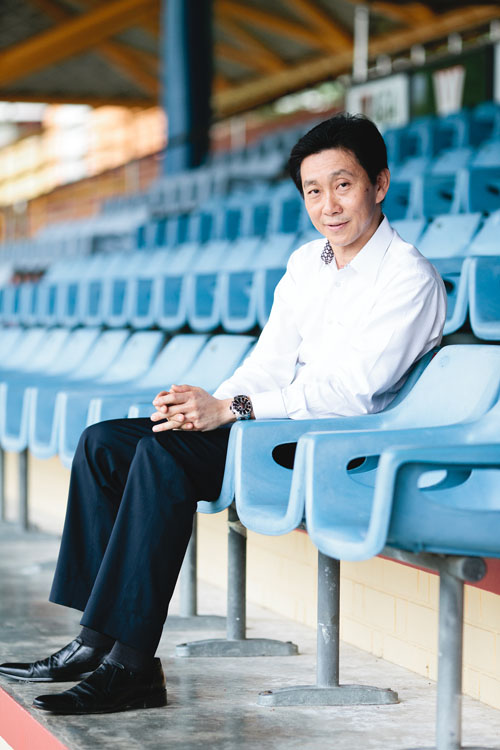
Bill Ng is building a community by making sure the bills are paid at his football club, Hougang United
Let’s get this out of the way: Bill Ng may have pulled out his bid for Scottish football giants Glasgow Rangers, but the businessman says he has not given up hope on buying it. The man, who has been making the news with a bid for the financially troubled club and suddenly dropping out of the race when he was the only contender left, says he is bidding his time to see how the club would respond to the latest developments.
Meanwhile, it is business as usual at Hougang United, the football club in Singapore that he took over as its chairman in the middle of 2009. Once perennial cellar-dwellers in the S-League for over a decade, the club’s fortunes have transformed since Bill took over. It is now a mid-table club that reached the Singapore League Cup final last year, and more than once during our interview, he declares Hougang will fight for top honours next season. Currently, the team is 8th out of 13 teams in the league.
The improved performance on the pitch has also been matched by what’s happening around it. Hougang United’s home is in Hougang Stadium, which sits inside a public housing estate. On most days, the stadium’s stands are empty while residents fill the tracks, jogging and walking to keep fit. This is reversed on match days, as residents turn up in orange and black, the club’s official colours, all ready to support their team, The Cheetahs.
Hougang’s residents didn’t always have a football team to rally around. When the stadium was set up in 1987, it was simply a sports facility for the neighbourhood. It was only two years after Singapore formed its own professional soccer league in 1996, the S-League, that a team was assigned to adopt Hougang as its home, Marine Castle United Football Club. Over the next decade, Hougang’s residents found little to cheer about for a club that struggled to climb out of the bottom of the league and changed its identity to Sengkang Marine then Sengkang Punggol Football Club.
By the time Bill took over as chairman in 2009, the club had a reported debt of $1.3 million dollars. But Bill had come in with a reputation of buying over another financially-troubled football club Tiong Bahru United and successfully bringing it from the third division of the nation’s semi-professional league to the first. Although, some were also wary of Bill’s of his motivations. “I came into football because I was influenced by the love my two sons have for the sport and I have to admit I’m not a football man,” he said during an interview with Singapore newspaper TODAY in December 2010. “When I came in, I didn’t even know what the offside rule was and my sons had to teach me.”
Throughout our interview, it was clear that Bill took up the job as yet another opportunity to successfully restructure another company — it’s what he does for a living in his private equity firm Financial Frontiers. He talks at length at how he has tried to get rid of excesses in the club and find new forms of revenue. To make sure the club would be self-sustaining, he also hired people whom not necessarily were football fans, but knew how to run it like a financial institution. At one point, he even throws out his sales pitch: “All businesses are good businesses. It only fails because of the human element.”
Despite speaking at length about finances, Bill says it is not enough to turnaround a club. Rather, Hougang United is enjoying a revival because it has gotten people involved in it. “Money is of course the necessary condition for running the club, but it doesn’t mean pumping in fresh money is sufficient, you need the people and the passion,” he says.
This he found in a batch of young players and a new coach, ex-national team footballer Aide Iskandar. As changes were made on the pitch, Bill also worked hard to reach out to the wider community. Last year, the club was rebranded Hougang United, giving the new owner an opportunity to start afresh. It also allowed the club to forge an identity with its stadium and its surrounding neighbourhood of the same name. The club also began working with the neighbouring town councils to promote the club’s matches to the residents, and the schedule of upcoming games started appearing on the lift lobbies of the nearby public housing estates. For its games, Hougang United also began inviting orphanages and nearby schools to attend their games to watch Hougang United play. This year, in June, the club is also holding its first-ever Junior Challenge Trophy soccer tournament for students under-10 and under-12, a way for the club to spot new talent and introduce itself to young children.
Perhaps the most significant outreach program for the club is establishing an official fan club, the “Hougang HOOLs” (Hougang Only One Love). It started as a grassroots initiative by friends of then coach Aide, but Hougang United soon recognised it as its official satellite organisation, giving it resources to organise events and promote the club. It is crucial to tap on the people’s passion to keep the resource-strapped club alive, says Bill. “We are only good at certain things. By giving these fans rewards and resources, they help to promote the club and they are the experts, helping us manage our websites,” he says. “Suddenly, all these guys are empowered over night.”
Over the last two seasons, the Hougang HOOLs have built up a noisy reputation, standing and singing throughout the game — a rare sight for a league that struggles to get supporters despite being a football-crazy city. Most Singaporeans would rather stay up late to watch their dose of European football games on television rather than turn up at their neighbourhood stadium to catch a live S-League game.
In a way, Bill wanted to acquire a European club so that he could bridge this disparity, and “fast forward” Hougang United and the Singapore footballing community to Western standards. He imagines exchanges of players and staff and even access to Rangers 5.5 million fans, slightly more than the population of Singapore. This dream of uniting communities of people via football all started with the now oft-heard story of how the man in his 50s fell in love with the game after watching Rangers win the 1972 European Cup Winners’ Cup. “It was really gorgeous, seeing the crowd cheer, the ‘wow’ factor really registered for years,” he says. “Football can bring people from all walks of life together, it’s a sports for the masses.”
At this point, Hougang United has yet to convince people in its community to fill even the 2,500 seater stadium during its matches. However, Bill is convinced all he needs is time. The original plan when he took over the club was to be an interim chairman to get it back in the black again, he reveals, but watching it grow and seeing the community’s response over his close to three years with it has convinced him to stay for the long-term. For a very brief moment during the interview, Bill shows a glimpse of how Hougang United means more than just a financial restructuring challenge to him. Now, he just needs to convince the rest of the community to united around his football club too.
———————————
A feature written for FIVEFOOTWAY magazine’s issue on PLAY