Category: Design

Singapore Design: We Are What We Eat

Where else should Singapore designers look for inspiration but in the nation’s favourite past time of eating? This is the theme of “Makan Time! Tuck into Good Design”, the latest exhibition put up by the Little Thoughts Group, a collective that explores local culture through design.

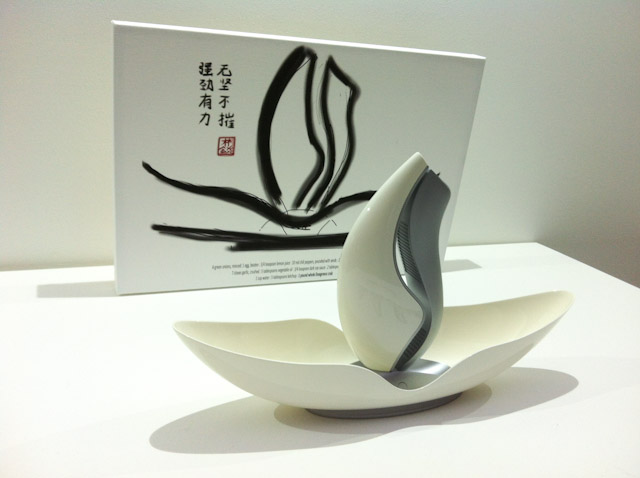
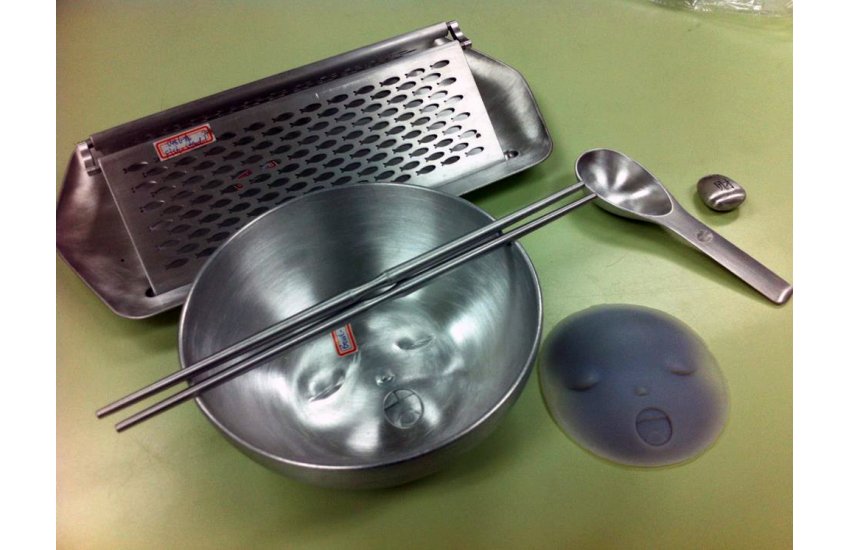
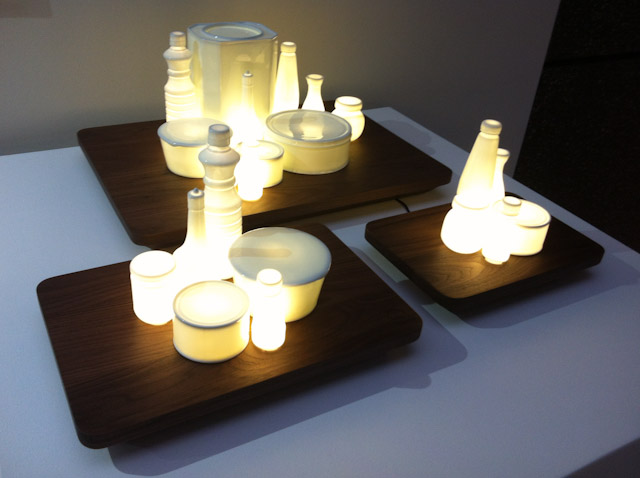
The group of 18 designers, many who work in multinational companies including Dell and Hewlett Packard, each spent their own time and money to create and exhibit a design prototype inspired by Singapore’s food culture and heritage. The resulting collection is a variety of cutlery that highlight local practices, products that appropriate the imagery of everyday food, and objects that re-interpret how and what Singaporeans eat.
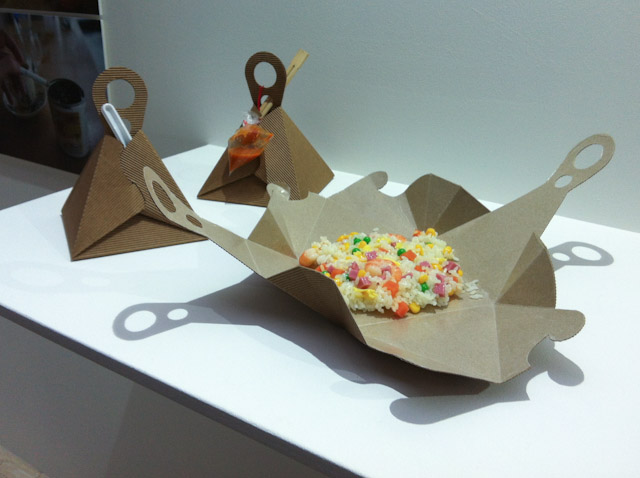


One of the most thoughtful pieces was Chan Wai Lim’s set of cutlery that embody traditional Chinese eating practices (right). To get around the problem of flipping a fish to eat the other side, which is seen as symbolic of a boat being capsized or simply bad luck, Wai Lim created a stand that holds it such that one can eat it from both sides at the same time (background). Another design by the recent winner of the President’s Design Award 2012 for her work on a Dell computer, illustrates the myth that one must  finish every morsel of their food on their plate lest their future partner turns out ugly by putting a face at the bottom of a bowl.

“Makan Time” is the group’s third initiative to come up with Singapore design products since they first got together in 2009. While their first exhibition was inspired by their personal stories, they followed up in 2010 with a design collection based on their memories of Singapore. This current exhibition, after a two year hiatus, is on at the National Museum of Singapore until 27 January.

The marriage of Singapore’s rich food culture with its design scene has been one recurring trend in recent years. One of the earliest compilations was “Shiok! A Gastronomy of Singapore Design” in 2010, which put together the creations of several designers to present the country’s food culture at the inaugural Asia Design Conference organised by the centre of creative communication (CCC), in Shizuoka City, Japan. For years now, there have also been groups such as Triggerhappy, FARM and wheniwasfour that have designed various products related to Singapore’s food culture.

Like the work by the Little Thoughts Group over the years, “Makan Time” is distinct for a functional collection that probably reflects the industrial design backgrounds of its creators. This is unlike other existing food-inspired designs in Singapore that are generally more whimsical, such as re-approprating familiar food items to turn into objects of other uses.

However,  “Makan Time” does reflect the increasing use of narratives to define what is Singapore design, instead of searching for it in a unique form. As I have outlined in “Got Singapore Design?” in The Design Society Journal No. 05, many of such works in recent times look like they can be from anywhere in the world, but seen in the eyes of those familiar with Singapore culture, they take on a different meaning altogether.

Finally, if you are keen to hear from the designers themselves, do check out their forum this weekend, 19 January!
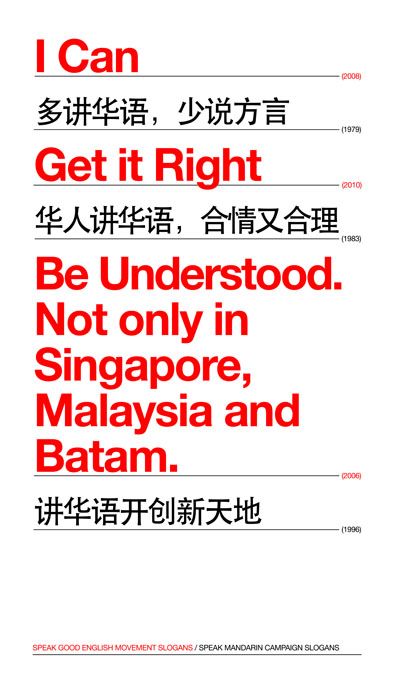
Campaign City – National Language Class

National campaigns —  against littering and breeding mosquitoes or encouraging the speaking of  good english and to have more babies — are part and parcel of everyday life in Singapore. A new exhibition, “Campaign City: Life In Posters”, celebrates this aspect of the country’s heritage by inviting 50 individuals from its creative community to design posters based on their personal memories of various campaigns. The works are currently being exhibited at the Lee Kong Chian Reference Library, on Level 11 of the National Library Building, until 3 July together with a historical survey from the library’s poster archives.

I was fortunate enough to have been invited to contribute a work for this event organised by The National Library of Singapore, in partnership with Salon Projects. Since I was a writer, I figured my best bet would to be create “word art”:

Print

Here’s what this “pledge”, made up of a mish-mash of campaign slogans over the years, meant to me:

As a writer, language is how I define my world. Growing up as a student under Singapore’s two language campaigns — first the Speak Mandarin Campaign, then the Speak Good English Movement — I always felt caught in-between.

The Chinese language was suppose to root me to my ethnic culture, but it was alien to my English-speaking family and my elders who spoke Cantonese, Teochew or Hainanese. When I discovered Singlish connected me with my family and friends in Singapore, I was told to speak English to plug in to the world outside.

Made to grow new roots and taught to cater to strangers outside of home, what have I become? A successful hybrid Singaporean or a failed translation of our bilingual policy?

As the campaign slogans over the years reveal, language for a Singaporean is so we can speak to everyone outside of this city, but never amongst, nor for, ourselves.


Highlights of Singapore Design in 2012

Here are my five trends of the Singapore design scene last year, which I think could possibly impact what we see in 2013.

1. The continuing rise of craft and Singapore designs
From coffee to bags, homeware to letterpress and even haircuts, these are just some examples of what young Singaporeans are getting their hands into nowadays. The interest in craft and the Do-It-Yourself culture started before 2012, but last year we saw many of such initiatives blossom and even more new ones join in the fray. This has since hti critical mass in the form of “Handmade Movement“, a fair for independent craftsmen and women that will be held in Singapore in January this year.

With more Singaporeans crafting a career, means more designs and products inspired by this city, as witnessed in the growing collection of Singapore design products — so don’t be surprised if we see our own MUJI or G.O.D soon.

2. Singapore design is entering mainstream
My confidence that Singapore might one day see a ‘national’ design label  is fueled by the growing awareness of the business of design here. Supporting our local designers is an emerging network of shops, online stores, flea markets, and even neighbourhoods such as Tiong Bahru, that sell Singapore design products as part of an assortment of lifestyle goods ‘curated’ from all around the world.

One interesting Singapore retail project is Outeredit, which not only sells designed T-shirts, but the creation process too. For each collection, customers are introduced to the designers, get to see them cross-collaborate, and finally vote for the designs to be printed.

Such avenues are exposing and defining local design to the Singaporean consumer, and if they grow and take off, that can only mean the same for Singapore design too.

3. ‘Designer’ cafés and restaurants
Who hasn’t visited or at least heard of one of these ‘designer’ cafes and restaurants that have sprouted up across the island? This has to be one project type that will define portfolios of the 2000s of Singapore design studios when we look back one day. While they all serve all-day breakfast, artisan coffee and indie magazines (ranging from just one to all three), one is amazed at how many different ways designers have come up with to brand and package their interiors! They have certainly introduced the dimension of design to the dining experience for Singaporeans, but as William Chan of TMRRW and PHUNK fame tweeted last year: “Nice to know that cafes here are paying proper designers for interior & branding. now they just need to hire proper chefs to do the cooking.”

Remember bubble tea and ice-cream parlours? I think this trend will go bust this year and we’ll be left with only those have the best design taste.

4. More Documentation of Singapore Design
With publishers turning their sights to Asia for new revenue streams, Singapore’s design scene has started receiving attention too.  The architecture scene here, in particular, has seen the most activity. Pesaro Publishing this year published a guide to 21st Century Singapore Architecture, and is working on books for WOHA (its third), K2LD and Cicada Designs. Some design firms have even went into self-publishing, such as DP Architects, and Ong & Ong’s Three Sixty Review.

Graphic designers here also got into the act too. The Design Society published a book detailing the historical evolution of the scene (which I authored), and the studio Hjgher published Creative Cultures, a directory of 100 individuals and groups from Singapore’s creative scene. There’s also a growing buzz between the nexus of graphic design and publishing with Epigram and Studio Kaledio coming up with books that have given the Singapore literary scene a much more exciting face. Finally, if the rumour mills are to be trusted, we are looking forward to books in 2013 about d.lab, and the Singapore Institute of Architects, who celebrate their 50th anniversary in 2013.

Publications are important materials that represent a design scene. They provide potential clients a glimpse into the work of studios; researchers a documentation of the work of designers here, and fellow designers a reflection of the scene they are in.

5. International recognition of Singapore Design
From the Design & Advertising Direction (D&AD) to the SaloneSatellite, and the World Architecture Festival, Singapore designers received many accolades and awards this year. While we did not show  at the Venice Architecture Biennale, Singapore design still travelled overseas with Thesus Chan holding an exhibition for the latest issue of his two-decades old WERK magazine in Japan’s Ginza Graphic Gallery, and Hjgher’s Creative Cultures featuring  as part of DesignTide Tokyo. This year, I hear there will be a Singapore pavilion at the SaloneSatellite for the first time — we have indeed grown.

At home, it was relatively quieter last year. Even though we held the World Architecture Festival and 100% Design Singapore for the first time, these were trade shows that confined themselves to the scene. What was missing were public-centric design programmes, with the only two major on-going events being the annual ArchiFest and President’s Design Award exhibition. The Singapore Design Festival did not make a return in 2012, but at the end of this year we will see the launch of the National Design Centre. Hopefully, that will be more than just a business hub for design.