Category: History

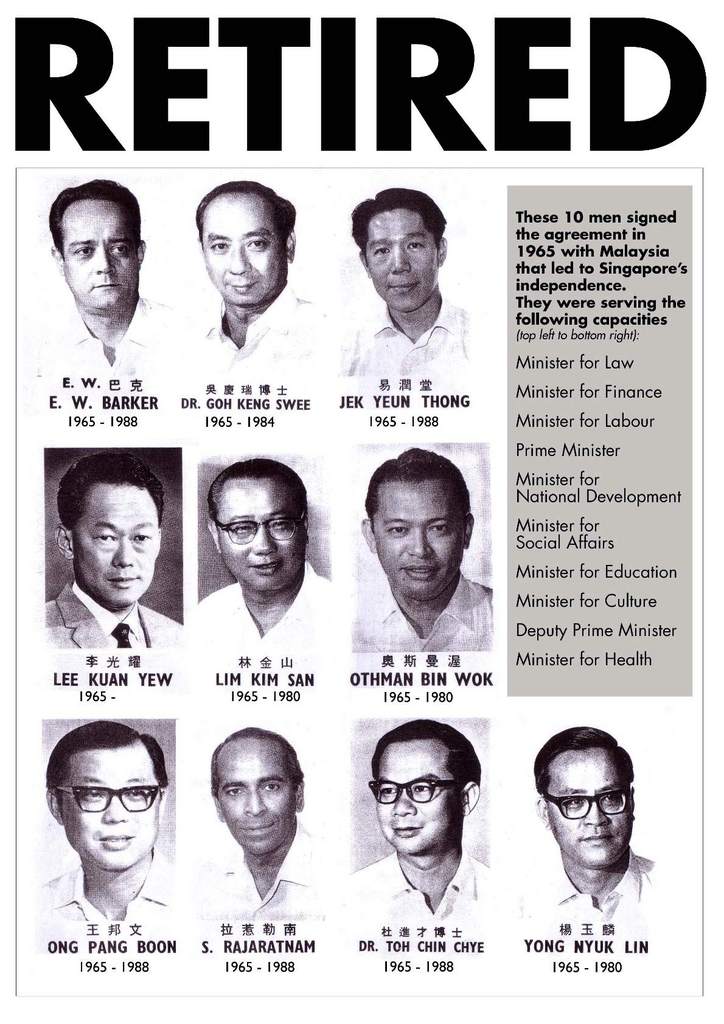
Singapore on A4 #1 – RETIRED

Retired

This is an on-going project where I attempt to question the cultural, historical and social building blocks of Singapore on pieces of A4 through works that based on facts but expressed via imagination. They are available on PDF for anyone to download and distribute.

With this first piece I wanted to highlight the fact that Singapore has more than one founding father and that they have all retired except one. I hope by putting a face to the names, Singaporeans can start remembering that the Singapore story is more than just about one man’s struggle.

The Fabrication of History

Don’t believe everything you see.

What is history?

It connotes some kind of “official” account of a past that is often seen as “the truth” because it has been verified by historians who practice certain methods that help to determine its validity.

This is probably the single defining factor that distinguishes “history” from two other accounts of the past — “memories” and “myths”. The former suggests a past that is much more personal and anecdotal, often presented without the rigour of verification associated with history. “Myths”, while also usually anecdotal is additionally tinted with a layer of incredulity that suggests it was failed history.

Accounts of the past can be broken down into an objective component and another that involves interpretation. What is often regarded as objective would be artifacts or information that can be verified. However it is the issue of interpretation that is often forgotten but is a thread that runs through all the three types of accounts. For every primary document or artifact, its use and significance can be interpreted in a multitude of ways. So the whole process of becoming history is left to “official” people such as historians who employ “objective” methods to define “history”.

In this sense, “history” is really fabricated by who writes it, and that being the case, “history” as the holy grail of “truth” diminishes in significance. Moreover, “memories” and “myths” often do not make it as “history” not because they are not true, but because the nature ofbeing history is the need for tangible evidence that may no longer exist today.

Thus, a much more holistic understanding of our past is to accept history, myths and memories as a package rather than choosing one over the other. It is also what might make the past more relevant and interesting to us all.
Memory markers and objects

On what do you inscribe your memory on?

I have a friend who remembers places she has been by marking them to a song. So we would be listening to radio and she would suddenly say: “This song reminds me of a time when I was at… ”

That made me think about the objects and things around me and what triggered memories for me. I think it has got to be spaces. I associate a huge part of my memories with spaces thus I like to stick to a certain route to avoid places because of bad memories I have had. Sometimes, I do end up in the places I try to avoid and actually re-inscribe it with new memories.

Besides spaces, certain objects or colours also serve as memory markers for me. That probably explains why I am cluttered with so many things because I hang on to a lot of memories such that what my brain can no longer store I re-inscribe it to the things around me. It’s my brain’s way of data management.

I suppose the beauty of things, or what I am really amazed at, is how memories give life to dead objects. What it also means, is an object besides what it is socially defined as is also empty and its meaning is there for us to fill up with our own interpretations. So a nail clipper is what we define as it is socially but also to each and everyone of us, the nail clipper holds some other meaning too.

Ahhh… I hope you see the light.