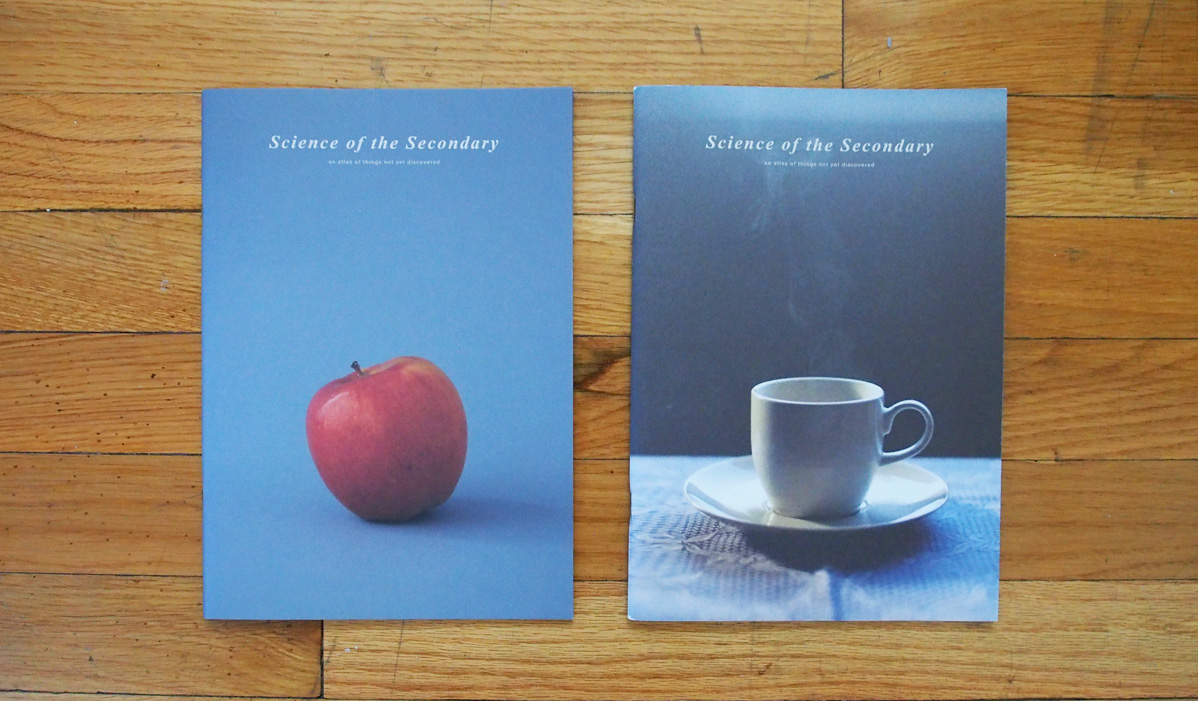
Launched in October 2013, “Science of the Secondary” promises to map an “atlas of things not yet discovered.” | ATELIER HOKO
Many of us experience the world primarily through our eyes. We are quick to make judgements based on how things look, while considering how they work is of secondary importance. It’s as if we can only see when we actually have four other senses: smell, hearing, taste, and touch.
“Science of the Secondary” is an on-going series of bi-annual booklets by design studio Atelier HOKO. The series aims to expand our narrow view of the world through a close examination of the everyday things that surround us. As if by teaching us how to read a new language, the first issue begins with the apple, taking the reader step-by-step through the seemingly mundane experience of eating this fruit. The Singapore-based studio (led by Alvin Ho and Clara Koh) draws out a series of unexpected insights that makes you chomp through the 44-page booklet in one sitting.
What is the role of each finger when holding an apple? Does the sound of crunching into an apple affect its taste? Why do we unconsciously bite into an apple in sequence? HOKO considers these questions and gives its answers by way of beautiful photography, illustrations, and short captions bound together in a handy comics-sized publication.
In May of this year, the duo released the second issue that looked at the cup and questioned the act of drinking. Alvin sums it up nicely in the introductory page:
“…but what does it mean to drink? Do we drink with our skin when the hands are hugging the cup? Are we drinking with our body posture while sipping earl grey in a team room? Are the ears drinking as we take each sip of the coffee? Can we consider the act of licking one’s lips drinking? Does the nose know that it is drinking as it hovers above the caramelised milk froth sitting atop a very large cup of coffee…?”
Although it may sound esoteric, Science of the Secondary’s content is meant to keep the general reader intrigued with plain, short captions, and by borrowing the visual language of science publications. Informative diagrams and photographic sequences give the duo’s observations and thoughts the weight of scientific objectivity.
More than just lessons about objects, one comes out of reading this series with a more mindful view of the world. Try closing your eyes for a moment to “see” — that’s how much more there is to the world than what lies in front of our eyes.
———– Written for Elizabeth Spiers and Chappell Elison’s Online Publishing class at D-Crit.
“Architectural Decoration: Negotiating Symbols Across Time and Place” examines the symbolic images of Hokkien architectural-style temples. | JESVIN YEO
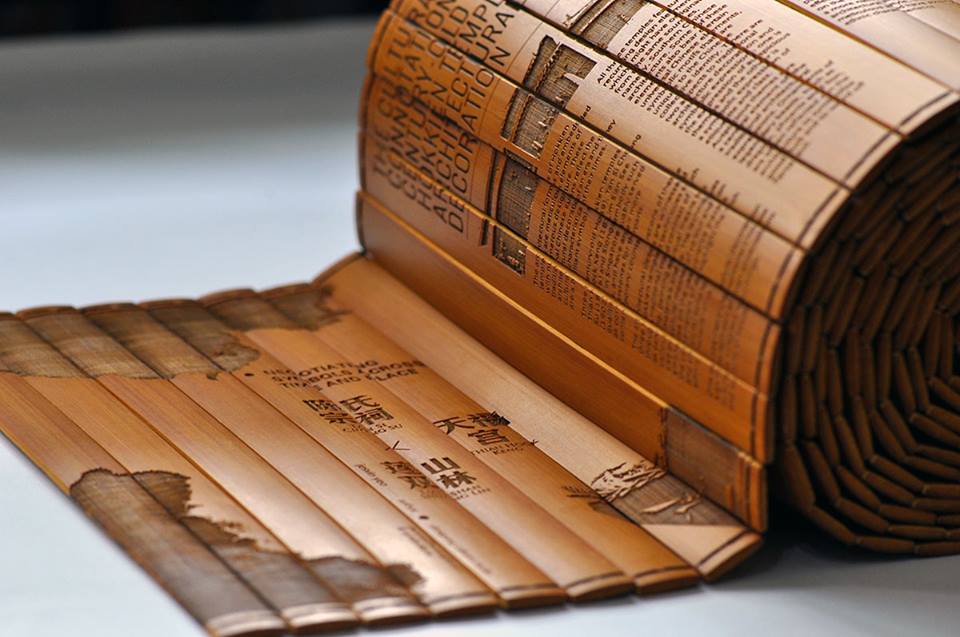
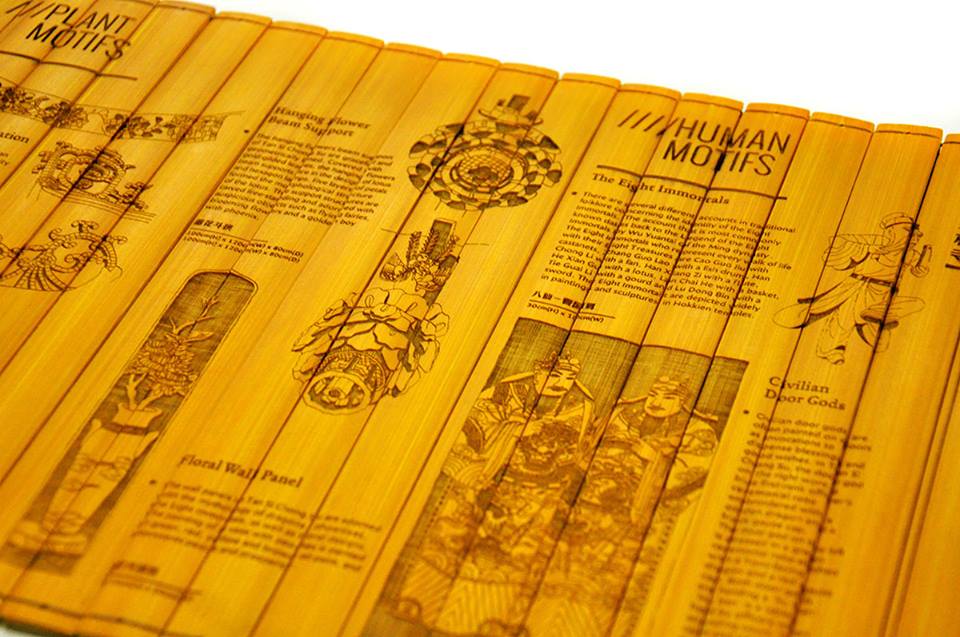
In the age of the e-book, this print publication offers a different take on “scrolling” through text. For her new book about the symbolic images of Hokkien architectural-style temples, designer Jesvin Yeo turned to ancient Chinese scrolls for design inspiration. Architectural Decoration: Negotiating Symbols Across Time and Place is a stunning 225 bamboo strips-long (4.35 meters) English publication examining the symbolic meaning of images found in three temples in Singapore built between the 18th and 19th century. Jesvin recently took us through her limited-edition publication (Only 40 were made and each selling at S$338) and her fascination with designing projects on Chinese culture.
How did this book project come about? The idea for this book derived from my experience of collecting data for my other published book, Choi! Touchwood!, which was in 2010. Through many visits to the oldest Chinese temple in Singapore, Thian Hock Keng, I discovered many unique and interesting symbolic images. When I researched further, it remained a mystery, and no one, not even the people who take care of the temple, could provide answers to the meaning behind some of these symbolic images. I decided to research and understand the meaning of these images through the lens of visual communication. Moreover, I am a Hokkien, therefore it is important for me to understand my own culture and roots. Especially, how my ancestors designed these symbolic images more than 1,000 years ago.
This book recently won a 2014 Red Dot Award in communication design. | JESVIN YEO
Why do a bamboo scroll book? This book is deliberately made in the format of a traditional bamboo scroll to:
1) Indicate the importance of these cultural images as bamboo scrolls were used to record the chronicles of ancient China.
2) Enhance the value of these cultural images as they display our ancestor’s expectations and pursuits of beautiful things. As the bamboo scroll allows for the depiction of a continuous narrative, the viewing is a progression through time and space.
3) Let our younger generation have a chance to read a bamboo scroll book — how fascinating!
What were some of the challenges in designing this book? I worked with a research team on this project with support from Nanyang Technological University and the Ministry of Education. The main members are Wong Wei Loong and Charissa Ho Jia En, with the help of others like Kent Neo and Kenneth Lim Zhi Wei. I start the project in February 2011 and we took over two years to take the photos, to archive and analyze, and to research on the meanings behind these symbols. The illustration, designing, and refinement took another year or so.
The main challenges in creating this book were:
1) Taking photos of the temples: some caretakers of the temples preferred us to send an email request before we shot and we were not allowed to set-up any equipment when photographing symbols on the roofs or ceilings. Of course, I totally understand this need for restrictions as these temples are Singapore monuments.
2) Researching on the meaning and mythology behind the symbolic images. I could not found any English books on the symbols of the temple then. Therefore I gathered information from Chinese references books and compared them with English articles written by scholars, especially on the name of the symbols and techniques used. At the end of 2011, I also went to Taiwan to interview caretakers of Hokkien-style temples too.
3) Illustrating the images: we hand-drew more than 150 illustrations of the symbols, and our eyes were seeing stars after a few images as they are very fine and detailed. Charissa started the first round and I continued from there and also refined all of them on computer later. It took us about eight months to finish.
Many of the images in this book were hand-drawn by Jesvin and her team | JESVIN YEO
How did you convince the client to commission such an unconventional book?
This is not the first time I have proposed an unconventional book form toBasheer Graphic Books. They also commissioned my other book, Choi! Touchwood!, which is made up of four parts and costs a lot to produce. LuckilyChoi! Touchwood! was well liked by readers, so Basheer was confident in what I could produce.
Was it difficult to find someone to manufacture this book? I checked with a couple of printers in Singapore and they were unable to produce the book as the bamboo material was a major issue. Moreover, their laser machines cannot achieve the details that I wanted. In the end, we had it produced in China by Neo Brands. But the Chinese printer did complain that the book was too time consuming as it involves hand work to tie the more than 200 bamboo strips to form one book and laser engraving is also done manually. They experimented with more than 10 different threads to find the right one to hold the weight of the scroll. Each book took about five days to complete.
You’ve designed several projects related to Chinese culture. Can you talk about your personal fascination with this subject? As a Chinese Singaporean, I am always very interested in symbol, totems and the visual culture of Singapore. I remember those fascinating stamp designs on the back of my T-shirts printed by Taoist mediums during my childhood. Studying and working in London allowed me to further realise and understand the value of one’s cultures and heritage. After returning from London, I came across a statement by Singapore’s founding leader, Mr Lee Kuan Yew, who said that the digital age was making it impossible to evolve a Singaporean culture even in a few hundred years. I decided to explore this statement through experiments in design and cultures.
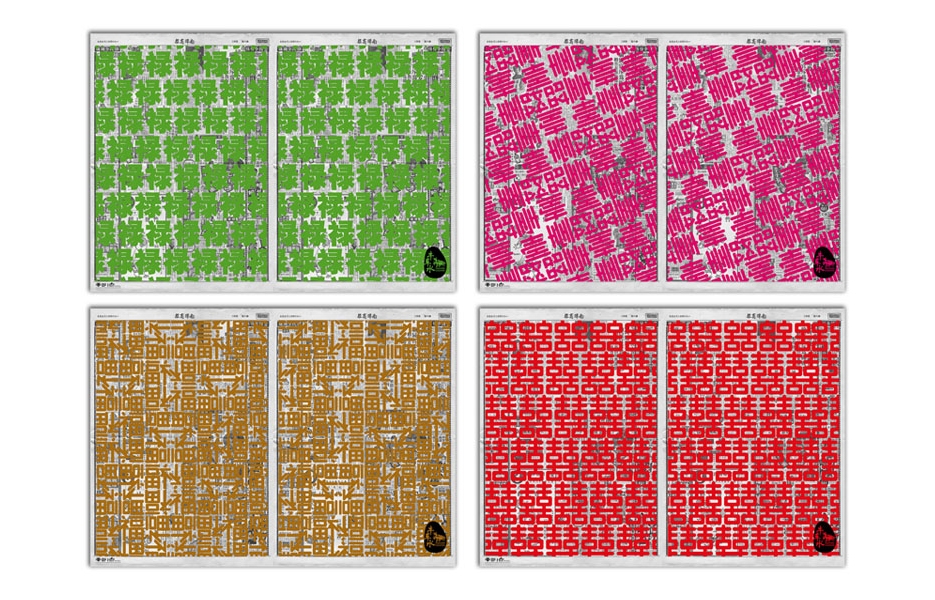
A set of wrapping paper designed by Jesvin which uses typographic elements from Singapore newspapers in the 1950s. | JESVIN YEO
It’s interesting that this book about Chinese culture is in English. Can you talk about navigating between two cultures as a designer? As a Gen X, I understand both English and Chinese. Therefore, it is not too difficult to navigate between these two cultures.
The book is in English because one of my aims in doing cultural projects is to bring as much knowledge and value of our cultures to the younger generations. And we know that our younger generation prefers English and they are not really interested in print. Therefore, my projects have to be in English, easy to digest, unconventional and visually appealing to stimulate interest their interest.
A lot of your work is also about bridging modernity and tradition. How do you approach such work as a designer without falling into stereotypes and cliches? A good and difficult question. I am not too sure whether my work are stereotypes and clichés. I just know that I am interested in the dialogue between tradition and contemporary, old and new. Although I work with tradition elements, I create my content with our younger generation in mind. I believe that tradition and culture are symbols of thought and it is important to pass them down. Hopefully our young people can continue to preserve it. Moreover, I feel that a product is made up by a combination of effort from many people, so it has to scream and not just sit subtly.
Have you eaten an apple without a sequence? Can you recognize one if it is upside down? How different would an apple taste without a crunch when you bite into it?
These are just some of the unusual questions raised in a new booklet about the apple, and how its ‘design’ shapes our experience of eating it.
Authors Clara Koh and Alvin Ho were curious about what eating an apple entailed besides its taste. Through observation, the duo who work under the studio name Atelier HOKO found that the fruit’s less noticed features — or what they term “secondary” — are just as important too.