The Fabrication of History

Don’t believe everything you see.

What is history?

It connotes some kind of “official” account of a past that is often seen as “the truth” because it has been verified by historians who practice certain methods that help to determine its validity.

This is probably the single defining factor that distinguishes “history” from two other accounts of the past — “memories” and “myths”. The former suggests a past that is much more personal and anecdotal, often presented without the rigour of verification associated with history. “Myths”, while also usually anecdotal is additionally tinted with a layer of incredulity that suggests it was failed history.

Accounts of the past can be broken down into an objective component and another that involves interpretation. What is often regarded as objective would be artifacts or information that can be verified. However it is the issue of interpretation that is often forgotten but is a thread that runs through all the three types of accounts. For every primary document or artifact, its use and significance can be interpreted in a multitude of ways. So the whole process of becoming history is left to “official” people such as historians who employ “objective” methods to define “history”.

In this sense, “history” is really fabricated by who writes it, and that being the case, “history” as the holy grail of “truth” diminishes in significance. Moreover, “memories” and “myths” often do not make it as “history” not because they are not true, but because the nature ofbeing history is the need for tangible evidence that may no longer exist today.

Thus, a much more holistic understanding of our past is to accept history, myths and memories as a package rather than choosing one over the other. It is also what might make the past more relevant and interesting to us all.
We have been future shocked

futureshock

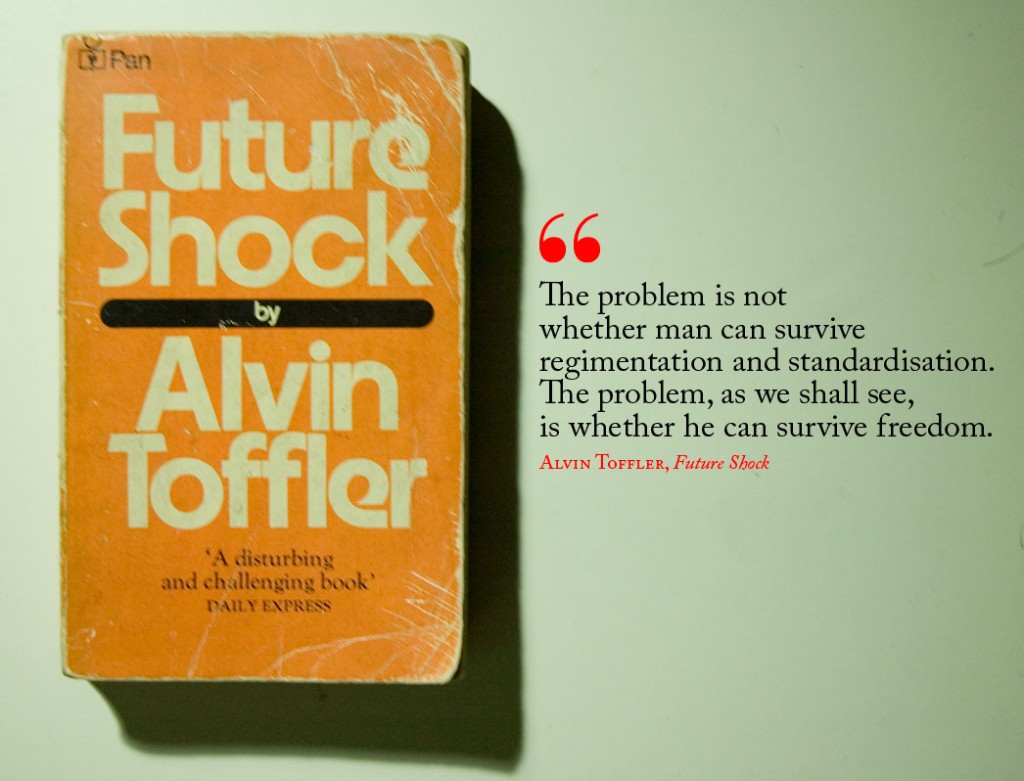
In the future, as technological advancement accelerates, the speed of change in human society will increase exponentially. And according to futurologist Alvin Toffler, this breeds a society built upon transience, novelty and diversity, and as humans struggle to cope with the increasing speed of change, they will experience “future shock”.

In this new world, our relationships with one another and things is drastically changed to something ephemeral. Permanence and loyalty are no longer desired because there is always something better, either a improved or a brand new version, just around the corner. Just think of how some people are constantly upgrading their mobile phones. The latest trends aside, the fact is, more often than not, the economic cost of buying something new instead of repairing it is just much lower. Thus, this creates what Toffler calls “The Throw-Away Society”.

The coming of this “super-industrial” society also heralds novelty as technology gives us the possibility and freedom to fashion anything we can fathom. The possibilities are indeed endless, from the option to pre-design our babies through genetics, to customising the design of that pair of sneakers we buy from Nike. The only restraints left to these possibilities are really ethical questions of should we and not the reality of can we. Such freedom paralyses us with “overchoice”.

Our response to “overchoice” is “lifestyles”. To be indie or corporate — “lifestyles” give us a set of values and behaviour to help us manage our choices as they tell us what to eat, how to dress and even think! As a result of the different choices we each make, a much more diverse world is created and this explains the rise of subcultures.

Strange that his future sounds very much like the world today? Well, Alvin Toffler wrote Future Shock in 1970. Now, that’s really shocking.

••••••••••••

ARE YOU A VICTIM OF FUTURE SHOCK?
In the book, four symptoms of victims of future shock are profiled,
see if you display any of them

  1. [Denial]
    The victim blocks out unwelcome changes by concluding that any change is really superficial and the truth is, nothing much has changed since the dawn of mankind
  2. [Specialising]
    The victim attempts to manage change by keeping track with change only in a narrow sector of life and assuming nothing changes in the other parts of life
  3. [Revising]
    The victim hangs on to his previous way of life and demands the return of the glory of yester-year
  4. [Super-simplifing]
    The victim searches for a idea that has universal relevance and can explain all the change that he sees

••••••••••••

McDonaldisation of Cities

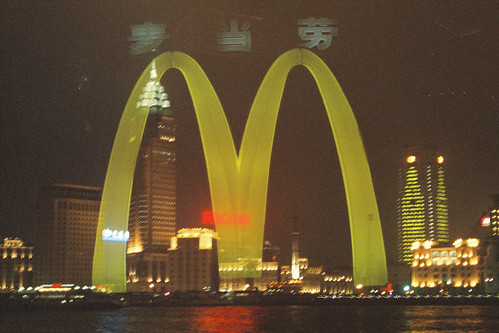
The World Cities Summit is happening in Singapore now and one issue being discussed is the sustainable development of a city. I’m just wondering whether the city has become such a formulaic response to urban living that we fail to think outside the box on other ways of sustainable living.

This thought inspired me to take the photo above, where I juxtaposed the McDonalds store across The Bund in Shanghai with the city skyline itself. After all, the food chain is an expert on providing uniform service and food wherever you go. Check out my other photos of Shanghai.