Meet the mom, dad, and two kids who run Singapore’s popular famzine
Family time is taxing and tiring, but it’s also a highly creative affair for the Lims. On most weekends, the Singaporean foursome—creative director Pann, homemaker Claire, 11-year-old son Renn, and eight-year-old daughter Aira—can be found at home, creating together as family art collective Holycrap. Renn and Aira’s playful drawings and paintings, and the family’s heartfelt biannual zine, Rubbish, have warmed many hearts and even won them Singapore’s top creative award. We recently got in touch to talk about their love for making art and design together as a family.
A government-led initiative to encourage ground-up ownership of public spaces is ironic, but very Singapore. Such was the reception of many when the Urban Redevelopment Authority (URA) launchedPubliCity to “involve the community to celebrate good public spaces and to enliven public spaces through good design and programmes.” A year on, PubliCity has unveiled a variety of projects, including adopting the worldwide movement “PARKing Day,” which was first piloted at Archifest 2013. We speak to the PubliCity team on the work that they have done thus far and what’s coming up next.
TellusaboutthePubliCitycampaignandhowitsitswithintheURAsetup. Launched in November 2013 by URA, the initiative aims to guide the development of new public spaces in Singapore, as well as rejuvenate existing ones. Through this initiative, we hope to engage and work with the community, private sector, stakeholders, as well as other agencies, to activate and make better use of our public spaces.
A PubliCity team was formed within URA to realise this vision. The team is made up of a group of enthusiastic architects and planners across the various departments who share a common vision and passion for place making.
Whythisinitiativenow? Over the years, URA has safeguarded sites for public spaces island-wide. In 2003, we identified parks, open spaces and water bodies that would provide the public with space for rest and recreation through the “Public Spaces and Urban Waterfront Master Plan” and the “Parks and Waterbodies Plan.” We have recently completed environmental improvement works for a number of the major public spaces identified in these plans including the Southern Ridges, Marina Bay Waterfront Promenade, Woodlands Waterfront, and Punggol Promenade.
We launched PubliCity in November 2013 to continue these efforts with a new focus on smaller spaces and ground-up initiatives to make better use of our public spaces and to activate and programme them with activities.
Thewebsitestatesthattheinitiativefocuseson“theelementsthatmakeourpublicspacesmoreenjoyable forthecommunity.”Whatwouldtheseelementsbe? There are a range of elements that contribute towards making public spaces that are well used and loved by the community. These can be as simple as providing basic amenities like seating and shade, or an element of fun/play to encourage the local community to stop and enjoy a space. And of course, the elements for the public spaces should be designed and provided to respond to the local communities’ needs.
Whyisitimportantfortheauthoritiestoundertaketheseplacemakingprojects? We see our role as one of demonstrating the possibilities of what can be done and of fostering community participation and ownership of our public spaces through ground-up projects like PARK(ing) Day. As the initiative evolves, we would like to encourage everyone to explore opportunities to improve, activate and create public spaces in their own communities.
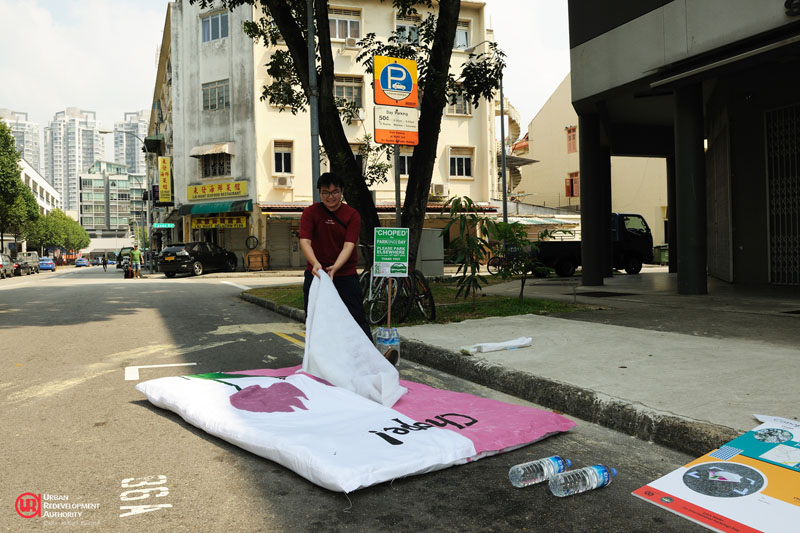
A SUTD student brings a uniquely Singaporean tradition to the road – reserving a space with a tissue packet during PARK(ing) Day 2014. | URA
Doyouthinkengagingthe‘ground’asagovernmentagency,makestheprojectanydifferentifthese interventionswereinitiatedbyanindependentcommunity?As a government agency, it is inevitable that we receive a different kind of response compared to an independent community group. In the long term, we would really like to see our role being taken over entirely by the community. But for now, I think we have an important role to play in lending our ‘official’ support to projects such as PARK(ing) Day to encourage the community to think outside the box and hopefully through our close working relationship with other agencies, help facilitate approvals needed for such projects.
Youmentionedthattheteamengagesthecommunity.Canyoushareexamplesofhow this has been done and what the results were? PARK(ing) Day is a great example of community engagement and participation. We owe a large part of its success to working with the groups of people from SUTD and COLOURS. While we helped to get the necessary approvals and opened up participation across the island, these groups actively engaged the community in Jalan Besar and created their own Jalan Besar PARK(ing) Day group. They had one of the most visited locations on the day.
We have also been working on a series of other community engagement projects. An example would be our first pop-up project, ‘Picnic In the Park – Under the Gelam Trees’, which was inspired by one of the submissions from the ‘Your Ideas for Public Spaces’ competition launched last year.
A makeshift barber shop at Hamilton Road providing free haircuts for the community. | URA
Couldyousharewithussomefactsandfigures? For instance, what was the participation and response to PARK(ing) Day, and what kind of budget were you working with? We were delighted by the overwhelming interest and participation for PARK(ing) Day. We saw 58 PARKs created, of which 41 PARKs were by members of the public. URA and other agencies, such as NParks, LTA and NHB took the opportunity to also participate by creating a number of PARKs ourselves.
Generally, there was a good turn-out at each PARK, and we are heartened by the positive comments that were received from the public.
We aim to deliver all of our projects based on the ‘Lighter, Quicker, Cheaper’ principle by using low-cost materials, and working with the community and property owners to deliver smaller scale projects. For PARK(ing) Day, the interventions were created by the participants themselves. There was no budget allocated to the participants.
We aim for our projects to be simple and affordable to implement so that property owners and community groups can see the potential and implement their own changes.
Whatistheroleofthelargercreativecommunityandthepublicingeneralintheactivationofourpublic spaces?Andalso,howcantheycontribute? By their very definition, public spaces are community spaces and “belong” to the public. We hope both the creative community and the community at large will be inspired to contribute to the making and activation of public spaces, and share with us their ideas on using and creating public spaces.
WhatisthedefinitionofsuccessforPubliCity? At the end of the day, we hope to create more awareness of the importance of good public spaces and the role these spaces play in the built environment. Success is also achieved when the community demands for more of these spaces, and when we receive more ground-up ideas to either create more public spaces or make use of existing ones.
At the end of the first year after the launch of PubliCity, we are happy with the results and have received great feedback from participants and communities where we have run projects. In some cases, we have received requests for a return of our pop-up projects or for more permanent interventions.
Whatkindof“support”fromthecommunityisneededtokeepthisprogrammegoing? Given the early stage of this initiative, the most valuable support we can receive right now is feedback from the community on both the projects that we are undertaking and their ideas on what they would like to see in the future. Over time, we hope to see more ground-up projects being put forward. We would like our role to change to one of supporting the community, rather than the community supporting us.
—————————————
INTERVIEWED BY ADIB JALAL
EDITED BY JUSTIN ZHUANG


 A government-led initiative to encourage ground-up ownership of public spaces is ironic, but very Singapore. Such was the reception of many when the Urban Redevelopment Authority (URA) launched