Category: Culture

Nostalgia versus Progress – The battle for the Singaporean psyche

As I watched the series of video interviews at the Singapore 1:1 exhibition it struck me how the older generation of architects, especially those outside the bureaucracy, displayed a deep longing for nostalgia. On the contrary, the bureaucracy’s planners being pragmatic, lived in the present and looked forward to the future. It was set up such that the story of the development of Singapore’s landscape hinged upon this overarching battle of nostalgia versus progress.

It made me reflect on my own fascination with the past. A friend once said that it would be very sad if we only lived in the past because what would the future hold then? I do not feel alone in my love for nostalgia and I think many other young Singaporeans seek out this country’s past because it moves so fast. We are fascinated by the discovery of abandoned places like Woodneuk House, because it is like an oasis that resisted the rapid pace of urban renewal.

Places that do not change stick out like a sore thumb. From a planners perspective, it only accelerates their desire to carry out urban renewal, and from my perspective, it means I better document it before another one bites the dust. Again, we seem to return to this age-old battle that has remained in the crux of Singapore’s development.

So this battle wages on, and the nostalgia camp has come up with various tools to further their case:

The nostalgia film and assorted media
This topic is common fodder for local film-makers and photographers who want to project their love for nostalgia to others. Seletar Airport: Singapore’s Secret Garden and Diminishing Memories are two films that come off my head right now.

Flea markets and the rise in retro fashion
It’s not common to see young Singaporeans decked out in attire paying homage to an era gone by and trawling the flea markets, buying memories of the older generation.

Taking part in policy-making
When it was announced that the old National Library would be demolished, many Singaporeans wrote into the newspapers and started initiatives to try to resist the decision. The recent opening of Old School also seems to have nostalgia in mind, taking over the premises of  a former secondary school and re-converting the space to a design haven. Apparently within the building, there are elements that integrate the building’s history to the current premises.

What is the golden ratio for conservation and development? I’ll say enough of the past so that the present has some bearing of their future. As I’ve quoted Kohei Sugiura, a Japanese designer, some time back:
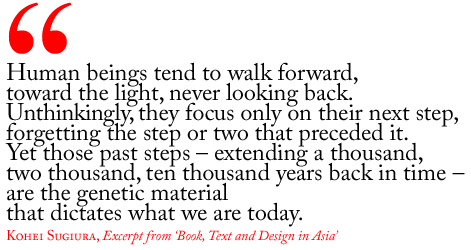
kohei

A trip to Yangtze Cineplex

“随便坐!” (”Seat anywhere you like”) said the usher as we huddled into the cinema peering into the dark looking out for old men and their umbrellas. Indeed, the cinema was hardly filled, the men and a couple (a man and his prostitute, I imagined) made sure they sat seats apart. It must have been strange to see us, two men and a lady, seating together in the middle of the cinema.

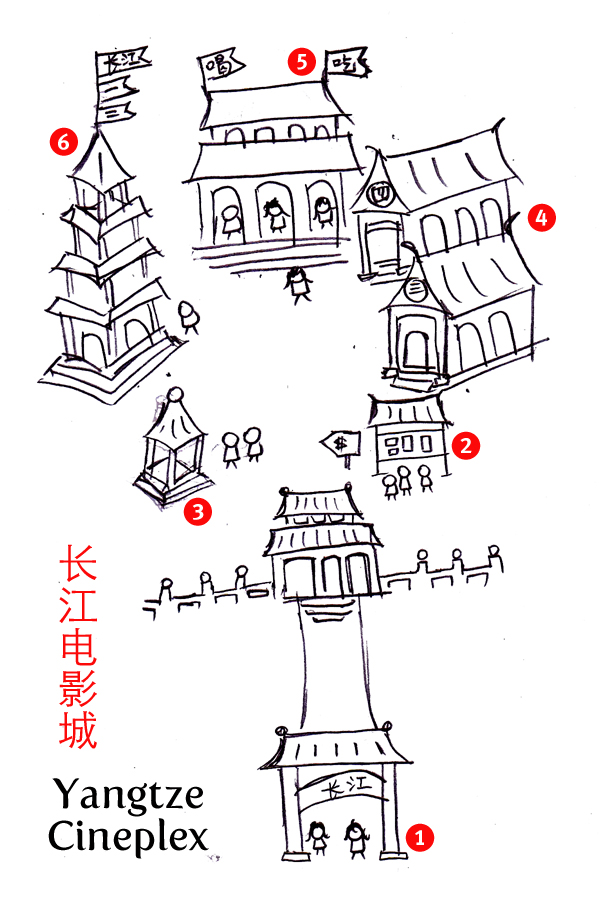
My colleagues and I had finally made the trip down to Yangtze Cineplex in Pearl’s Centre, which is famous for playing softcore erotic films that cater to old men with their umbrellas. It was an urban legend that we had to see for ourselves even at a cost of $8.50 a ticket! Below you will find my “imagined” map of the place, that will guide you through my adventure:

yangtze

1. At the corner of the 4th floor of Pearl’s Centre, lies a little community of its own, where old men live like mandarins, indulging in sin, in the kingdom of Yangtze. Even before one enters the cineplex, one is greeted by ladies dressed to kill outside a innocent-looking massage and spa centre. They scrutinise the people entering the kingdom, waiting for the eye contact to make their move.

2. One is greeted at the entrance by photos of the movies that are being shown. There is no need for Hollywood-style posters because everyone comes here just to watch one thing — sex. So, all you have is the title of the movie accompanied by the time slots and the sex scenes in the movie. The old men stand and scrutinise the photos, picking one which would fulfil their fantasy.

3. After making a choice, whether out of a convenient time slot or because one wants “her”, proceed to the ticketing booth, manned, strangely, by an auntie. She doesn’t judge the patrons at all, she’s just here to sell tickets. And since we looked young and innocent, she asks for our ID to show that we were above 21, but no, she never questions why we are here with a lady.

4. There are four cinemas in this cineplex, two on the ground floor and another two on the second floor, each guarded by an usher who could very well pass off as one of the old men in this small community.

5. This is a self-sustained community, there is a food centre where the old men feast in typical ah pek style — teh on one hand and a girl on the other. The men have their feast here, enjoying a good chat over mee pok and bottles of beer, evoking imagery of Imperial China, where the mandarins feast and indulged in sin.

6. Finally, we headed to Yangtze 1 to watch “Time to Revenge”, a film we picked because it had just started when we arrived. To our disappointment, the legendary umbrellas were but a myth. The movie was a B-grade movie about cowboys plotting against one another and after 20 minutes in, there was yet to be a sex scene and so a patron walked out. When there was finally a sex scene, it was just a couple in their underwear lying on bed. Eventually, an hour into the movie, with not a single nude scene in sight, we decided we had enough and left.

As we left disappointed, I tried to strike a conversation with the auntie at the ticketing counter. I asked her how old the cineplex was, she snapped back asking why I wanted to know. “Curiosity?” I replied in mandarin, and she broke into a smile and said she didn’t know.

I suppose that’s how she keeps on at this job and how this cineplex continues to be tolerated — we just choose to not know about it.

Singapore’s “Soft Power”

Over the weekend, I got introduced by a friend to a humanitarian organisation, Mercy Relief, that has been going to parts of Asia to provide disaster relief efforts including the Asian Tsunami of 2004. Their executive director, Frederick, was talking about how humanitarian efforts, such as those by Mercy Relief, are actually a form of “soft power” that can help extend Singapore’s influence and image overseas. He mused about how Singapore is often seen as a unfeeling and cold place where business and money is all we talk about.

That got me thinking about how extensive are Singapore’s efforts in the humanitarian sector? After all, it is a developed country and relatively wealthy. Yet, strangely, it is rare to hear us playing a role like USA, Japan or Europe in humanitarian efforts. Suddenly, our small size and position is drummed up when we talk about such efforts. We have sent troops and money to help during major disasters like the tsunami, but I’m just wondering to what extent are our efforts compared to other countries? Perhaps, one strategic limitation is ASEAN’s policy to not interfere in the domestic affairs of its members. Yet, with the ASEAN Charter being ratified, how will that change the way things are now?

Moreover, I think more and more of our youth are joining these efforts to go overseas to spread goodwill under the Singapore flag and seeing humanitarian work as part of their lives. So will that spur the growth of this sector in Singapore and make it even viable to work in it professionally in years to come? I think this is one sector that can enhance Singapore’s foreign relations with other states and in a sense such “soft power” is definitely power to be reckoned with too.

Trash-To-Go

On another note, Mercy Relief is in the works to launch a new program called “Trash-To-Go”, where they collect unwanted things, like watches, shoes and glasses, and get them refurbished to be donated to local charities and for their overseas expeditions too. If you are interested to help them out, you should touch base with them.

21st Singapore International Film Festival (SIFF)

Finally, from 4th April to 14th April, SIFF is back! I missed last year’s one because I was overseas but I’m definitely going to catch this one. If this doesn’t make you smile, you should go here instead.