Category: Culture

Just for my hair to stand

For those few minutes, the air was electrified. As the crowd stood up, then down, in a wave-like fashion, nothing, not even the empty stands in between, could stop the 30, 000 strong bring live to the drab grey dame. Not once, but twice, the crowd moved in unison, each of them eagerly awaiting their turn to stand up tall, motivated by nothing more than the desire to be one with the fan next to them.

This is what they called the Kallang Wave, and it returned so spontaneously tonight, for those precious few minutes, before a nation’s hopes were dashed as quickly as it took for this rare return of the wave to make me lose myself in the electrifying atmosphere.

This was the moment one lives for and also the only reason I keep going back to watch a Singapore soccer match, to capture and savour every moment like this because it tells me this place has a heart, a soul, if only we can keep it alive for longer.
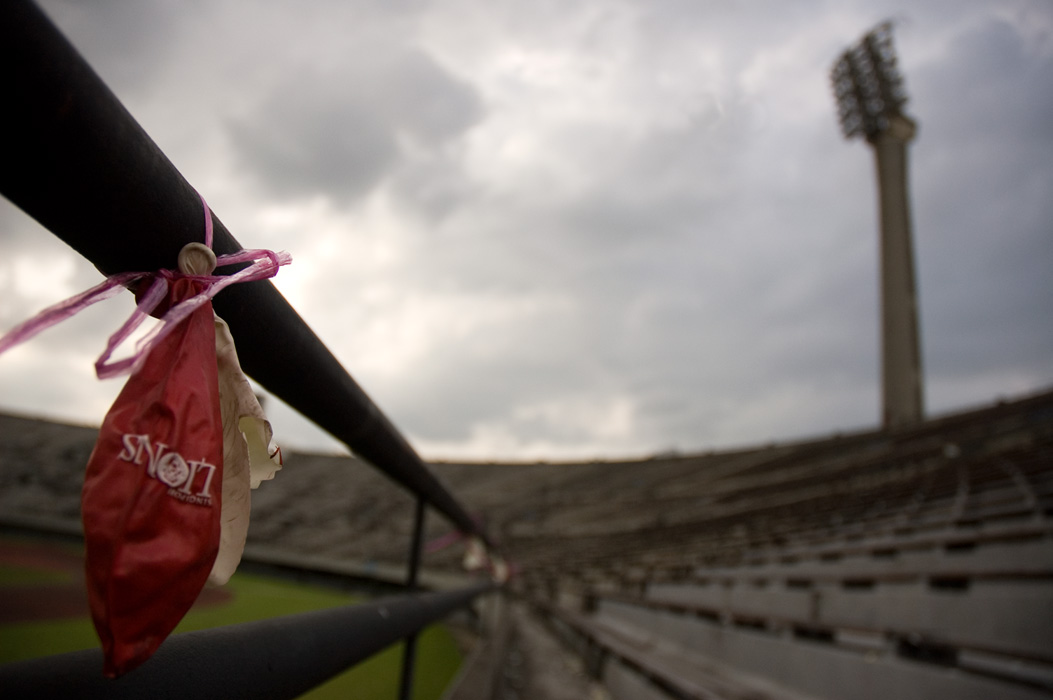
Just last week, a friend called and offered me tickets to watch Singapore play Bahrain because he could not think of any other Singapore fan than me. I thought it was such a strange remark, but the more I thought about it, I realised it was not so much the soccer that kept me going back, but really this grand idea of nationhood and how it manifested through its people. The Singapore soccer-watching crowd is strange, diverse and mostly pessimistic. There are the folks who attribute every outcome to a bookie’s decision, some dissect the players by race, others always think of what they players should have done… but come that genuine moment, whether it is watching the team take the lead or claw back a goal, every one unites and all is forgiven that very moment.

As my friend said, its these moments where “I can feel my hair stand.” And for the record, we lost 3-7 to Uzbekistan.

Constructing our reality

Reality exists because it can be constructed and over the weekend, I encountered various talks that de-constructed this process and I was totally blown away by how empowering it felt.

One thing that stuck in my head was this concept of “devices”. A curator was discussing about the construction of an exhibition space and referred to various “devices” built to counter “visitor fatigue”. That helped me to redefine my relation to the exhibition space as a visitor to one as a creator and it was empowering.

And if you extend this concept further, everything is a “device” built for some purpose. The recent re-design of The Sunday Times and The Straits Times have included more “devices” on the cover to hook in more readers to its papers. Thus, you have short blurbs about stories inside as “devices” on the cover instead of just three main stories like in the past. The cover thus becomes a platform to attract readers rather than making a statement what news you should know about. This reflects a subtle change in tone, from big brother telling you what to read, to many whispers luring you to read something, anything.

And by some strange coincidence, a friend pointed me to this page, where a exhibition poster in Singapore was de-constructed really quickly.

So if everything is constructed, are we then simply users of this spaces and a slave to its constructions? The Situationists would disagree. They would advocate personal empowerment and a re-imagination of these spaces. In short, we define what these spaces mean to us.

And so there I was with my colleague today, listening to a radio station in New York and in our windowless office, I thought that after work I would grab my big coat, step out to chilly night, walk past Time Square on my way to my apartment in Manhattan.

Show a little love to the local

I did not want to eavesdrop on the conversation, but the lady was very distressed.

Amidst the noise of the train, the book in front of me and her on the phone, I could not help but give her all ears. It seemed she was a model involved in the Singapore Fashion Festival and was heading home after auditions of some sorts and she was bitching to her friend about how the day had been tiring and the set-up of the audition horrendous. What really piqued my ears was when she lamented how some manager apparently restricted the number of Singaporean models to get on the runway, saying something like “That’s enough Singaporeans.” when the designer was picking his or her models.

And she added, “That’s what I hate about Singapore, I so want to leave.”

Her story may be grossly exaggerated, but I think it highlighted a problem in our society — we don’t give our local talents enough love. It is not about blindly supporting whatever is local but showing the support and the critique they need to improve and continue producing local works.

This lack of love has consequences on the creators that only result in massive disconnect between the audience and creator. While some of these talents, continue to improve with or without it, those who turn negative to this lack of support either completely give up on Singapore or their talent or turn inwards in their outlook.

The latter is something that I think is less explored, but what you essentially see are artists who create works that do not resonate with society (here, I mean beyond the arts community for instance) because he or she has been abandoned by it. In turn, when it goes on display, the average Singaporean cannot appreciate the art and does not even give it enough love to criticise it. This institutionalises into a vicious cycle and what you get are two distinct communities, those who support local and those who don’t, who are in their own conversations that never meet.