Category: Culture

We have been future shocked

futureshock

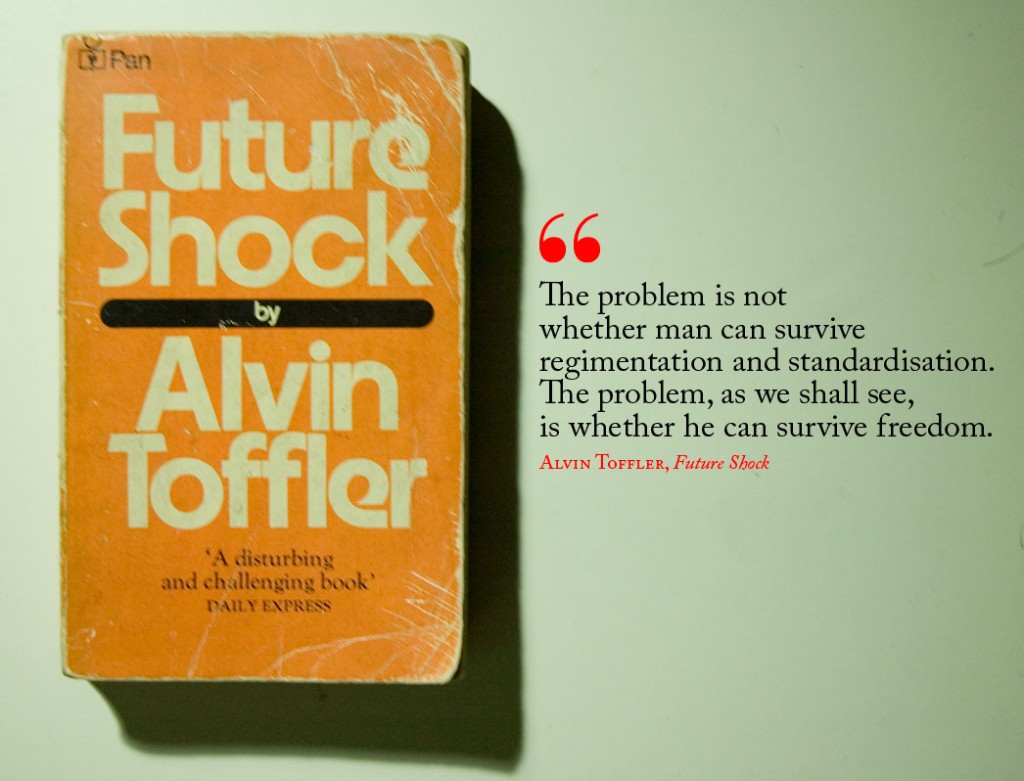
In the future, as technological advancement accelerates, the speed of change in human society will increase exponentially. And according to futurologist Alvin Toffler, this breeds a society built upon transience, novelty and diversity, and as humans struggle to cope with the increasing speed of change, they will experience “future shock”.

In this new world, our relationships with one another and things is drastically changed to something ephemeral. Permanence and loyalty are no longer desired because there is always something better, either a improved or a brand new version, just around the corner. Just think of how some people are constantly upgrading their mobile phones. The latest trends aside, the fact is, more often than not, the economic cost of buying something new instead of repairing it is just much lower. Thus, this creates what Toffler calls “The Throw-Away Society”.

The coming of this “super-industrial” society also heralds novelty as technology gives us the possibility and freedom to fashion anything we can fathom. The possibilities are indeed endless, from the option to pre-design our babies through genetics, to customising the design of that pair of sneakers we buy from Nike. The only restraints left to these possibilities are really ethical questions of should we and not the reality of can we. Such freedom paralyses us with “overchoice”.

Our response to “overchoice” is “lifestyles”. To be indie or corporate — “lifestyles” give us a set of values and behaviour to help us manage our choices as they tell us what to eat, how to dress and even think! As a result of the different choices we each make, a much more diverse world is created and this explains the rise of subcultures.

Strange that his future sounds very much like the world today? Well, Alvin Toffler wrote Future Shock in 1970. Now, that’s really shocking.

••••••••••••

ARE YOU A VICTIM OF FUTURE SHOCK?
In the book, four symptoms of victims of future shock are profiled,
see if you display any of them

  1. [Denial]
    The victim blocks out unwelcome changes by concluding that any change is really superficial and the truth is, nothing much has changed since the dawn of mankind
  2. [Specialising]
    The victim attempts to manage change by keeping track with change only in a narrow sector of life and assuming nothing changes in the other parts of life
  3. [Revising]
    The victim hangs on to his previous way of life and demands the return of the glory of yester-year
  4. [Super-simplifing]
    The victim searches for a idea that has universal relevance and can explain all the change that he sees

••••••••••••
Look at things differently

energyWith a flick of a switch, your room is light up, your computer starts up and your fan turns on, but have you ever wondered how that happens?

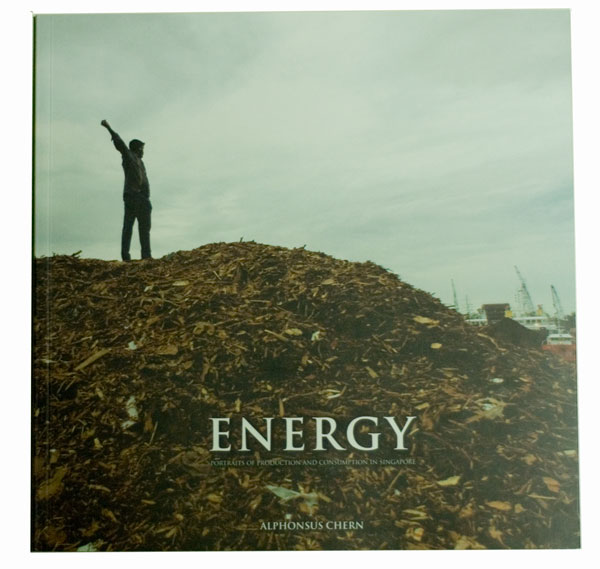
Energy: Portraits of Production and Consumption in Singapore attempts to put a face to what creates something that so many of us take for granted — energy. Out of sight of most Singaporeans, the production of energy through fossil fuels, waste incinerators, natural fuel and alternative sources is documented by photojournalist, Alphonsus Chern, in his first-ever photo exhibition at the National Library. The exhibition runs till the 15 June at Level 7.

While the photo stories may seem disparate at first sight, what is noteworthy is the translation of an abstract concept like energy to images that portray its industrial glory that hopefully creates a dialogue about how this country produces energy and its heavy reliance on fossil fuels.

energy1

Pages from the book Energy: Portraits of Production and Consumption in Singapore

Alphonsus is also selling a limited first-run of his photos in a similar-titled book (above) for $50 at the exhibition itself.

A different point of view

To further challenge your perspective of things, check out Matthew Ngui: Points of View where you are stretched mentally and physically to make sense of things by looking at them from, literally, a different point of view. This exhibition, at the National Museum of Singapore, is a curated collection of art work by local artist Matthew Ngui and is on till 29 June 2008.

Both these exhibitions challenge our perspectives of things. Matthew Ngui’s works put forth the importance of limitations to creating perspective. By forcing viewers into certain point of views, one realises how what may seem senseless at one point can be understood from a different point of view. It reminded me about the importance of limitations to the generation of knowledge as highlighted by linguist and political activist Noam Chomsky who went on to say, “…if anything could be possible, nothing would be possible.”

Memory markers and objects

On what do you inscribe your memory on?

I have a friend who remembers places she has been by marking them to a song. So we would be listening to radio and she would suddenly say: “This song reminds me of a time when I was at… ”

That made me think about the objects and things around me and what triggered memories for me. I think it has got to be spaces. I associate a huge part of my memories with spaces thus I like to stick to a certain route to avoid places because of bad memories I have had. Sometimes, I do end up in the places I try to avoid and actually re-inscribe it with new memories.

Besides spaces, certain objects or colours also serve as memory markers for me. That probably explains why I am cluttered with so many things because I hang on to a lot of memories such that what my brain can no longer store I re-inscribe it to the things around me. It’s my brain’s way of data management.

I suppose the beauty of things, or what I am really amazed at, is how memories give life to dead objects. What it also means, is an object besides what it is socially defined as is also empty and its meaning is there for us to fill up with our own interpretations. So a nail clipper is what we define as it is socially but also to each and everyone of us, the nail clipper holds some other meaning too.

Ahhh… I hope you see the light.