Category: History

In Need of A Pioneering Design

Here’s a graphic design project I hope someone will take on in the years to come: A system of design guidelines to brand the public service.

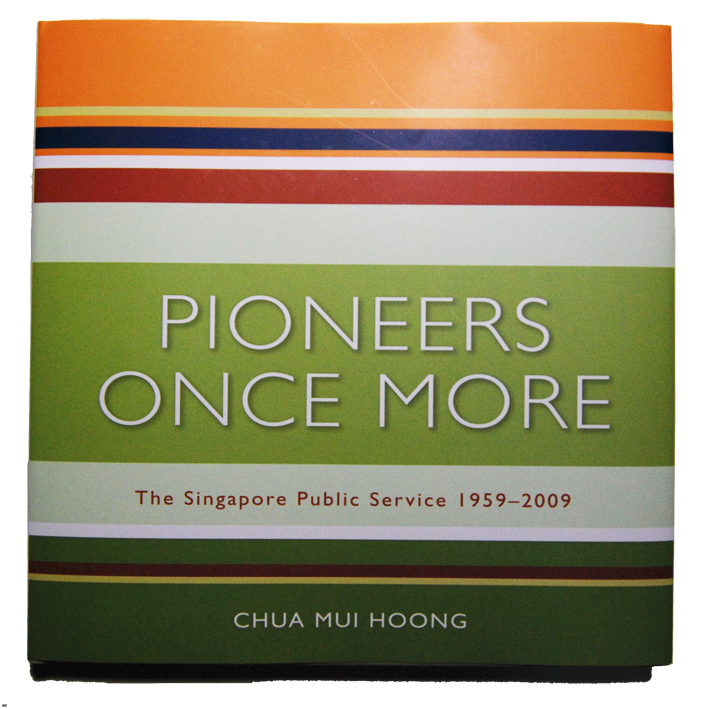
The Singapore Public Service is  a vast and diverse entity containing some 15 Ministries and over 50 organisations. They differ in terms of age, what they do, who they are made up of, and also who they serve. However,  in recent years, the public service  has been championing a “whole-of-government” approach to how it serves the public. To some extent, it has tried to brand itself this way too. Just today, they launched a coffee table book Pioneers Once More, “the first about the Singapore Public Service as a whole”.
pioneersoncemore

Yet, the design of the book cover is disappointing. It is an abstract kueh lapis that doesn’t say much to me. It hides the interesting stories and photos inside, and lacks a stature that you would associate with history books. It looks like one of those diaries you may find at Popular bookstore. I’m guessing the design team faced the problem of who can be the face of the public service? How can we present the public service as one when the reality is that people don’t see it as that?

The final product is an lost opportunity to visually define the public service as one for the first time. So, the issue remains out there for our local designers to take on, and it’ll be interesting to see what solutions exist.
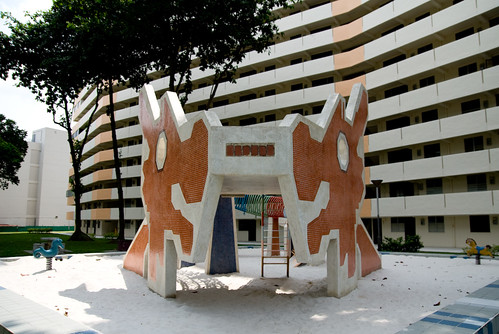
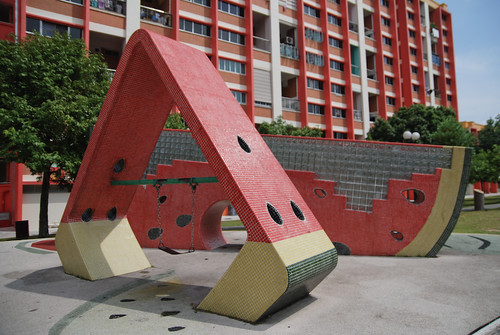
Old Playgrounds in Singapore

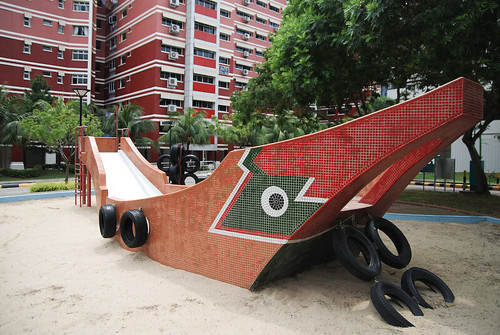
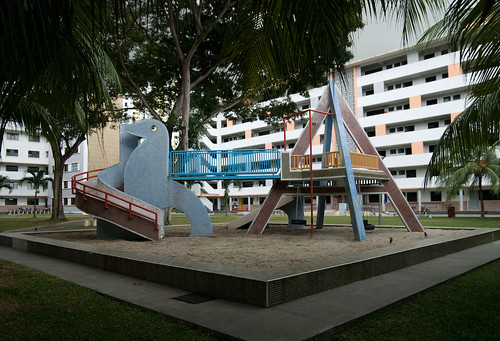
Dragons, watermelon, bumboats and doves — these were just some designs of public playgrounds built from the 1970s to early 1990s in Singapore. Built by the HDB, they were based on local themes and icons, and were unique spaces for a generation of Singaporeans who grew up with fond memories of them.

This is an on-going project. View photos of the playground and  find them to relive your childhood!

UPDATE

Read my article at CNNGo for a short history of these playgrounds or my Singapore Architect essay on what we’ve lost with their passing. Also in the works — a more detailed history of the playgrounds and I may have tracked down its designer…

A Design of Its Time

Keeping up with the times – the changing look of Singapore’s longest surviving English newspaper The Straits Times.

— — — —
First published in  The Design Society Journal,
and edited into seven posts for this site.
— — — —

A newspaper is often seen as a mirror of its society. While this usually refers to the content of the paper, what is often passed over is how its appearance is part of that reflection too.

If you stop reading the newspaper for a moment and examine its overall look and individual elements instead, you would notice how its nameplate, the type of underlying grid, choice of typefaces, and even the paper’s size come together to shape the experience of the newspaper that we take for granted in our daily read.

“Any newspaper we read conveys its personality through the accumulation of these visual cues,” writes visual communications professor Kevin G. Barnhurst.[i] “We assume that it is the writing that makes the difference, but that is only partly true.”

Yet newspaper design is more than its aesthetics, it is a means to convey a message, summed up in former editor of Britain’s The Sunday Times Harold Evans’ observation, “[D]esign is part of journalism. Design is not decoration. It is communication.”[ii]

It for this reason that newspapers, like The Straits Times (ST) in Singapore, have periodically spent money and time to redesign its product.

Explaining ST’s 1998 redesign, then editor Leslie Fong wrote: “The short answer is that we have to – if we wish to stay on top of the competition and give you a better paper.” He adds, “And the competition is not just against other media or information providers but also, increasingly, for your time.”[iii]

A newspaper’s design thus becomes a visual expression of its readers’ values and environment that the paper operates within. Each design change is a deliberate move driven by the need to stay relevant to its readers. In a sense the changing looks of the 164-year-old ST, the oldest English newspaper still around, serves as an archive of how Singapore has changed from a British colony to an independent First-World nation today.

— — — — — — — — — — — — — — — — — — — — — — — —
Introduction } 1960s } 1970s } 1980s } 1989 } 1998 } 2000s
— — — — — — — — — — — — — — — — — — — — — — — —

  • [i] Kevin G. Barnhurst, Seeing the Newspaper, New York: St. Martin’s Press, 1994.
  • [ii] Harold Evans, Book Five: Newspaper Design, 5 vols., Editing and Design: A Five-Volume Manual of English, Typography and Layout, London: Heinemann, 1973.
  • [iii] Leslie Fong, “The Aim: To Give You a Better Paper ” The Straits Times, March 22 1998, HOME, 23.

— — — —