Tag: Graphic Design

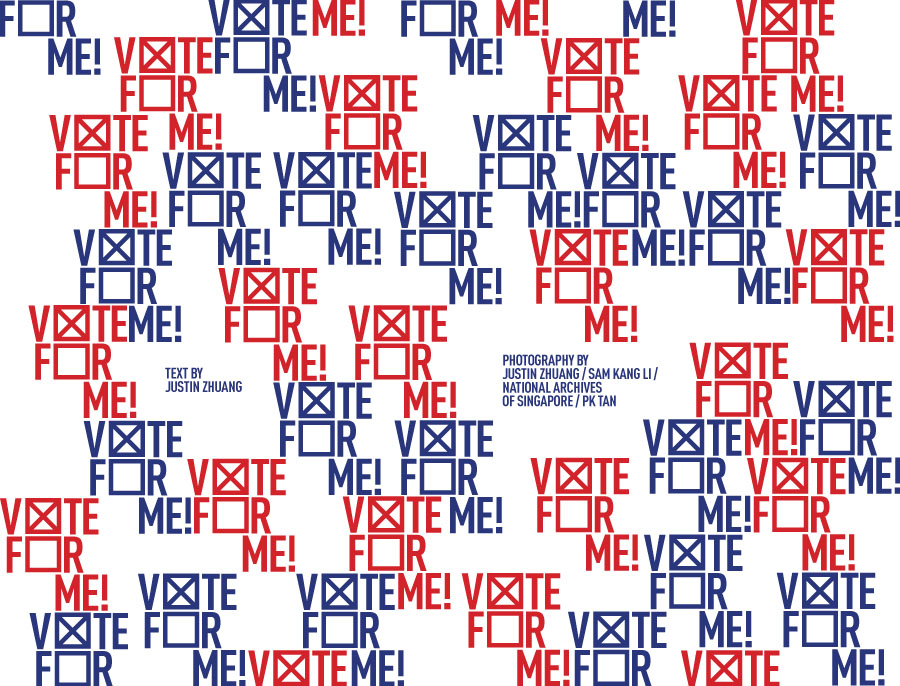
Vote For Me! Singapore Elections Ephemera

TDSJ-Vote-For-Me

Singapore’s 11th General Elections since independence marks the beginning of a design-conscious politics—a 2011 essay I wrote for The Design Society Journal No. 03.

The day after Nicole Seah was officially presented as an election candidate for the National Solidarity Party (NSP), The New Paper asked on its cover: “Do looks matter in elections?” It was directed at the online buzz generated after the 24 year-old Seah first announced over Facebook that she was standing for elections. Netizens were clearly taken in by her profile picture—what the paper described as “lovely flowing hair, make-up and her good side showing”—so much so that nobody bothered who she was contesting with in Marine Parade Group Representation Constituency (GRC). Some even began dubbing NSP as the “Nicole Seah Party”. Soon, digitally edited pictures of her as Wonder Woman and Scarlett in the upcoming G.I. Joe movie also began making their rounds online.

However, Seah, in her own words, was not just “another pretty face”. She was confident and articulate, making astute remarks during her campaign trail. This, plus her good looks, projected the image of an attractive and credible candidate to voters. Just over a fortnight after starting her Facebook page, Seah received even more ‘Likes’ than the nation’s founding father Lee Kuan Yew, earning her the title of Singapore’s most popular politician. Despite this, her NSP team did not win the election battle at Marine Parade. Yet, by garnering so much attention and winning 43.36 per cent of the votes against a People’s Action Party team led by former prime minister Goh Chok Tong, Seah’s campaign demonstrated how image played a part in helping a young unknown like her win votes.

This echoes the 2008 presidential election in the United States, when a relatively newcomer Barack Obama “crafted a meticulous visual strategy”, that helped propel him to victory. While Seah and the other candidates of Singapore’s 11th General Election did not display the sophistication of Obama’s visual campaign—right down to choosing an appropriate typeface—they produced one of the most visually-driven election in recent Singapore history, heralding the beginnings of Obama-style politics in the future.

Read more

A New Generation of Super Successful Singapore Brands All Have One Thing in Common

Brand guides have probably never appeared on a summer reading list, but after seeing Foreign Policy Design Group’s take on the genre, we’re telling everyone to move it to the top of their stack.

Brand Guide: Singapore Edition is the design studio’s 400-page dossier on the secrets to success of 17 contemporary brands from the Southeast Asian city-state. From boutique restauranteur and hotelier Unlisted Collection, to small independent bookstore BooksActually, this guide features a spectrum of Singapore lifestyle brands, including fashion, cultural, hospitality, retail, offices, and food and beverage.

Read the rest at AIGA’s Eye on Design

Déjà vu: A review of I Have A Room With Everything Too

COURTESY I HAVE A ROOM WITH EVERYTHING

Many would have recognized, but few actually seen IRL (in real life) the works displayed in I Have A Room With Everything Too. This recent exhibition at The Substation Gallery (2-12 July) showcased over a hundred books, magazines, and printed ephemera by design studios around the world—offering a rare opportunity to appreciate avant-garde graphic design outside the digital screen. Instead of viewing endless studio shots on infinite scroll and click thumbs up, graphic design aficionados could actually pick up design and flip, stroke, or even smell.

An annual report retold as a travel diary by Singapore design duo Couple, an art catalogue with a cover made from amusement park tickets by Indonesian studio Artnivora, and a calendar resembling a miniature pallet of printed sheets by Hong Kong based Co.Design were part of a line-up of eclectic projects assembled by curator Yanda Tan. Laid out across a single row of makeshift tables spanning the 23-metres long gallery were the mostly arts and cultural projects Tan had acquired from bookstores and designers via his art and design blog THEARTISTANDHISMODEL and recent travels to other cities.

The collection is a diverse portfolio of graphic design production possibilities which reminded visitors of “the joy of holding something tangible in our hands that took hours, days, months to put together.” But this worked only up to a point. There was little context besides the name of the designer and their city of origin in order for visitors to appreciate the works beyond design as a process of production. This was particularly telling for the foreign language publications whose contents were indecipherable, rendering them no different from a mockup by printers. Even as many of the works wowed with their cool surfaces and exteriors, the lack of details on production processes or a nod to the printers meant how the designs were created remained a mystery unless the curator was on hold to conduct a walk-through. For instance, Yoshie Watanabe’s One Plus One Crossing book is an intriguing flip book of die-cut pages, but what makes it even more impressive is it was actually a packaging designed in 2006 to hold the story behind an engagement or wedding ring. 

COURTESY I HAVE A ROOM WITH EVERYTHING TOO

As the exhibition title suggests, the showcase is the personal inspiration library of Tan who runs the creative studio DO NOT DESIGN. The self-taught designer has clearly studied his materials well, as seen in his works which also feature in the showcase. The elaborate cut-out cover of his latest DEAR magazine and the hand-scrawled marks plus torn edges of his album design for Monster Cat both echo Tan’s obsession for the materiality of design—an aspect that the exhibition rightly points out isn’t always evident in a time where the digital image is our most common encounter of graphic design. I Have A Room With Everything Too presents graphic design in third-dimension, but still keeps it on a pedestal that is to be appreciated as an objet, rather than a material we encounter in our everyday lives.

Visitors may have felt déjà vu at the exhibition for another reason. In 2011, Tan held the first edition of a similar exhibition featuring several of the same works, such as Theseus Chan’s WERK magazines and Stefan Sagmeister’s 1998 album design for song-writer Jamie Block. Back then, Tans’ exhibition was larger and even had a day of presentations by designers. This time around there was a printed supplement featuring question-and-answer interview with designers, as well as personal essays by lovers of print.

Without the shock of the new from four years ago, I Have A Room With Everything Too was less fresh, but still a welcome relief in a city where exhibitions on graphic design remain few and far between.