Integrated developments that combine retail, residential and transport such as the recently opened Bedok Mall and the upcoming Northpoint City in Yishun may now be presented as a solution for a denser Singapore, but it is an idea that is almost five decades old.
Back when the newly independent Singapore was drawing out plans for its future city, a group of architects and planners—William Lim, Tay Kheng Soon, Koh Seow Chuan, Chew Weng Kong, Chan Sau Yan, amongst others—formed the Singapore Planning and Urban Research Group (S.P.U.R) in 1965 to study and develop proposals for the nation’s city development. Anticipating a future where the world would only become more densely populated, the group imagined a “true city” to be a “congested city”, one where people would live in higher concentration and on land that was intensively used for multiple functions.
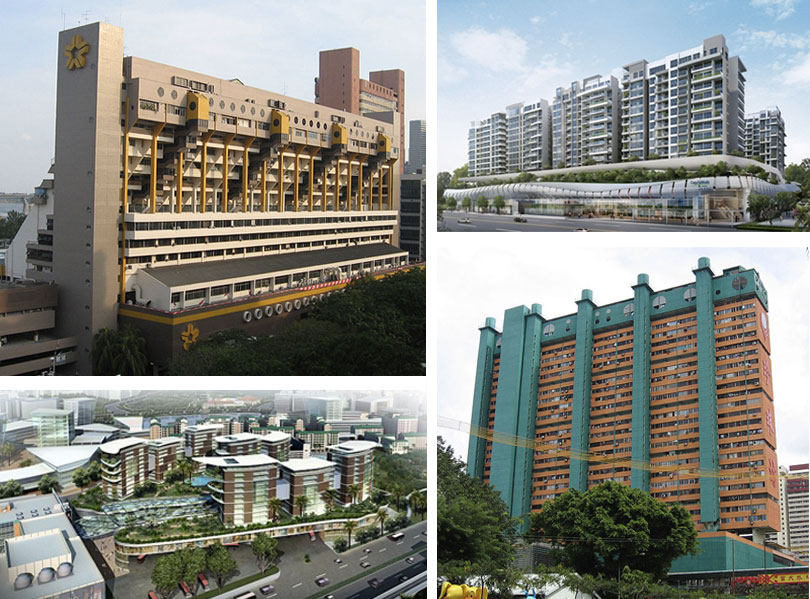
This was a vision S.P.U.R sketched out (above) for Asia Magazine in May 1966—and some of its members eventually built it out in the forms of Golden Mile Complex and People’s Park Complex. Completed in the 1970s, these buildings that combined offices, residences and shops stood apart for decades in a city that became carved out for single land uses, or what the group warned in their article as “out-dated planning principles that seeks to segregate man’s activities into arbitrary zones, no matter how attractive it may look in ordered squares on a land use map.” But as Singapore’s population has almost tripled from 1.9 million in 1966 to 5.5 million today, the state has shifted its urban planning approach, which echoes S.P.U.R’s proposals for the future Asian city. The Golden Mile and People’s Park complexes are no longer eccentric anomalies of the city but architecture templates for Singapore’s future.
(Clockwise, left to right) Golden Mile Complex (1973), rendering of Bedok Mall (completed 2013), People’s Park Complex (1973), and rendering of Northpoint City (expected 2018). | WIKIMEDIA/SENGKANG
Not all ideas by this non-governmental organization were rejected by the state at first. During the 1970s debate over expanding Paya Lebar airport or moving it to Changi, S.P.U.R made a public case for the latter—and they were vindicated. With the on-going expansion to build a fourth airport terminal, Singapore must be glad to have made the move. This was also to be one of the group’s last contributions to the nation’s urban planning discourse as it de-registered in 1975. Its members, however, carried on their activism in different forms, continuing to publish books and proposals about the city’s future.
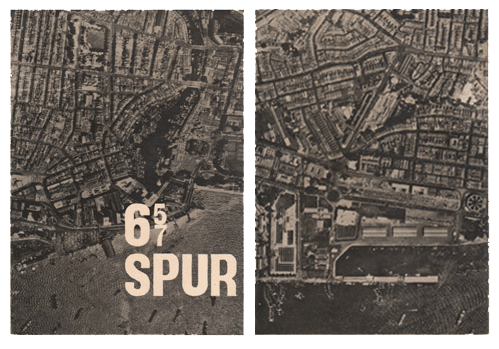
Front and back cover of the inaugural SPUR publication.
Many of S.P.U.R’s proposals and activities were documented and published in two journals the group released. The pages may be in black and white, but they vividly show how Singapore became, or is only now becoming. Alas, their contribution has received much spotlight until now. NUS Museum is hosting a 50th anniversary reunion for the group next week, and it will be a fantastic opportunity to revisit a declaration they made in their inaugural publication: “We are at a cross-road between the old and the new Singapore and the planning and environmental decisions which we make today must be with vision and foresight, as future generation will judge as we judge our predecessors.”
As nations struggle to house their rapidly growing urban populations, Singapore offers a promising solution with its profusion of innovative high-rise, high-density housing “estates,” as is the local parlance. Today, over 80 percent of the city-state’s resident population lives in public housing.
Key to this success is the Housing & Development Board (HDB), the nation’s public housing agency, which was set up in 1960 to tackle the shortage of housing and clearly overcrowded slums. HDB has since evolved from resettling Singaporeans who once lived in overcrowded villages to catering to the lifestyles of its now 5.5 million inhabitants.
In the last decade, public housing has gone from utilitarian rectangular blocks formulated by faceless public servants to stylish complexes designed by top local architecture firms, such as WOHA Architects, which completed their SkyVille@Dawson in July. Containing 960 units of a variety of apartment types and sporting tropical landscaping and extensive communal spaces, the three-tower scheme humanizes the HDB housing blocks of yesteryear.
SkyVille@Dawson is just one example of HDB enlisting the private sector to create more distinctive public housing. “The concepts that we have tested out in Dawson are also being implemented in other new housing projects in different ways,” says Dr. Cheong Koon Hean, HDB’s chief executive officer. “Our new estates will be greener and more garden-like, to provide a more conducive living environment for residents.”
Against this backdrop of progressive public housing for low- and middle-income residents, Singapore’s developers have turned to starchitects to differentiate their profit-driven projects. Jean Nouvel, Zaha Hadid, and Toyo Ito have all recently designed signature high-rise luxury residences. OMA and Ole Scheeren’s Interlace and Moshe Safdie’s soon-to-be-completed Sky Habitat offer further examples. Yet, Safdie is discerning: “Very few countries at this point are building housing by the government for the people as Singapore does. I don’t think there is any country like that.”
A government-led initiative to encourage ground-up ownership of public spaces is ironic, but very Singapore. Such was the reception of many when the Urban Redevelopment Authority (URA) launchedPubliCity to “involve the community to celebrate good public spaces and to enliven public spaces through good design and programmes.” A year on, PubliCity has unveiled a variety of projects, including adopting the worldwide movement “PARKing Day,” which was first piloted at Archifest 2013. We speak to the PubliCity team on the work that they have done thus far and what’s coming up next.
TellusaboutthePubliCitycampaignandhowitsitswithintheURAsetup. Launched in November 2013 by URA, the initiative aims to guide the development of new public spaces in Singapore, as well as rejuvenate existing ones. Through this initiative, we hope to engage and work with the community, private sector, stakeholders, as well as other agencies, to activate and make better use of our public spaces.
A PubliCity team was formed within URA to realise this vision. The team is made up of a group of enthusiastic architects and planners across the various departments who share a common vision and passion for place making.
Whythisinitiativenow? Over the years, URA has safeguarded sites for public spaces island-wide. In 2003, we identified parks, open spaces and water bodies that would provide the public with space for rest and recreation through the “Public Spaces and Urban Waterfront Master Plan” and the “Parks and Waterbodies Plan.” We have recently completed environmental improvement works for a number of the major public spaces identified in these plans including the Southern Ridges, Marina Bay Waterfront Promenade, Woodlands Waterfront, and Punggol Promenade.
We launched PubliCity in November 2013 to continue these efforts with a new focus on smaller spaces and ground-up initiatives to make better use of our public spaces and to activate and programme them with activities.
Thewebsitestatesthattheinitiativefocuseson“theelementsthatmakeourpublicspacesmoreenjoyable forthecommunity.”Whatwouldtheseelementsbe? There are a range of elements that contribute towards making public spaces that are well used and loved by the community. These can be as simple as providing basic amenities like seating and shade, or an element of fun/play to encourage the local community to stop and enjoy a space. And of course, the elements for the public spaces should be designed and provided to respond to the local communities’ needs.
Whyisitimportantfortheauthoritiestoundertaketheseplacemakingprojects? We see our role as one of demonstrating the possibilities of what can be done and of fostering community participation and ownership of our public spaces through ground-up projects like PARK(ing) Day. As the initiative evolves, we would like to encourage everyone to explore opportunities to improve, activate and create public spaces in their own communities.
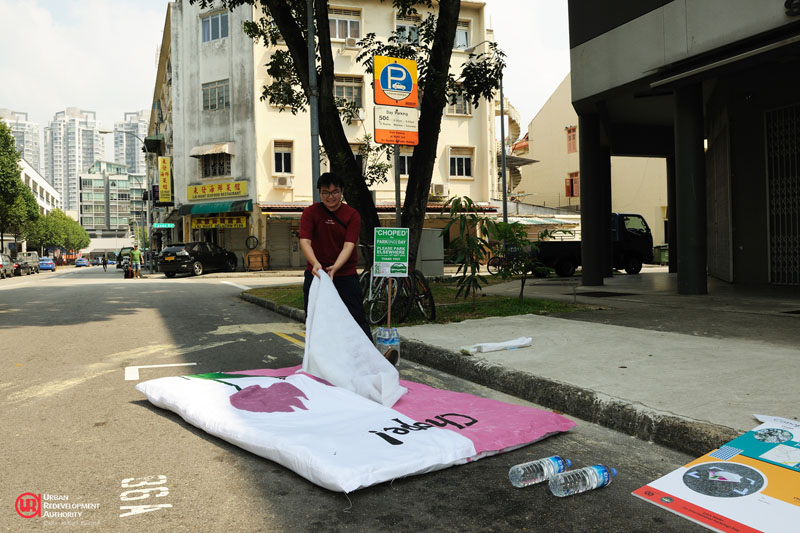
A SUTD student brings a uniquely Singaporean tradition to the road – reserving a space with a tissue packet during PARK(ing) Day 2014. | URA
Doyouthinkengagingthe‘ground’asagovernmentagency,makestheprojectanydifferentifthese interventionswereinitiatedbyanindependentcommunity?As a government agency, it is inevitable that we receive a different kind of response compared to an independent community group. In the long term, we would really like to see our role being taken over entirely by the community. But for now, I think we have an important role to play in lending our ‘official’ support to projects such as PARK(ing) Day to encourage the community to think outside the box and hopefully through our close working relationship with other agencies, help facilitate approvals needed for such projects.
Youmentionedthattheteamengagesthecommunity.Canyoushareexamplesofhow this has been done and what the results were? PARK(ing) Day is a great example of community engagement and participation. We owe a large part of its success to working with the groups of people from SUTD and COLOURS. While we helped to get the necessary approvals and opened up participation across the island, these groups actively engaged the community in Jalan Besar and created their own Jalan Besar PARK(ing) Day group. They had one of the most visited locations on the day.
We have also been working on a series of other community engagement projects. An example would be our first pop-up project, ‘Picnic In the Park – Under the Gelam Trees’, which was inspired by one of the submissions from the ‘Your Ideas for Public Spaces’ competition launched last year.
A makeshift barber shop at Hamilton Road providing free haircuts for the community. | URA
Couldyousharewithussomefactsandfigures? For instance, what was the participation and response to PARK(ing) Day, and what kind of budget were you working with? We were delighted by the overwhelming interest and participation for PARK(ing) Day. We saw 58 PARKs created, of which 41 PARKs were by members of the public. URA and other agencies, such as NParks, LTA and NHB took the opportunity to also participate by creating a number of PARKs ourselves.
Generally, there was a good turn-out at each PARK, and we are heartened by the positive comments that were received from the public.
We aim to deliver all of our projects based on the ‘Lighter, Quicker, Cheaper’ principle by using low-cost materials, and working with the community and property owners to deliver smaller scale projects. For PARK(ing) Day, the interventions were created by the participants themselves. There was no budget allocated to the participants.
We aim for our projects to be simple and affordable to implement so that property owners and community groups can see the potential and implement their own changes.
Whatistheroleofthelargercreativecommunityandthepublicingeneralintheactivationofourpublic spaces?Andalso,howcantheycontribute? By their very definition, public spaces are community spaces and “belong” to the public. We hope both the creative community and the community at large will be inspired to contribute to the making and activation of public spaces, and share with us their ideas on using and creating public spaces.
WhatisthedefinitionofsuccessforPubliCity? At the end of the day, we hope to create more awareness of the importance of good public spaces and the role these spaces play in the built environment. Success is also achieved when the community demands for more of these spaces, and when we receive more ground-up ideas to either create more public spaces or make use of existing ones.
At the end of the first year after the launch of PubliCity, we are happy with the results and have received great feedback from participants and communities where we have run projects. In some cases, we have received requests for a return of our pop-up projects or for more permanent interventions.
Whatkindof“support”fromthecommunityisneededtokeepthisprogrammegoing? Given the early stage of this initiative, the most valuable support we can receive right now is feedback from the community on both the projects that we are undertaking and their ideas on what they would like to see in the future. Over time, we hope to see more ground-up projects being put forward. We would like our role to change to one of supporting the community, rather than the community supporting us.
—————————————
INTERVIEWED BY ADIB JALAL
EDITED BY JUSTIN ZHUANG
 A government-led initiative to encourage ground-up ownership of public spaces is ironic, but very Singapore. Such was the reception of many when the Urban Redevelopment Authority (URA) launched