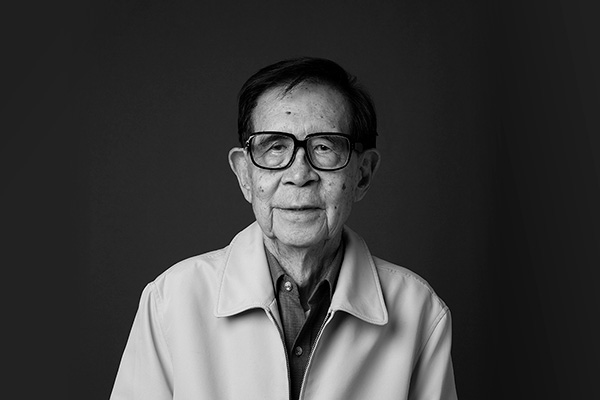
In the years leading to Singapore’s independence, Alfred Wong and other young architects founded what became the Singapore Institute of Architects (SIA) to empower local practitioners and educate society about the architecture profession.
Over five decades on, with the architecture profession well established locally, the 85-year-old has embraced the global market and built up a successful multinational practice that works on projects from around the world out of its two offices in Singapore and Chengdu.
Such foresight has helped Wong successfully grow his practice since starting it in 1957, just four years after graduating from architecture school in Melbourne, Australia. It has also made him a pioneer in Singapore’s design history. Besides laying the foundation of the profession as a founding member of SIA, Wong also advocated for architecture training to be transferred from the polytechnic to the university, and successfully delivered some of the country’s earliest modern buildings against a backdrop of decaying shophouses and traditional kampungs.
WOHA Architect’s latest public housing design in Singapore: SkyVille @ Dawson.
To the provocative question of what future lay for architecture, the responses from this year’s Archifest conference were surprisingly measured. Invited speakers Kerry Hill, Professor Waro Kishi, Professor Li Xiaodong – with the exception of Wong Mun Summ – offered moderate answers to the theme of “What Future?” set by the Singapore Institute of Architects (SIA) for its annual festival this year. While acknowledging the profession is now in an “age of uncertainty”, the first speaker of the conference, the 72-year-old architect Kerry Hill, quoted the late English actor Arthur Wing Pinero and declared that “The future is only the past again, entered through another gate.”
Integrated developments that combine retail, residential and transport such as the recently opened Bedok Mall and the upcoming Northpoint City in Yishun may now be presented as a solution for a denser Singapore, but it is an idea that is almost five decades old.
Back when the newly independent Singapore was drawing out plans for its future city, a group of architects and planners—William Lim, Tay Kheng Soon, Koh Seow Chuan, Chew Weng Kong, Chan Sau Yan, amongst others—formed the Singapore Planning and Urban Research Group (S.P.U.R) in 1965 to study and develop proposals for the nation’s city development. Anticipating a future where the world would only become more densely populated, the group imagined a “true city” to be a “congested city”, one where people would live in higher concentration and on land that was intensively used for multiple functions.
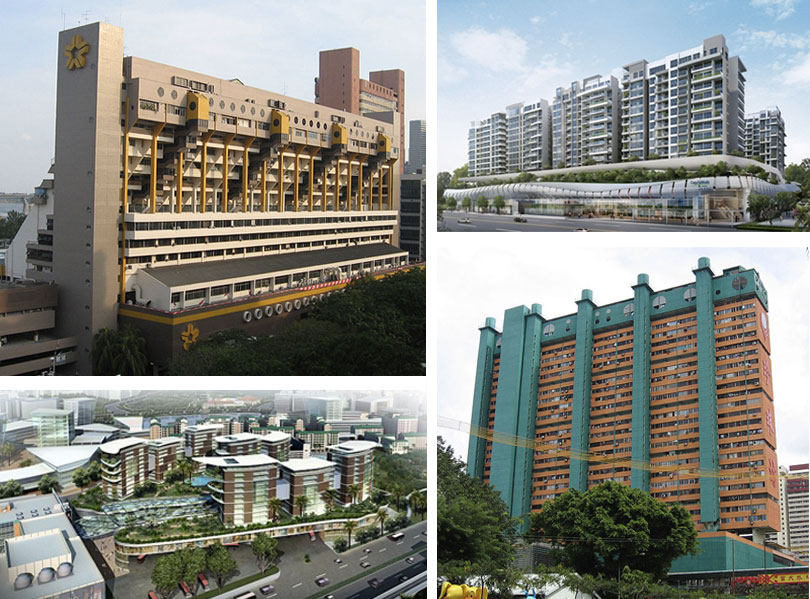
This was a vision S.P.U.R sketched out (above) for Asia Magazine in May 1966—and some of its members eventually built it out in the forms of Golden Mile Complex and People’s Park Complex. Completed in the 1970s, these buildings that combined offices, residences and shops stood apart for decades in a city that became carved out for single land uses, or what the group warned in their article as “out-dated planning principles that seeks to segregate man’s activities into arbitrary zones, no matter how attractive it may look in ordered squares on a land use map.” But as Singapore’s population has almost tripled from 1.9 million in 1966 to 5.5 million today, the state has shifted its urban planning approach, which echoes S.P.U.R’s proposals for the future Asian city. The Golden Mile and People’s Park complexes are no longer eccentric anomalies of the city but architecture templates for Singapore’s future.
(Clockwise, left to right) Golden Mile Complex (1973), rendering of Bedok Mall (completed 2013), People’s Park Complex (1973), and rendering of Northpoint City (expected 2018). | WIKIMEDIA/SENGKANG
Not all ideas by this non-governmental organization were rejected by the state at first. During the 1970s debate over expanding Paya Lebar airport or moving it to Changi, S.P.U.R made a public case for the latter—and they were vindicated. With the on-going expansion to build a fourth airport terminal, Singapore must be glad to have made the move. This was also to be one of the group’s last contributions to the nation’s urban planning discourse as it de-registered in 1975. Its members, however, carried on their activism in different forms, continuing to publish books and proposals about the city’s future.
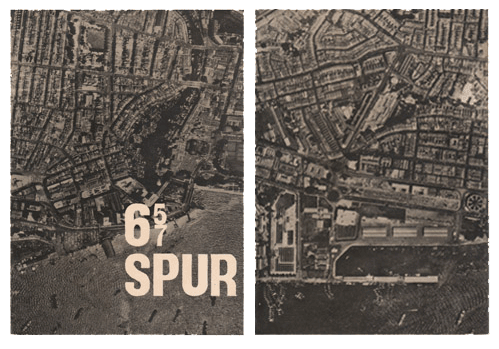
Front and back cover of the inaugural SPUR publication.
Many of S.P.U.R’s proposals and activities were documented and published in two journals the group released. The pages may be in black and white, but they vividly show how Singapore became, or is only now becoming. Alas, their contribution has received much spotlight until now. NUS Museum is hosting a 50th anniversary reunion for the group next week, and it will be a fantastic opportunity to revisit a declaration they made in their inaugural publication: “We are at a cross-road between the old and the new Singapore and the planning and environmental decisions which we make today must be with vision and foresight, as future generation will judge as we judge our predecessors.”