What started five decades ago as a government-led project to build Singapore into a clean and green city, has today become a dialogue between the state and its citizens.
STRAITS TIMES
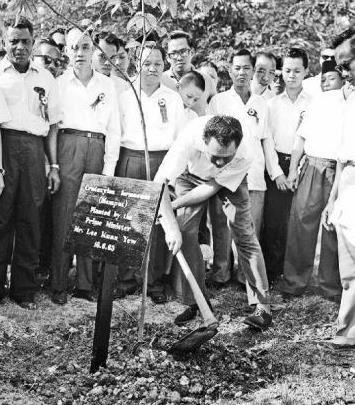
A Straits Times photo of former Prime Minister Lee Kuan Yew launching Singapore’s first-ver tree planting campaign in 1963 best depicts how the idea of building Singapore into a Garden City first took root. As Mr Lee bent over to dig a hole with a changkol to plant a Mempat tree in Farrer Circus, Singaporeans stood around and watched — none of them offering a helping hand.
Fast forward to 2012, and one finds a different landscape of Singapore’s Garden City. In August, a group of residents in Limau estate petitioned the government to conserve a stretch of greenery near their homes instead of selling the land for development. This was not an isolated case. In that year alone, residents in Dairy Farm, Pasir Ris and Clementi also clamoured for green plots near their estates to be preserved, using what has since become a tried-and-tested method of engaging the government: banding together to write petitions and meeting their Members of Parliaments to convey their thoughts and concerns.
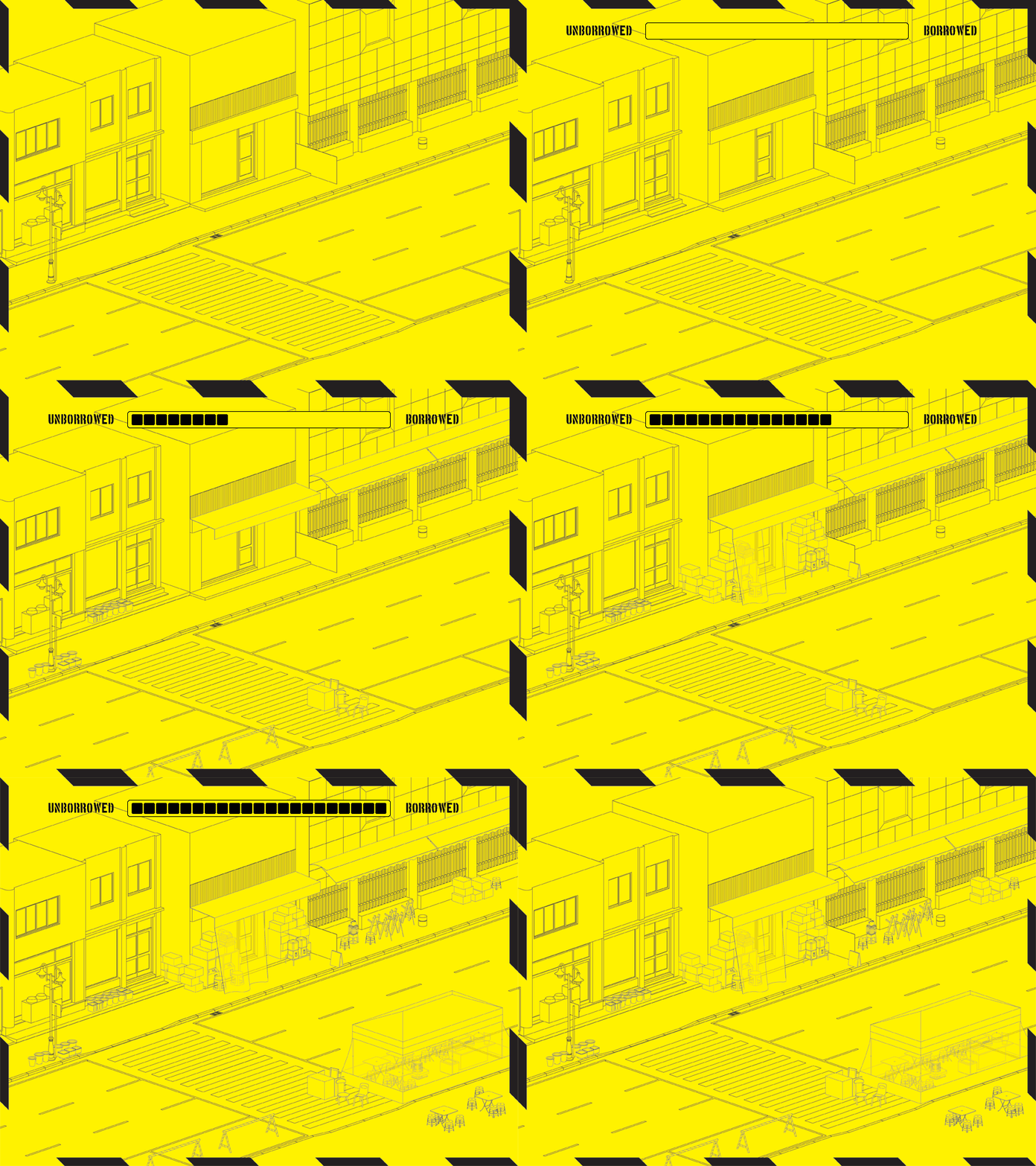
Imagine the city as a space for borrowing instead of buying, says architecture studio MOTOElastico in their book “Borrowed City”. | MOTOElastico
The city is often portrayed as a playground for the rich and powerful: the real estate developer, the urban planner, the starchitect. From their point-of-view (often high up in skyscrapers), ordinary city inhabitants look nothing more than specks amidst the glitzy urban skyline.
Two recent books from Asia take us down to the streets of the city instead. Both publications are fascinating collections of hyper-local vernacular designs that demonstrate how two Asian cities are built from the ground-up.
For the cover of “Borrowed City”, graphic designer Fritz K. Park reappropriated the visual language of the yellow-and-black striped street barricades commonly found in Seoul.
Borrowed City (2013) is a tour through Seoul by MOTOElastico. The architecture studio has been documenting how private citizens use public space for their personal benefit in the capital since 2009. Turning sidewalks into stores with just a few baskets of goods, planting vegetables along public staircases, or ‘parking’ on the roadside to have a picnic lunch — these are just some of the book’s examples of how citizens have built their own spaces in the city; each intervention is photographed and enhanced with 3-D models. By reading such acts as “borrowing” as opposed to “buying” the city, the studio (headed by Italians Marco Bruno and Simone Carena) makes a case for how the considerate use of public spaces by citizens can help build a more participatory and inclusive city.
Siu King-chung’s lesser designs (2013) showcases similar projects from Hong Kong. Inspired by 19th century English designer and critic William Morris’s idea of the “Lesser Arts”, Siu created a book that celebrates the design wisdom of ordinary citizens. Beginning with a typical Hong Kong home and ending out on the city’s colourful neon-lit streets, the associate professor at the city’s PolyU Design points out the variety of anonymous designs in everyday life through photographs. The simple Chinese and English captions prove how design and creativity are not exclusively for professionals — “Lesser designs” for Siu are not lousier, just less obvious.
What makes both books particularly precious is that they offer another view of city life — one that is often transient and threatened by rapid urban development. Whether it is in Seoul, Hong Kong or any of the growing cities in Asia, “modern” solutions are increasingly introduced with the promise of order, efficiency, and a better living environment. But by re-framing seemingly chaotic street life through smart citizen interventions, both books offer a more humanistic reading of city living that begs a closer look.
———– Written for Elizabeth Spiers and Chappell Elison’s Online Publishing class at D-Crit.
It’s all about you, me, and them, at this year’s Archifest. Singapore’s annual architecture festival turns to the “Crowd” for its eighth edition as it looks at the impact of communities and collaborations in the built environment.
From a pavilion created by two architecture teams to “crowd pricing” workshops that demonstrate the economic benefits of purchasing as a group, this two-week long festival organised by the Singapore Institute of Architects will address how individuals can work with one another to affect change in the city from the ground-up.
This year’s focus on people is not just apt for a festival which aims to bring architecture closer to the public, but also reflects the beliefs of a new team. Taking over from previous director Adib Jalal and his team is PLUS Collaboratives, a two-year-old design collective who say they are all about working together to making work that the common man can appreciate.
“We feel creating programmes out of thin air is not something that a short festival should do. Instead, the programmes created should have a lasting reference,” said member Mervin Tan who is also this year’s Archifest director. “What we tried to do is to collect parallel voices to sing the same tune, and to sing louder together for this festival. We aim to show to the public the idea of ‘crowd’ does exist amongst the creative industries and is something real.”
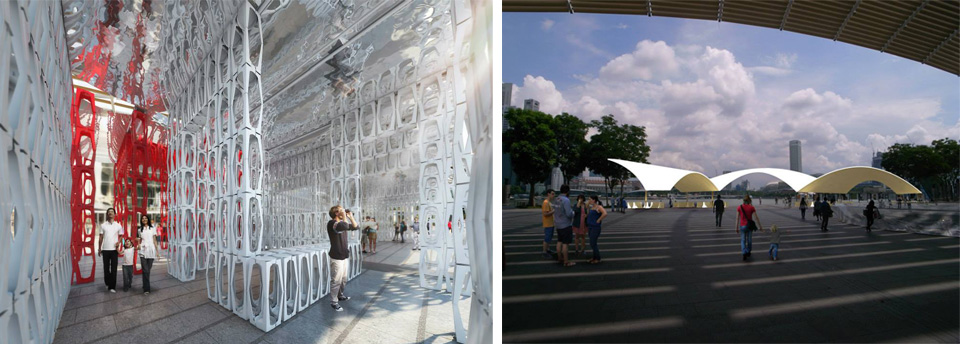
New to this year’s festival is working closely with students from various design schools to create projects that address this years’ theme. The students of Ngee Ann Polytechnic designed spaces for Little India to promote interaction and integration between the users of different social and cultural backgrounds in this ethnic enclave, while the architecture undergraduates of the National University of Singapore (NUS) studied appropriate materials and designs to better shade the city’s public spaces from the sun. These projects and more will be showcased at Marina Bay Sands where Archifest has erected a pavilion which is a design collaboration between HCF and Associates as well as Agfacadesign and the NUS. Both teams were winners for this year’s pavilion design competition, an unexpected decision made by the jury.
This year’s Archifest pavilion will be designed by HCF and Associates as well as Agfacadesign and the NUS, whose respective concepts “Fugue 1357″ (left) and “Cloud Arch” (right) were picked as joint winners for this year’s design competition. | ARCHIFEST
“This year we experienced the highest number of entries (28) since the beginning of the competition (in 2012) and the final shortlisted entries were really outstanding in their own rights,” explained Mervin. “Although it was not conventional to commission two winners, the jury decided to go ahead with this decision, which also bolts well with the overall theme of crowd and collaboration.”
Even as Archifest continues to make architecture relevant to the Singapore public, the festival has also not forgotten about the industry. From this year on, the festival will be launching ArchXpo, a new tradeshow component. Unlike other industry-specific events in Singapore such as the recent International Green Building Conference or the upcoming World Architecture Festival, Mervin said their show will be less topical and “a direct showcase of new ideas, future, projects” instead. More importantly, it is part of an effort to make the home-grown Archifest internationally relevant, as the Singapore Institute of Architects has partnered event organisers Conference & Exhibition Management Services for this event.