Category: Cities

Bringing Architecture to the Crowd

It’s all about you, me, and them, at this year’s Archifest. Singapore’s annual architecture festival turns to the “Crowd” for its eighth edition as it looks at the impact of communities and collaborations in the built environment.

From a pavilion created by two architecture teams to “crowd pricing” workshops that demonstrate the economic benefits of purchasing as a group, this two-week long festival organised by the Singapore Institute of Architects will address how individuals can work with one another to affect change in the city from the ground-up.

This year’s focus on people is not just apt for a festival which aims to bring architecture closer to the public, but also reflects the beliefs of a new team. Taking over from previous director Adib Jalal and his team is PLUS Collaboratives, a two-year-old design collective who say they are all about working together to making work that the common man can appreciate.

“We feel creating programmes out of thin air is not something that a short festival should do. Instead, the programmes created should have a lasting reference,” said member Mervin Tan who is also this year’s Archifest director. “What we tried to do is to collect parallel voices to sing the same tune, and to sing louder together for this festival. We aim to show to the public the idea of ‘crowd’ does exist amongst the creative industries and is something real.”

New to this year’s festival is working closely with students from various design schools to create projects that address this years’ theme. The students of Ngee Ann Polytechnic designed spaces for Little India to promote interaction and integration between the users of different social and cultural backgrounds in this ethnic enclave, while the architecture undergraduates of the National University of Singapore (NUS) studied appropriate materials and designs to better shade the city’s public spaces from the sun. These projects and more will be showcased at Marina Bay Sands where Archifest has erected a pavilion which is a design collaboration between HCF and Associates as well as Agfacadesign and the NUS. Both teams were winners for this year’s pavilion design competition, an unexpected decision made by the jury.

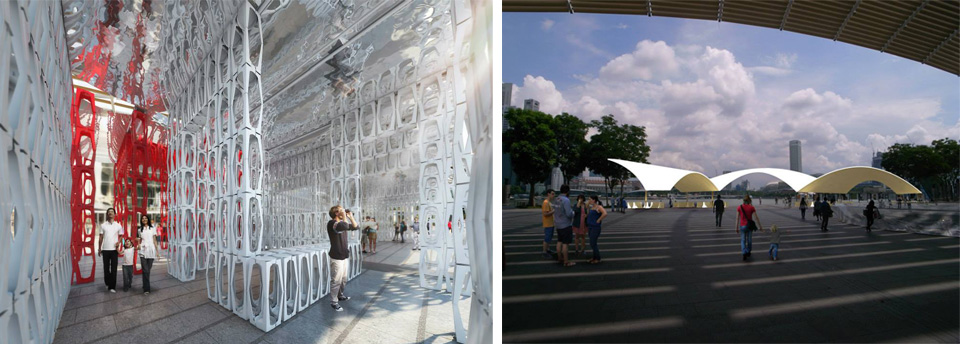
his year’s Archifest pavilion will be designed by HCF and Associates as well as Agfacadesign and the NUS, whose respective concepts “Fugue 1357″ (left) and “Cloud Arch” (right) were picked as joint winners for this year’s design competition. | ARCHIFEST
This year’s Archifest pavilion will be designed by HCF and Associates as well as Agfacadesign and the NUS, whose respective concepts “Fugue 1357″ (left) and “Cloud Arch” (right) were picked as joint winners for this year’s design competition. | ARCHIFEST

“This year we experienced the highest number of entries (28) since the beginning of the competition (in 2012) and the final shortlisted entries were really outstanding in their own rights,” explained Mervin. “Although it was not conventional to commission two winners, the jury decided to go ahead with this decision, which also bolts well with the overall theme of crowd and collaboration.”

Even as Archifest continues to make architecture relevant to the Singapore public, the festival has also not forgotten about the industry. From this year on, the festival will be launching ArchXpo, a new tradeshow component. Unlike other industry-specific events in Singapore such as the recent International Green Building Conference or the upcoming World Architecture Festival, Mervin said their show will be less topical and “a direct showcase of new ideas, future, projects” instead. More importantly, it is part of an effort to make the home-grown Archifest internationally relevant, as the Singapore Institute of Architects has partnered event organisers Conference & Exhibition Management Services for this event.

Book Review: Lesser Designs

Lesser Designs Cover

In cities across Asia, design is largely understood with a capital ‘D’. A professional service that raises the economic value of things through the language of style. A modern high-end product only for those who can afford it.

But what about traditional crafts and vernacular creations found in everyday life? Are these also not designed? In his delightful book, “lesser designs” (揦西設計) (2013), Siu King-chung calls the inclusion of everyday inventions of ordinary people in his city of Hong Kong as part of our understanding of contemporary design. From modified street trolleys to simple pamphlets advertising money-lending services, the professor at The Hong Kong Polytechnic University School of Design picks out ordinary things found around the city and unveils the design wisdom behind each through photographs and casual explanations written in Chinese and English. In all, close to 30 collections of objects are divided into four themes to illustrate what “lesser designs” are and where to find them.

Read the rest at art4d.asia

Creativity Pops-up Across Singapore

Singapore creativity is all around town these days — if you can catch it on time. Pop-up markets have become a popular platform for local designers to display and sell their wares. These ephemeral events allow groups of small independent designers to rent interesting spaces together, as well as present as an attraction larger than themselves.

While trade shows in convention centres have traditionally served this role, the new pop-up style markets present themselves as specially-crafted experiences. They present designers around particular themes or standards, and are usually held in locations outside of typical retail spaces. Creatory showcased over 60 of Singapore’s creative talents in an industrial building in MacPherson two weekends ago, and in February, NÓNG took over the rooftop carpark of People’s Park Complex where organiser Edible Gardens is also building an urban farm.

A carpark rooftop was turned into an urban farm and marketplace for food and design in February as part of Edible Garden’s efforts to promote Singaporeans to “Grow Your Own Food”. | NÓNG

Reclaiming out-of-the-box locations for creative showcases is not new in this city. Back in 2004, design agency WORK brought the Comme des Garcons Guerilla Store to Singapore, helping the Japanese fashion label open year-long pop-up stores in Chinatown, Arab Street, Bukit Merah and Mount Sophia — none of which were known to be hip districts then. Around the same period, FARM also started regular ROJAK sessions by inviting designers and artists in Singapore to present their work at unconventional spaces such as the old National Stadium and an apartment in Golden Mile Complex. That today’s pop-ups are filled with local designers who are making and selling (not just talking), suggests the industry has grown. And it’s not just online design retailers like Naiise and Haystakt who hold such pop-ups, but there are specialist companies like Public Garden and Shophouse & Co that do so.

Creative pop-ups are only getting bigger and more ambitious. Come mid-September, Keepers: Singapore Design Collective will open for five months in the heart of Orchard Road with a specially-built pavilion designed by Zarch Collaboratives and ACRE. Also worth mentioning, is 2902 Gallery‘s on-going campaign to build DECK, a photography centre designed out of container boxes by LAUD Architects, which presumably can be moved when the two-year lease runs out.

2902 Gallery is trying to raise $20,000 online to build DECK, a new independent arts center dedicated to photography.

Even as pop-ups expand, brick-and-mortar stores that retail local design are not going away anytime soon either. Hong Kong based Kapok opened a store in the National Design Centre last year offering products from designers around the world including Singapore. Home-grown design shops, The Little Dröm Store and Supermama also recently refreshed and move into new stores too.

For a country, whose previous prime minister once declared that “Life for Singaporeans is not complete without shopping,” buying local design has never been easier than now.