Singapore creativity is all around town these days — if you can catch it on time. Pop-up markets have become a popular platform for local designers to display and sell their wares. These ephemeral events allow groups of small independent designers to rent interesting spaces together, as well as present as an attraction larger than themselves.
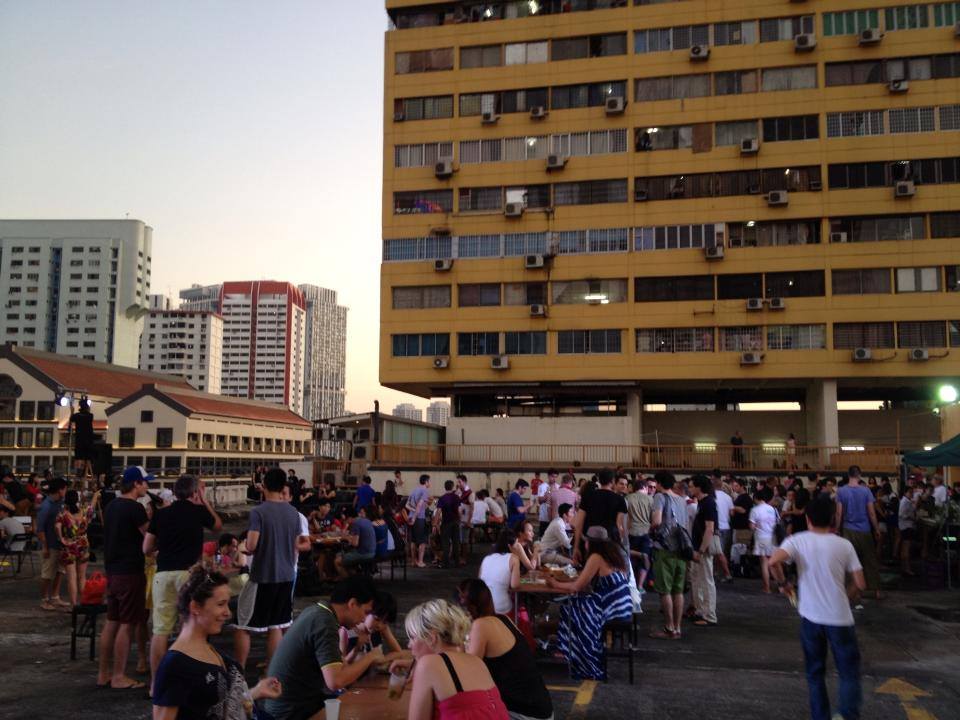
While trade shows in convention centres have traditionally served this role, the new pop-up style markets present themselves as specially-crafted experiences. They present designers around particular themes or standards, and are usually held in locations outside of typical retail spaces. Creatory showcased over 60 of Singapore’s creative talents in an industrial building in MacPherson two weekends ago, and in February, NÓNG took over the rooftop carpark of People’s Park Complex where organiser Edible Gardens is also building an urban farm.
A carpark rooftop was turned into an urban farm and marketplace for food and design in February as part of Edible Garden’s efforts to promote Singaporeans to “Grow Your Own Food”. | NÓNG
Reclaiming out-of-the-box locations for creative showcases is not new in this city. Back in 2004, design agency WORK brought the Comme des Garcons Guerilla Store to Singapore, helping the Japanese fashion label open year-long pop-up stores in Chinatown, Arab Street, Bukit Merah and Mount Sophia — none of which were known to be hip districts then. Around the same period, FARM also started regular ROJAK sessions by inviting designers and artists in Singapore to present their work at unconventional spaces such as the old National Stadium and an apartment in Golden Mile Complex. That today’s pop-ups are filled with local designers who are making and selling (not just talking), suggests the industry has grown. And it’s not just online design retailers like Naiise and Haystakt who hold such pop-ups, but there are specialist companies like Public Garden and Shophouse & Co that do so.
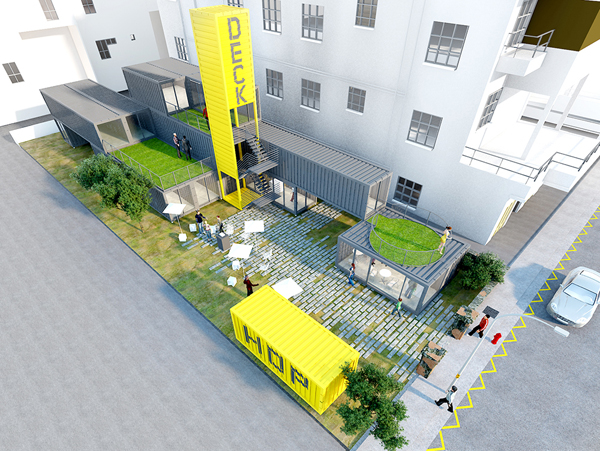
Creative pop-ups are only getting bigger and more ambitious. Come mid-September, Keepers: Singapore Design Collective will open for five months in the heart of Orchard Road with a specially-built pavilion designed by Zarch Collaboratives and ACRE. Also worth mentioning, is 2902 Gallery‘s on-going campaign to build DECK, a photography centre designed out of container boxes by LAUD Architects, which presumably can be moved when the two-year lease runs out.
2902 Gallery is trying to raise $20,000 online to build DECK, a new independent arts center dedicated to photography.
Even as pop-ups expand, brick-and-mortar stores that retail local design are not going away anytime soon either. Hong Kong based Kapok opened a store in the National Design Centre last year offering products from designers around the world including Singapore. Home-grown design shops, The Little Dröm Store and Supermama also recently refreshed and move into new stores too.
For a country, whose previous prime minister once declared that “Life for Singaporeans is not complete without shopping,” buying local design has never been easier than now.
In land-scarce Singapore, the sky is the next frontier for building a “City in a Garden.” Following iconic designs such as Marina Bay Sands SkyPark and Pinnacle@Duxton’s skybridge, the Housing and Development Board recently revealed it has been greening up the rooftops of public housing boards and carparks creating some 28ha of greenery in the skies.
“Design Green! Skycourts & Skygardens” is a new event this month that looks more closely at this phenomenon. Architecture firm Pomeroy Studio have put together an exhibition on the evolution of skyrise greenery, discussions with leading practitioners such as Andrew Grant and Ken Yeang, as well as an installation to showcase with Shophouse & Co’s Transitional___ programme to showcase how rooftops can be transformed in dense and built-up cities like Singapore.
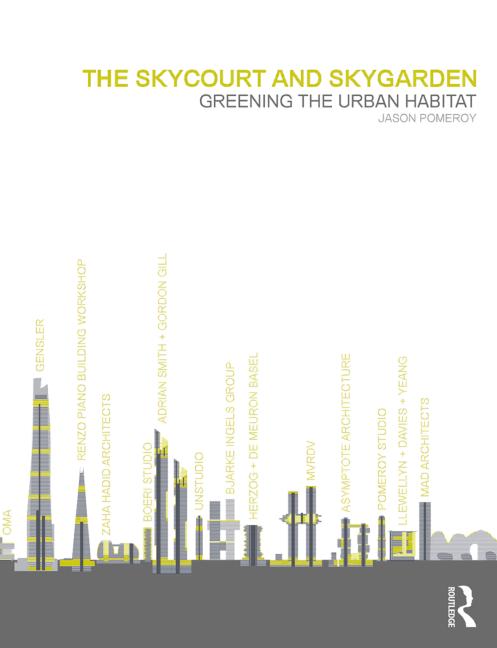
Pomeroy Studio’s principal, Professor Jason Pomeroy, who is also the author of The Skycourt and Skygarden: Greening the Urban Habitat, talked to us recently about skyrise greenery and how Singapore can green its skies.
Are skycourts and skygardens simply about planting greenery on rooftops?
JP: That is the common misconception. Not only are they places of potential greenery that naturally bring the environmental and bio-diversity properties of plants to the urban habitat, they are also social spaces that offer recreational amenity and places to meet, greet and congregate.
You make a distinction between “skycourts” and “skygardens”, could you elaborate on the difference? JP: Skycourts’ are internal or external social spaces, often incorporating elements of greenery, that are located mid–point within buildings. ‘Skygardens’ has become quite a generic term used for the greening of social spaces in the urban habitat, but it is better described as rooftop garden social spaces.
What are some benefits of skycourts and skygardens? JP: Spatially, skycourts and skygardens replenish the loss of open space one would normally use for social interaction through urbanisation. They provide the social function of bringing people together, and create a forum for communal activity. When planted, they can further assist in reducing ambient temperatures, reduce rainwater run–off, reduce noise, and enhance the bio-diversity of a place. They can also be income generating if the rooftop garden is used as an observation deck.
In your book, you argue that skycourts and skygardens are a way of replacing the loss of greenery as cities become denser due to commercial development. Are they equitable replacements? JP: In an ideal world, we would have an abundance of forests that will help balance our eco-systems and cool the environment, but the reality is that we are increasing the concrete and glass jungle in lieu of the natural counterpart. Skycourts and skygardens is a means of helping to replenish the loss of urban greenery. In fact, we can measure the quantum of greenery using what is called the ‘Green Plot Ratio’ method to either maintain or enhance the appropriate greenery levels in the city for the environmental benefits.
Prof Pomeroy’s book makes a case for skycourts and skygardens using some 40 projects from around the world. | POMEROY STUDIO
One issue with skygardens and skycourts is they currently exist in isolation and are inaccessible to many. How can this be changed? JP: This statement may have been true 10 years ago, but things are changing. Examples completed more recently show the promise of more ‘public’ orientated environments, and their greater usage as an environment for transition as well as social interaction. Unlike their mono-functional predecessors that were less integrated with people movement patterns, newer skycourts and skygardens are more integrated into the cores of tall buildings–spatially linking vertical methods of circulation and facilitating people movement. They also socially link occupants through the heightened probability of chance meetings.
What is required for building skycourts and skygardens? Must architecture be designed to accommodate them?
JP: Just as we design the infrastructure for our cities (i.e streets, squares and boulevards to facilitate people movement and meeting) we similarly need to design into our buildings a ‘vertical urbanism’ that sees the skycourts and skygardens function as quasi ‘squares’ and the vertical transportation (stairs, elevators, ramps ) acting as the streets and passageways. Skycourts and skygardens should not be designed as superfluous additions to a building, but a fundamental part of the building’s socio-environmental infrastructure.
HDB recently unveiled plans to add more rooftop greenery to public housing estates. Any thoughts on this development?
JP: As part of my recent architecture travel TV series “City Time Traveller“, I visited Treelodge@Punggol and the Pinnacle@Duxton and was delighted to see steps being taken to green rooftops. This offers many benefits to the community; not least the ability to have recreational space for the inhabitants and potentially reduced running costs given the ability of greenery to reduce temperatures and thus the reliance on artificial cooling methods.
What are the challenges to the spread of skycourts and skygardes in a city like Singapore? Is it infrastructure, policy or social? JP: I actually think Singapore is really living up to its vision of being a city within a garden. It has 2,800 hectares of parks and open spaces, and 3,300 hectares of nature reserves. That’s 8 per cent of the city state’s land area! So it comes as little surprise that it should have a natural penchant for greenery to expand vertically given its high density/high rise nature. Much credit for this has to be given to the forward looking legislation in place that also offers economic incentives to developers to go green, and we as a green design studio are similarly strong advocates for such practices.
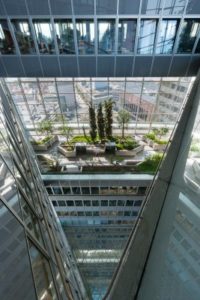
At nine different levels of the Commerzbank Tower, the atrium opens up to a large sky garden. | COMMERZBANK AG / FOSTER + PARTNERS
Can you give one example of a good skycourt or skygardem design? What’s good about it? JP: Commerzbank in Frankfurt by Foster + Partners is still a fine example of skycourt design, despite it being an older case study. The tall building was conceived as three ‘petals’ of triangular office floor plates, grouped around a central ‘stem’ formed by a full height atrium. Sealed sky courts, four storeys high, rise up through the height of the building, rotating every four storeys to the next face. The skycourts provide employees with an opportunity to view other skycourts above and below, as well the cityscape beneath and the sky above. These spaces provide a social dimension for the office employees to use as places of meeting, events, lunches or remote working.
Before Singapore became a city of glass and steel skyscrapers, it was a town built out of bricks made on the very shores of this island. “Our Brick Estate” is an on-going exhibition traces the history of this construction material in Singapore, rebuilding the history of the local brick industry by assembling a collection of Made-in-Singapore bricks at the library@esplanade. Architectural and urban historian Lai Chee Kien, who curated this exhibition, tells us more.
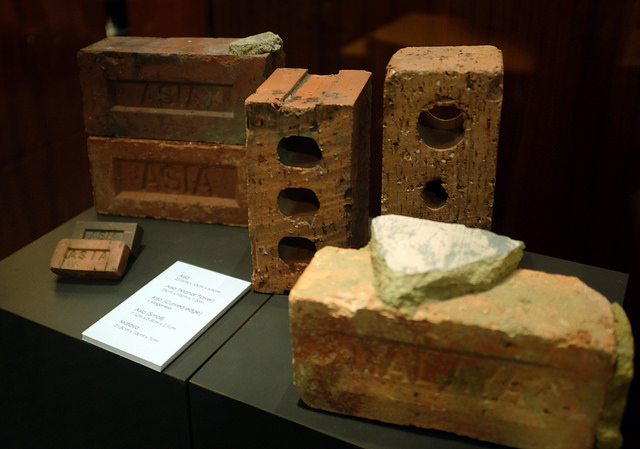
A collection of Made-in-Singapore bricks are on display at the “Our Bricks Estate” exhibition through the end of August. | PUBLIC DOMAIN
How did this exhibition come about? The library@esplanade has seven vertical glass showcases used for exhibition every August for topics related to National Day. This year, a friend — Ms. Khoo Ee Hoon, suggested I curate one about bricks found in Singapore. She had heard my comment while documenting Bukit Brown Cemetery tombs, that bricks of all types from Singapore could be found there. She was also an avid collector of these bricks.
Where did you find the bricks for this exhibition? The bricks came from several collections including Ee Hoon’s, those of Mr. Jevon Liew, and those excavated by a friend, Dr. Anoma Pieris, in 2001 while working on the former convict prison site at Bras Basah during the construction of the Singapore Management University. Together, they constitute an almost complete collection of bricks from most of Singapore’s important brick factories after World War II, as well as the early hand-made bricks which were thinner (about 1.5 inches thick) and coarser in finish.
Why were bricks made in Singapore? Even during the classical Malay kingdom period when structures were constructed on Fort Canning, bricks would have been used. In 1822, the first Town Plan of Singapore mandated permanent materials to be used, and various brick kilns were set up around the Rochore-Kallang river areas. In 1858, the colonial government started its own brick factory, and the industrial methods produced bricks good enough to win prizes, as they did in Agra exhibition in 1867. Bricks were continually used in construction as many areas in the southern and western areas of Singapore had good quality clay to be used as raw materials for the bricks. There was a labour and price crisis in the 1950s when many factories closed, but the next decade onwards saw a rekindling of the industry when the Singapore government embarked on a large scale development programme including housing. By 2000, however, the factories’ land in Jurong and Choa Chu Kang were acquired to create new housing estates.
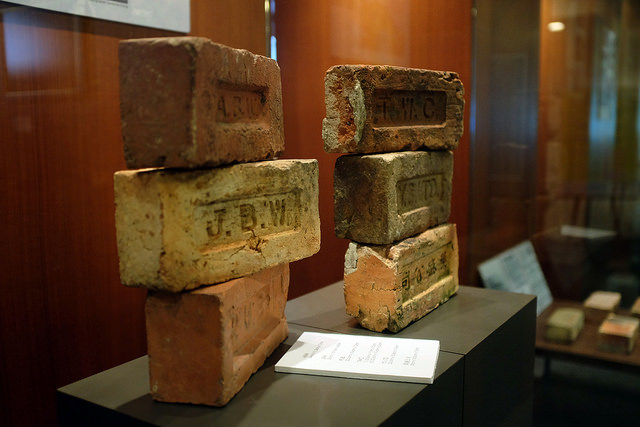
Brick makers in Singapore often printed their names onto the bricks themselves | PUBLIC DOMAIN
What were bricks made in Singapore like? Were they unique in anyway? (e.g. material, quality) They were various types of bricks made in Singapore, including white bricks using a different clay. I think the development from the traditional kiln to more industrial kiln types, like the Hoffman kiln and later the tunnel kiln, made quality control a mainstay. For example, even though Asia Brick Factory at Jalan Lam San occupied only 10.3 hectares of land, it was able to produce around 37 million bricks annually in the late 1980s, when they employed a tunnel kiln.
Who were Singapore’s brick makers?
They varied from convict labour used to make the earliest bricks, to small-scale Chinese brickyards all over the island during the colonial and inter-war periods. Investment from elsewhere was also used to finance them. In 1972, sensing that it would be better for their supplies, the Housing & Development Board purchased a factory to make its own bricks and to prevent price fluctuations. At one point in time in the 1980s, the demand for bricks was so great that millions of bricks had to be imported from elsewhere to feed the construction industry.
What was the extent of Singapore’s bricks industry? The factories were located in the southern areas of Singapore (Bukit Merah and Alexandra, for instance) and in large areas in the west. There was one in the Upper Serangoon area and earlier ones adjacent to the Rochore and Kallang Rivers. Most bricks were produced for use in Singapore, but companies have been known to supply bricks to Malaysia and elsewhere.
Where is Singapore’s brick industry today? There are no more brick factories in Singapore today, as bricks are now all imported from overseas. Their characteristic tall chimneys and sprawling drying yards can no longer be seen. There are still kilns, but these are used more for firing ceramics, like Thow Kwang in Jurong.
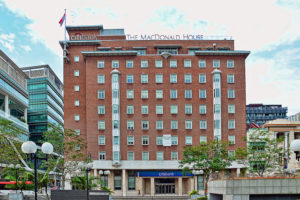
The MacDonald House was completed in 1949 with locally made bricks, and has been gazetted as a national monument. | CHOO YUT SING
What are some buildings still standing today that used these Made-in-Singapore bricks? The many HDB flats all over the island would have them — these are the ones built before pre-cast panels and components were used in the 1990s. MacDonald House, the old Central Fire Station, old shophouses and even the National University of Singapore campus uses a lot of bricks as a primary construction material. You can see an exposed brick archway at The Arts House, which was completed in 1826 using probably imported bricks. A lot of bricks are plastered up nowadays so you can only see the plaster work and not the bricks that were covered up. Many others have known to paint over facing bricks for their homes and other buildings.
How can we identify a Made-in-Singapore brick?
We can mainly tell by their factory names imprinted onto the brick recess. Some of these include: Alexandra, Jurong, Nanyang, Sin Chew, Malayan, Asia, Goh Bee, Kim Lan, and Tekong, etc.