Category: Cities

Building Singapore Brick by Brick

Before Singapore became a city of glass and steel skyscrapers, it was a town built out of bricks made on the very shores of this island. “Our Brick Estate” is an on-going exhibition traces the history of this construction material in Singapore, rebuilding the history of the local brick industry by assembling a collection of Made-in-Singapore bricks at the library@esplanade. Architectural and urban historian Lai Chee Kien, who curated this exhibition, tells us more.
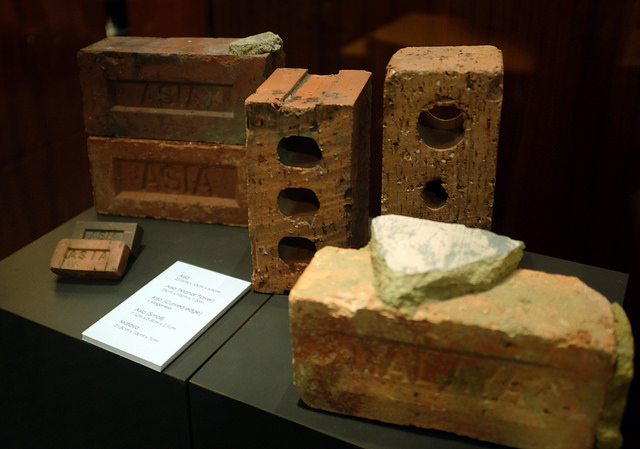
A collection of Made-in-Singapore bricks are on display at the “Our Bricks Estate” exhibition through the end of August. | PUBLIC DOMAIN

How did this exhibition come about?
The library@esplanade has seven vertical glass showcases used for exhibition every August for topics related to National Day. This year, a friend — Ms. Khoo Ee Hoon, suggested I curate one about bricks found in Singapore. She had heard my comment while documenting Bukit Brown Cemetery tombs, that bricks of all types from Singapore could be found there. She was also an avid collector of these bricks.

Where did you find the bricks for this exhibition?
The bricks came from several collections including Ee Hoon’s, those of Mr. Jevon Liew, and those excavated by a friend, Dr. Anoma Pieris, in 2001 while working on the former convict prison site at Bras Basah during the construction of the Singapore Management University. Together, they constitute an almost complete collection of bricks from most of Singapore’s important brick factories after World War II, as well as the early hand-made bricks which were thinner (about 1.5 inches thick) and coarser in finish.

Why were bricks made in Singapore?
Even during the classical Malay kingdom period when structures were constructed on Fort Canning, bricks would have been used. In 1822, the first Town Plan of Singapore mandated permanent materials to be used, and various brick kilns were set up around the Rochore-Kallang river areas. In 1858, the colonial government started its own brick factory, and the industrial methods produced bricks good enough to win prizes, as they did in Agra exhibition in 1867. Bricks were continually used in construction as many areas in the southern and western areas of Singapore had good quality clay to be used as raw materials for the bricks. There was a labour and price crisis in the 1950s when many factories closed, but the next decade onwards saw a rekindling of the industry when the Singapore government embarked on a large scale development programme including housing. By 2000, however, the factories’ land in Jurong and Choa Chu Kang were acquired to create new housing estates.
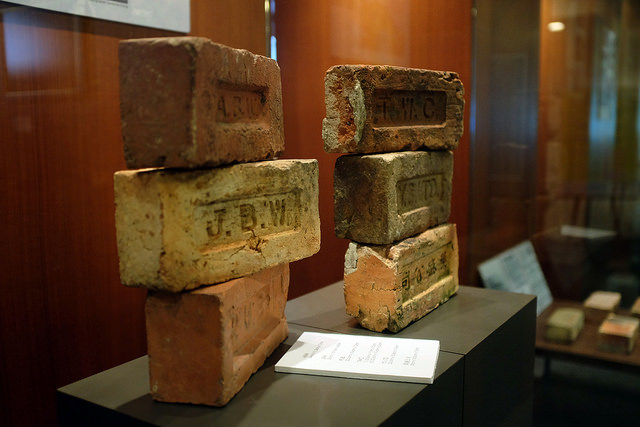
Brick makers in Singapore often printed their names onto the bricks themselves | PUBLIC DOMAIN

What were bricks made in Singapore like? Were they unique in anyway? (e.g. material, quality)
They were various types of bricks made in Singapore, including white bricks using a different clay. I think the development from the traditional kiln to more industrial kiln types, like the Hoffman kiln and later the tunnel kiln, made quality control a mainstay. For example, even though Asia Brick Factory at Jalan Lam San occupied only 10.3 hectares of land, it was able to produce around 37 million bricks annually in the late 1980s, when they employed a tunnel kiln.

Who were Singapore’s brick makers?
They varied from convict labour used to make the earliest bricks, to small-scale Chinese brickyards all over the island during the colonial and inter-war periods. Investment from elsewhere was also used to finance them. In 1972, sensing that it would be better for their supplies, the Housing & Development Board purchased a factory to make its own bricks and to prevent price fluctuations. At one point in time in the 1980s, the demand for bricks was so great that millions of bricks had to be imported from elsewhere to feed the construction industry.

What was the extent of Singapore’s bricks industry?
The factories were located in the southern areas of Singapore (Bukit Merah and Alexandra, for instance) and in large areas in the west. There was one in the Upper Serangoon area and earlier ones adjacent to the Rochore and Kallang Rivers. Most bricks were produced for use in Singapore, but companies have been known to supply bricks to Malaysia and elsewhere.

Where is Singapore’s brick industry today?
There are no more brick factories in Singapore today, as bricks are now all imported from overseas. Their characteristic tall chimneys and sprawling drying yards can no longer be seen. There are still kilns, but these are used more for firing ceramics, like Thow Kwang in Jurong.
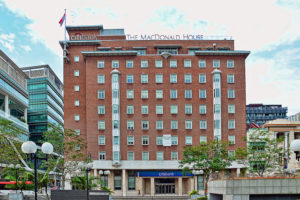
The MacDonald House was completed in 1949 with locally made bricks, and has been gazetted as a national monument. | CHOO YUT SING

What are some buildings still standing today that used these Made-in-Singapore bricks?
The many HDB flats all over the island would have them — these are the ones built before pre-cast panels and components were used in the 1990s. MacDonald House, the old Central Fire Station, old shophouses and even the National University of Singapore campus uses a lot of bricks as a primary construction material. You can see an exposed brick archway at The Arts House, which was completed in 1826 using probably imported bricks. A lot of bricks are plastered up nowadays so you can only see the plaster work and not the bricks that were covered up. Many others have known to paint over facing bricks for their homes and other buildings.

How can we identify a Made-in-Singapore brick?
We can mainly tell by their factory names imprinted onto the brick recess. Some of these include: Alexandra, Jurong, Nanyang, Sin Chew, Malayan, Asia, Goh Bee, Kim Lan, and Tekong, etc.

More Than Rubbish

Every city has its trash can—a forgotten object of design

BY ANGELA SOH FOR CUBES

The dirty, the broken, and the unwanted — the trash can shelters everything a city discards.

Yet, even in this object of singular function one finds a diversity of designs across different cities. From the grounded basketball hoops of New York to the bongo-like drums of Mexico, or the lean baskets of Havana to the stout barrels of Singapore, these different trash can designs contain not just a city’s rubbish, but clues to its culture too.

The typical perforated trash can of New York mimics the gridded streets of the city which it sits on. Contained within is the raw energy and grit of this concrete jungle. Everything is on display: the good, the bad, and the ugly. You’re never sure what you’ll find in the mix that threatens to fly out of the forest green can’s open top or seep through its metallic porous sides. But such openness is what defines New York—a lightly framed cradle unashamed of what it takes in or gives out.

In contrast, Singapore’s commonly found trash bin is a capsule that not just contains, but encloses. This controlled environment is managed by two side openings only large enough for trash to enter but not escape. What is discarded is never given a second look or life: things drop into a large black plastic bag to be condemned into a single unit of measure: rubbish. This homogeneity of trash—and the city—is echoed by the bins’ plastic opaque shells, which protect and project (in green) the government’s efforts to market Singapore as a clean and green city.

More than just symbols of a city, trash cans are also street signs of its refuse collection systems. These temporary repositories come in different sizes and shapes that reflect the peculiarities of a city’s castaways and what happens to them after. While New York’s cans are light enough for cleaners to manually haul its contents into a garbage truck, those in Singapore require the extra step off bagging before disposal instead. But both cities have larger trash cans and in greater numbers than in lesser developed places—a sign of how wasteful modern urban life is with its individualised products often wrapped up in layers of packaging.

Despite their ubiquity and multifaceted designs, trash cans are overshadowed by skyscrapers and glitzy creations as design icons of a city. The myopia of modern design recognizes only the creations of celebrity designers or things that look out-of-the-box as “design”. While these tower over urban dwellers as the exclusive domain of a few, objects like trash cans are on their knees offering an everyday service to all.

Such humility and accessibility are lessons for the world of design. After all, trash cans hold the excesses of a city consumed by the “designer” and the “designed.” What we call rubbish is mostly the remnants of failed or unnecessary design—and the trash can is our convenient solution to forget and ignore the problems it is creating for the city.

An essay written for Cubes Magazine Issue #69 (July/August 2014).

Emerging Design Districts: Jalan Besar (Singapore)

Chye Seng Huat Hardware used to be a neighborhood hardware store in Jalan Besar. Today it serves Third Wave coffee. This conversion is symbolic of how rapidly this industrial area has changed. Together with the design-store-cum-craft- workshop space The General Co above the café, the building has become a landmark of Jalan Besar’s retooling by Singapore’s emerging creative economy.

Just two metro stops east of Singapore’s historic center, City Hall, or a 15-minute drive from the picturesque Marina Bay waterfront, Jalan Besar was swampland that developed as the former colonial town expanded in the late nineteenth century. First home to mills, abattoirs, and brick kilns, the area evolved in the twentieth century with an industrial community that built rows of Art Deco shop houses still standing today. Many have now been creatively repurposed.

Since Chye Seng Huat (which means “to flourish”) opened two summers ago, the neighborhood has percolated with a slew of cafés and creative outfits. Affordable rents at the city’s edge are the draw, but so is the history, culture, and grit. New establishments are nestled amid traditional kopitiams (coffee shops) and workshops left over from Singapore’s yesteryear. At night, the neighborhood features a lively mix of supper spots and dodgy karaoke bars—Little India’s 24-hour Mustafa Centre shopping mall is just a short walk away.

Flanked by the four-lane Jalan Besar (Malay for “big road”) and Rochor River, this neighborhood is a kind of drip-coffee cone, filtering a creative brew into Singapore’s commercial and cultural center. Will it last? By the end of the year, Lavender Food Square Centre, Jalan Besar’s iconic late-night food emporium since the 1980s, will make way for a commercial development that real estate agents are already promoting as “hip.”

Read the complete report at Metropolis