If there is one thing that I already knew after reading the redesigned Straits Times was that the next day, the would run a self-congratulatory article about how its readers liked it. One thing that surprised me, was how they ran promotional articles about the new look on its cover page a few days before the launch. In what way would those articles constitute news that the reader must know first thing in the morning? If that’s not enough, a blogger pointed out that the new ST Homepage launched with a video of bikini babes…
I think such self-promotion, or selling of the ST brand, is telling of how it had become much more concerned about its commercial viability as a corporation and not just being a newspaper. I would suggest that this concern manifests in its re-design.
Indecisive masthead
The masthead embodies a newspaper’s “identity”, and ST’s feeble attempt to mix the old and the new, only suggests how a lot of this newspaper is a compromise. The root of ST’s problem is its compromised answer to who does it want to attract? Time and again, the answer seems to be, we want to be the newspaper for all English readers. After all, the Singapore market is so small and the newspaper market is in decline, hence it must be kiasu: to survive, target everyone! Its attempt to be everything to everyone shows in its re-design — colourful, mix-and-match, yet really indistinguishable. As for the token nod to its heritage with the “.”, I’ll say that some things die with time for a reason, and bringing something back from the dead doesn’t make it a “comeback”.
Blurring the distinction between news and advertisements
While some would argue that the paper looks more vibrant with its multitude of colours, it is this very explosion of palate — in terms of colours, fonts, and styles — that give the presentation of news a “glossy” sheen that I would associate with advertisements. While I like the use of a bigger headline size, the choice of the font, Rocky, is distracting because it has distinct serifs that call attention to the individual letters than to read as a word. In fact, I would think the font is fanciful and associate with use in advertisements, and as a reader I feel I cannot quickly and clearly distinguish where is the news and what it is about. This failure (deliberate or not) to clearly demarcate news and advertisement gets especially troublesome in the advertorials. In the Aug 8 issue in the Life! section, there was a “Special: Corporate Milestones” report, one can see that the distinction in design elements are very subtle.
More white space, not just line space
The news stories now have more line space that make reading breezier, but does that mean stories suffer from the lack of space? How does the bigger headline size restrict the number of stories as well as their depth? I think these are some interesting posers that will be answered in time. For me, it’s more important that a design gives me enough white space to ponder between stories and breathe amidst the claustrophobia induced by the kaleidoscope of colours and advertisements in this new design.
So three of the English newspapers had a re-design this year, Sunday Times, TODAY and now The Straits Times. In my opinion, TODAY, did the best because it came out cleaner, more modern, and more distinguishable. The last I heard, a little bird said The New Paper was going to be re-designed too. That would be interesting, how would a tabloid targeting the professional English-speaking class look like?
P.S. I’ll bet in the next few days we’ll see stories about new-highs in viewership for all the other online forms of ST…


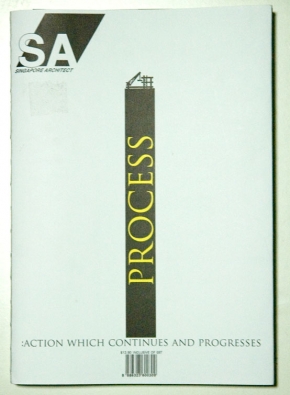 It was by pure coincidence that I chanced upon the newly-revamped
 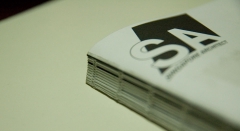 The theme aside, I liked the new logo and how a third dimension as compared to the previous logo was added with the parallelogram. In a sense, architecture is about creating the 3-D form and the new logo communicates this very well. Moreover, the parallelogram behind “SA” acts as a very strong identifying symbol and is used at the end of all its articles.