In a strange coincidence, the last three books I’ve read all explored the problem of how to achieve equitable income distribution in society. The question comes back again and again: How is it that even as the world becomes increasingly developed and wealthier, the income gap between the rich and the poor not only fails to narrow but only increases exponentially? The trio of books — America: What Went Wrong?, The Shock Doctrine and Anarchism — conclude that the problem is due to a systemic flaw in the economy and the answer, optimistically, lies in our own hands.
 Taxing the Wrong People
Compiled from a nine-part series of articles in The Philadelphia Inquirer published in October 1991, America: What Went Wrong? , is the work of two journalists who provide exacting details of how obscenely wrong income inequality was in America in the 1990s. The reason behind it all, argued Donald Barlett and James Steele, lies in the tax system. Not only do loopholes exist that were exploited by companies, the tax system had been written to favour businesses at the expense of citizens. Together with the prevailing attitude then that acquiring debt would impose financial discipline on companies resulted in many expanding beyond their means. The result: alarming debts that drove businesses to bankruptcy and even those that survived had to carry out massive lay-offs or huge cost-cutting measures. It was the tax code that encouraged such reckless behaviour and to a certain extent, even protected the management that made such decisions after that while ordinary Americans took the full brunt of the fall — not only losing their jobs buy bearing the tax burden. Moreover, an industry grew out of handling these bankruptcies, and many consultants, lawyers and office-movers lined up to profit from facilitating the resulting mergers and acquisitions.
 A Tragic Economy Built on Tragedy
This idea of profiting from someone’s losses is applied to the global stage in Naomi Klein’s The Shock Doctrine, a solid journalistic piece about “disaster capitalism”. Drawing from the stories of Chile, Russia, Iraq, Poland, South Africa and Sri Lanka, she shows how disaster is no longer a tragedy but an opportunity for capitalists to swoop in and profit by imposing on them an economic regime guided by the teachings of the late economist Milton Friedman. The idea is elegantly simple: before a country can recover from shock (either from a disaster, if not use military might to shock them like Iraq) force them into taking on an economic shock therapy prescription of de-regulation, privatisation and reducing government spending often with the carrot of promised hefty loans from The World Bank and the International Monetary Fund. Such economic prescriptions and its promised “trickle-down-effects” have only resulted in these countries experiencing staggering increase in income inequality and lower than before standards of living. Moreover, the citizens become divided along class and the rich turn to private providers creating “gated communities”, while those who cannot afford it struggle with whatever little government help there is left.
 Power To The People
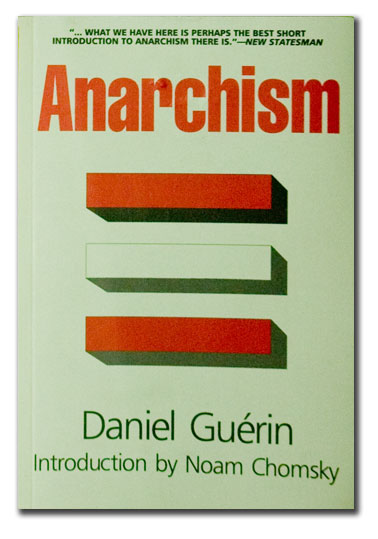
So if the government is barely there, who else can we turn to but ourselves? The empowerment of the individual, argues Daniel Guérin in Anarchism, is really what this misunderstood political movement is about. Often associated with being anti-government and disorder, this books outlines its main beliefs and traces its evolution from its beginnings to the revolution in France of May 1968 in an effort to debunk what this movement is popularly known to be. Anarchy is only the start of anarchism and not its end because it is only then that people can freely associate with one another to organise themselves to self-manage their lives. One has to suspend the Hobbesian belief of human nature as “nasty” and “brutish” to appreciate the beauty that anarchism proposes. But far from suggesting it as utopian, one starts to question Hobbes could be wrong. After all, the history of the implementation of anarchism has shown much promise although it was never complete, and the increasing popularity of human rights, collaboration and the empowerment of the individual all seem to contain strains of the belief in goodness of the individual that lies central to this movement.
You Can Only Blame Yourself
This series of book reading brings the issue of income inequality through the prism of Marxism and arises at very similar conclusions made then — that the masses are simply not in control of the economy which determines their livelihood. There are so many layers of laws, systems and bureaucracies that continue to confuse us while those who draw them up go on making decisions for us. All we can seem to do is to put our faith that they will work for our best interests, but really, can we leave it as that? Because once things go wrong, we have no one to blame but our own apathy and suffer a decision which we had no hand in. Although, if that were to happen we can take comfort in the words of Allan Meltzer, an accused proponent of The Shock Doctrine, who said: “Ideas are alternatives waiting on a crisis to serve as the catalyst of change.”
So hold on to those alternatives, hopes and ideals, your revolution may just be next up.

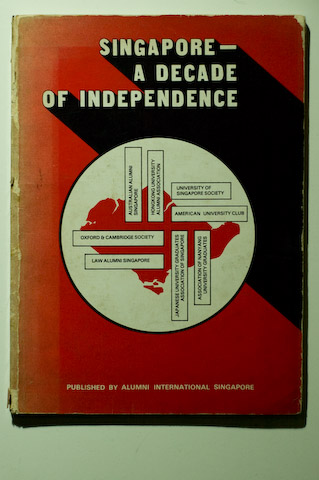 How else can Singapore look like today?
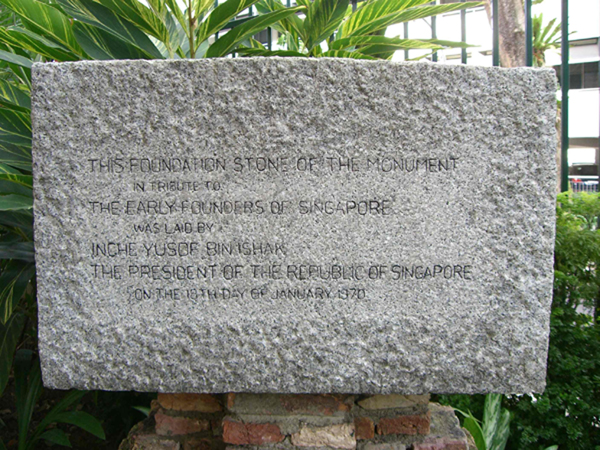 An interesting point to note was how this book was meant to raise funds for the organisation to built a “Monument to the Early Pioneers” that never came true. All that is left of this effort is a foundation stone (right) that is found in the National Archives today. It was originally located at the waterfront side of Collyer Quay and was relocated to its present location because of road works there.
 Another group that proposed an alternative vision of urban Singapore was the Singapore Planning and Urban Research Group (S.P.U.R.) that was set up in 1965 by a group of architects and planners. Its more prominent members include William Lim and Tay Kheng Soon. Its ideas and works can be found in “SPUR 1965-1967” (left), a self-published report and you can still purchase limited copies of it at