Category: Design

Building a Better Singapore Together

Singapore’s success as a city has largely been the work of its state. This top-down approach to urban planning, however, has faced increasing stress from Singaporeans clamouring for more say and the population’s growing diversity of needs. BetterSG was started in 2012 as an independent initiative to improve the city from the ground-up. The campaign lasted only a year, but was recently relaunched by non-profit organisation, Participate in Design (P!D), to get Singaporeans to work together in designing a better city. P!D co-founder Mizah Rahman tell us more about the updated BetterSG, and the challenges of getting people to work together in building a better Singapore.

betterSG

BetterSG has been some years in the making having first been inspired by #betterKL in Malaysia. Tell us more about why and how it’s come to this latest iteration.
BetterSG was initiated in 2012 with Safe Streets, organized by FIVEFOOTWAY in partnership with Macpherson CC, P!D, and Love Cycling SG, and various other individuals, Mr John Rehm, Ziqq from Design Says Hello and the Make Your Mark team at SUTD, and supported by Singapore Institute of Architects. It went on a standstill after the second iteration of Safe Streets in 2013.

Early this year, P!D came together and decided that we needed to have a structured framework and methodology on the way we design with local communities and the tools that we use to do so. We wanted to document and learn from our past projects and also from successful examples of participatory design projects locally and overseas as well. We decided to embark on a research-in-action project to understand, learn, create, prototype and share P!D’s methods and framework for Singapore. We felt that P!D’s new initiative resonated with the BetterSG/BetterCities vision, and so we decided to lead BetterSG this year.

We are currently in Phase 3: Create — where we are developing a blueprint for designing with communities based on findings in Phase 1 and 2. We are in the midst of reviewing the information gathered in earlier phases so as to develop critical insights into the challenges and opportunities for greater involvement from individuals/organisation/designer in Singapore. We will then formulate better tools and methods for working with people to create spaces and solutions that they can own.

Both of you have been carrying out participatory design work in the MacPherson neighbourhood since 2010. What led to the step up to tackle the entire city?
Our emphasis is on a small scale shared spaces, and to first start with the neighbourhood, then the city.

Starting at the level of the neighbourhood, rather than the city, allows us to experiment with smaller but more concrete forms of improving the urban environment through the involvement of regular citizens. Our vision is to make Singapore better, one neighbourhood at a time.
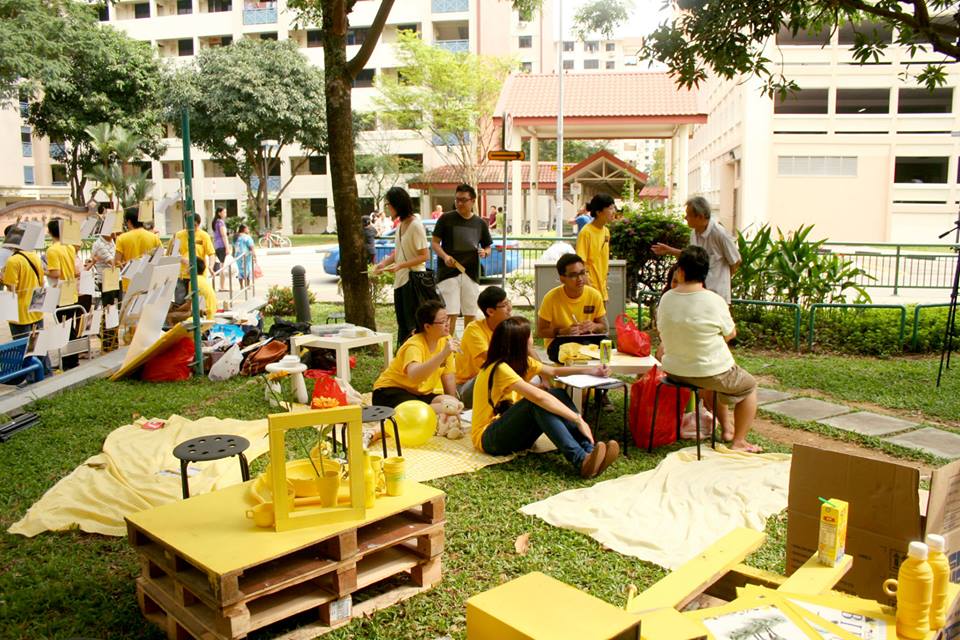
One of P!D’s Macpherson project collected stories from residents and worked with them to create the Retellings exhibition and workshop to foster a sense of community. | P!D

Singaporeans are stereotyped as an apathetic lot. What has your groundwork taught you about getting Singaporeans to be more involved?
We have gained several insights:

  • Current design and planning practices have resulted in a limited sense of responsibility and ownership towards the public realm. Thus, we need a new approach to the design and planning of the public realm, so that people will feel a greater sense of ownership towards these spaces.
  • People may want to participate more, but do not know exactly how to or desire to be involved in a formal set-up. Thus, we need to provide a clear framework that informs people of the various ways in which they can get involved, both formally and informally.
  • The government is largely seen as a service provider, from which people expect the delivery of solutions. Thus, we need to give people more autonomy over smaller, neighbourhood issues, as a first step towards shifting this expectation.

Both of you recently went on a whirlwind tour through Australia, USA and Denmark to present BetterSG. Tell us more about what you’ve brought back to your project.
We have received a grant for BetterSG, and we are grateful to have traveled to New York and Copenhagen. The aim of the trips was to study and learn from these cities’ successful projects that have aspects of participatory design and community engagement. From these global case studies we draw learning points that can be adapted and applied to our local context. We seek to understand how participatory design and planning works in New York City and Copenhagen, and what that means for Singapore.
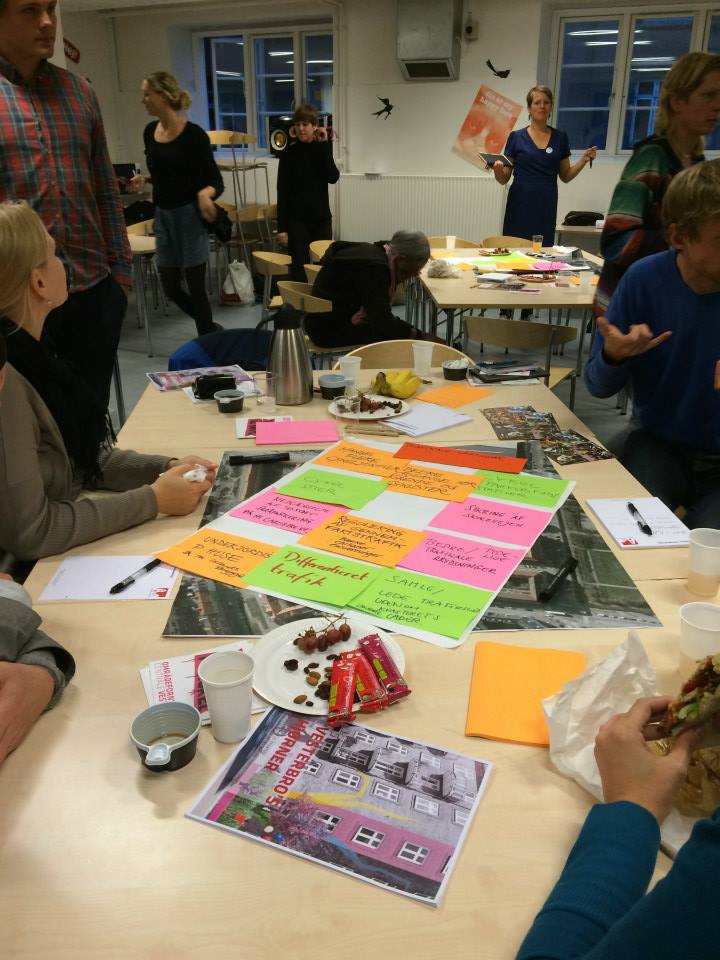
P!D attended community meetings (above) and spoke to groups carrying out urban participatory projects in Copenhagen, and also New York. | P!D

The first step of BetterSG is to understand local practices and perceptions via an online survey to find out people’s thoughts on Singapore. What is your plan for the data?
The data will be used to show people’s perception of ownership to shared spaces and their attitudes towards getting involved and participating in their neighbourhood’s issues. It will form part of our documentation and analysis on the existing landscapes in participation in Singapore. Alongside the data from the survey, we will be analysing local interviews that we have conducted.

The aims of BetterSG and the highlighted interviews with experts read as a critique of how close Singapore’s existing urban planning system is. Even before involving the people, what are some steps the state can take to making a BetterSG?
It would depend on how the state defines a BetterSG and the context of the problem/issue. There is not a one-size-fits-all “steps” or “solution” the state can take. When faced with a problem/issue, I think is not even about trying to find the right answer to a problem/issue, but it is sometimes, trying to identify with precision what is the right question to the problem. Nonetheless, it is not so much the steps the state can take. Perhaps, a change in mindset, values, and having an alternative way of looking at problems on hand would be crucial even before involving the people.

There are already various government arms (e.g. People’s Association (PA) and Residents’ Committees (RC)) working to get Singaporeans involved in their neighbourhoods and committees. As a non-governmental movement, how useful and effective do you think BetterSG can be?
The outcome of the initiative is a BetterSG Blueprint, which will be made available to the public on the BetterSG website, and it will lay out our vision and methods of designing with communities.

The target audience for this framework is any organization/designer/individual who is interested to be involved in designing with communities and creating community-owned solutions. The organizations would include grassroots organization such as PA, RC, volunteer welfare organisations (VWO) and government agencies, etc. The content will be open source, and we are planning for workshops and training to complement the use of the methods and tools in the Blueprint. The aim is to garner more awareness of and interest in participatory design, and lead to commissioned projects and workshops with communities.

With regards to the exciting grassroots structure, we acknowledge that there is potential for existing grassroots organisations to do more in enabling people to step up. We can leverage these existing organisations by introducing new roles that they can play to build up the community’s capacity for participation. We identify existing roles in the neighbourhood and maximise their potential to contribute to the project. This is key to designing community-owned solutions. It is not about creating new structures, but working with the existing grassroots structure that people are familiar with.

We see the BetterSG blueprint to be used in various ways:

  1. An organization (VWO, PA, RC,etc) who would like to to be involved in designing with communities will engage P!D to be a facilitator for a community. For example, a VWO is planning to design and build a community kitchen in the void deck space for its residents and would like to engage the residents and the relevant neighbourhood stakeholders in designing the spaces and programmes for the kitchen to create a sense of ownership.
  1. P!D will work in partnership with the designer/individual on projects they self-initiate. For instance, if a heritage site in Singapore is gazetted to be demolished, the BetterSG Blueprint can be used to understand, gather and create community-owned solutions with the relevant stakeholders involved.
  1. P!D initiated project.

What’s in a Name?

When a Singapore designer applied for grants from the government’s art council some years ago, he was referred to the national design agency instead because of his profession. But when he did just so, the same proposals were regarded as too artistic to be considered design.

This encounter, and the fact that art and design are governed by separate departments in Singapore (and in most parts of the world), confirm an existing difference between the two. What is art and what is design is something we seem to intuitively know until we try to explain the distinction between them.

Design has its roots in art, having been referred to in the past as the applied arts. Particularly telling was how graphic design — a term coined only in the 1920s — used to be called “advertising art” or “commercial art” and was a means by which many fine artists in Singapore made a living. This backdrop of the fraught relationship between the two explains the tinged perception that design is the ‘selling out’ of art to serve the needs of commerce. While professional designers have since rationalised what they do as problem-solving by offering a function to businesses and society which artists and their personal introspections do not, art has retained a halo of higher calling by seemingly remaining ‘pure’ and freed of any external influence.

This might have been true in the age of industrialisation, when design rose as a profession with the boom in mass production and consumption, but the once seemingly precise divide between art and design has blurred in recent times. Not content with just serving solutions to clients, designers are striking out on their own with speculative designs (or art?) that pose questions, or self-initiated projects (such as this film festival) that demonstrate alternative possibilities of practising design. The centralising of design production in the computer has also democratised its practice and enabled the injection of “personality” into a profession that once strove for objective answers. Designers nowadays have become celebrities whose work, ranging from posters to furniture and even buildings, are increasingly being collected (and produced in limited editions) just like art pieces too.

Conversely, art has been brought down from its pedestal. Movements like Dadaism that celebrate anti-art, and Pop Art’s appropriation of popular culture have attacked the traditional understanding of art by re-introducing everyday imagery and objects that we often encounter as products of design first. Today, it’s also not unheard of for famous artists to collaborate with corporate brands to mass produce design products (or art?) or to have their works sold at auctions for millions of dollars — who’s making commercial art now?

As the boundaries between the two get muddled up, the task of classifying something as art or design becomes increasingly difficult. Why we call something art or design is becoming less contingent on definitive attributes, such as what form it takes or how it is practiced, but instead what we value in each. I find myself asking why isn’t beautiful art a function for our well-being? And why can’t a design that solves an everyday problem be a work of art too?

Art and design are first and foremost acts of human expression. They contain the intentions of their creators, the material of cultures, the spirit of the times, and still leave space for our personal interpretations. Call them works of art or brilliant by design — there is probably some truth in both. Through art and design we try to make sense of the world we live in, and hopefully, use them to create a better one too.

———–
Written for A Design Film Festival Singapore 2014 festival guide.

Printing Things: The Future is Here

IMG_0319

“Welcome to the future” is a sign that greets visitors to the Long Island factory of Shapeways, a 3D printing company.

It could also speak for the hype surrounding the emerging technology of 3D printing today too. Many have touted the ability to produce objects simply by “printing” digital files as nothing short of a Third Industrial Revolution. Traditional mass manufacturing gave birth to consumers by figuring out how to produce the exact same object on an industrial scale, but digital fabrication technologies like 3D printing will empower everyone to become their own designer and manufacturer of things.

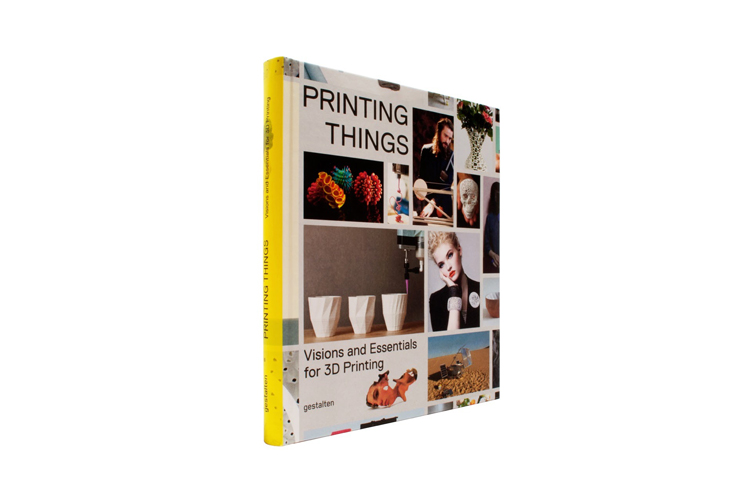
Printing Things: Visions and Essentials for 3D Printing is a new book that examines how this technology“will influence our economical, social and cultural ways of life” in the coming years. This 256-page book by German publisher Gestalten is an excellent introduction to the technical workings of 3D printing, the issues surrounding it, and showcases some of the most provocative design projects that have used this technology in recent years.
The book’s editors include, Claire Warnier and Dries Verbruggen, whose experience experimenting with this technology as Antwerp-based design studio Unfold helps this book standout from just a trendy compilation of 3D printing projects.

Printing Things: Visions and Essentials for 3D Printing is Gestalten's new book on the much-hyped digital production technology. | GESTALTEN
Printing Things: Visions and Essentials for 3D Printing is Gestalten’s new book on the much-hyped digital production technology. | GESTALTEN

They have written a comprehensive glossary of terms to explain how 3D printing is really a handy term for a collection of different processes and materials, and also penned eight essay on topics ranging from the technology’s history to the new aesthetics and alternative business models that it is introducing to contemporary design. These set the context for exploring the close to 200-pages of case studies that follow, and the connection between theory and practice is highlighted in each project with the tagging of keywords, such as “#empowerment”, “#wearables” and “#new craftsmanship” (all presented as hashtags as if they were tweets of a digital revolution), that reference back to the essays.

Printing Things presents a more nuanced reading of the technology beyond just a gadget that can print anything you want. For instance, a case study onKevin Spencer’s mini Vitra designer chairs brings out issues of authorship and intellectual property as the Swiss furniture company also sells the same miniature versions of classic designs such as Gerrit Reitveld’s Red Blue Chair and the Eames Lounge Chair, albeit in different materials. Despite what it looks, the chairs are probably legal because copyright does not protect functional objects. But there is also the question of the digital files that Kevin’s chairs are printed from. Who owns the renderings? The book suggests that Kevin’s files were probably created from virtual models freely distributed and used by professionals for their renderings — something which Vitra has previously never objected as they indirectly advertised their furniture. Now that these same files could easily be modified for print, how will things change?

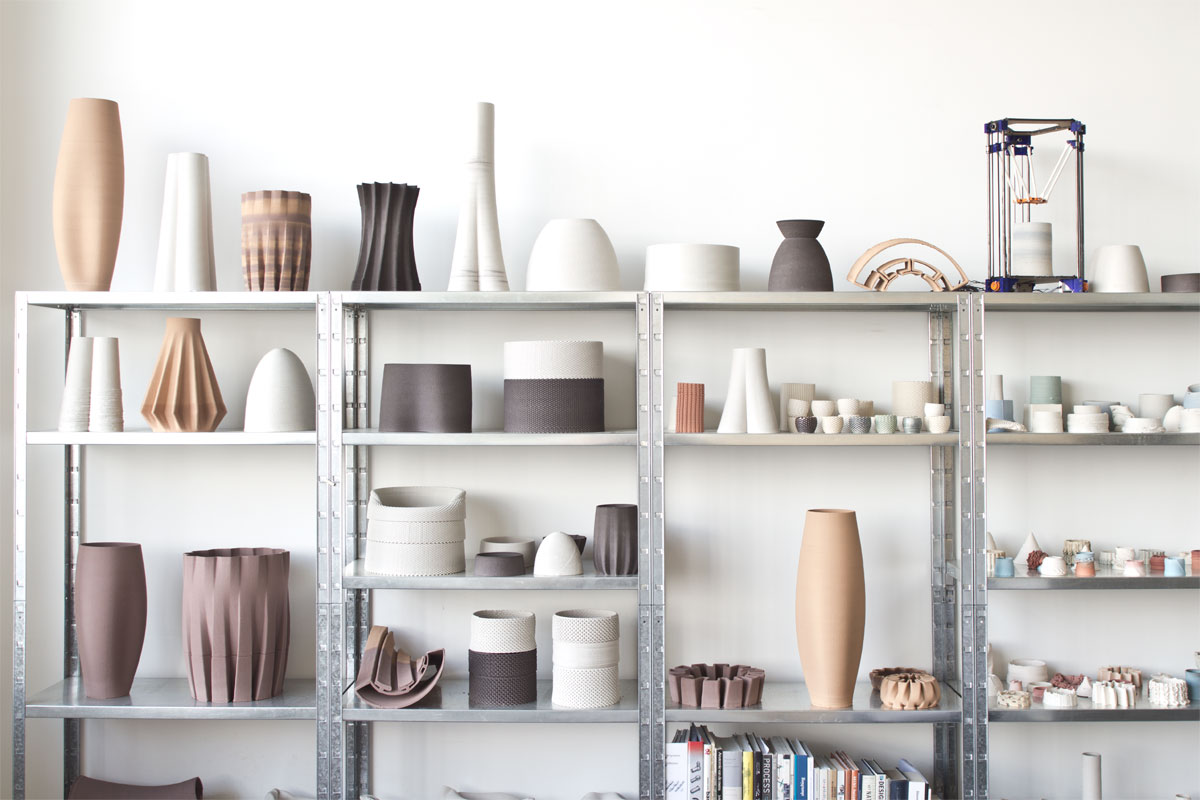
A collection of ceramics 3D printed by Olivier van Herpt. | OLIVER VAN HERPT

Another aspect of 3D printing is how it allows for new forms of craftsmanship as demonstrated by the featured designs of Olivier van Herpt. The Eindhoven-based designer has created his own printer and techniques to print out ceramics with textures, patterns and details that challenge the self-conscious and amateurish designs that the technology has come to be associated with when it grew out of the domain of hackers and hobbyists.

One comes out of Printing Things with a renewed excitement for 3D printing technology. It is also a measured one. We only have to look to the history of graphic design and the arrival of desktop publishing technologies in the 1980s to recognize a similar buzz in what’s being said about 3D printing today. Desktop printers may have become ubiquitous, but professional graphic design is still going strong. The same will go for 3D printing and product design. But just as how technology changed the way we think and produce graphic design since, this new ability to print things is making us rethink how we create, distribute and use objects in our lives.

———–
Written for Elizabeth Spiers and Chappell Elison’s Online Publishing class at D-Crit.