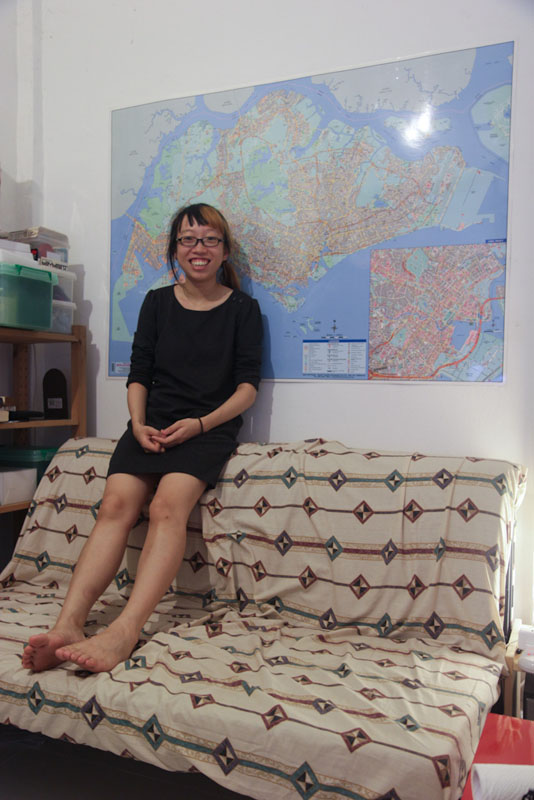
Artist Debbie Ding invents games, solves mysteries and seeks adventures to cope with the banal everyday life her city of Singapore
Daily travels in a city is a boring journey most of us endure. We distract themselves by catching up on sleep, reading a book, watching videos or playing games on our phones or media players. So does Debbie Ding, except the city itself is the text she reads and her playground for fun.
While working in a creative agency inside Singapore’s Central Business District (CBD), Debbie invented games to entertain herself during her lunchtime travels and when she needed to walk to her clients’ offices in the neighbourhood.
“I had a map where I outlined roads I walked before, and I would try to walk roads I had not every time I had to get to places. It’s kind of like the game Pac-man, where I had to walk through every single road,” she says.
It was during these walks that Debbie also began noticing circular symbols with random numbers and letters painted on the floors and buildings in the CBD. What began as a few random photographs grew into another “game” to discover what they were. Her search for these mysterious symbols even got her colleagues hooked, and they often reported to Debbie on new “sightings”. The “game” was completed when Debbie solved the mystery, correctly decoding the symbols as a language used by building contractors working on a new mass rapid transit railway line running underneath her work place.
Such playful views of the city has been a defining element in Debbie’s approach to her art and projects, which she has often described as “psychogeographical games”. These investigate the city, challenging how we see, understand and even navigate them. Her inventive nature has been with her since a child, says the English Literature graduate from the National University of Singapore says who made herself believe ‘green’ was her favourite colour when she was 10-years-old because she thought it was strange she didn’t have have a favourite. It was only when she started working in London in 2009 as a copywriter for a creative agency that she started taking an interest in cities. Despite London turning out like how the self-professed Anglo-phile had expected, Debbie felt the city was special and it while attempting to make sense of the place that she began devouring books and academic texts about cities, opening her eyes to a new way of looking at her surroundings. At the same time, she was also taught herself how to use multimedia tools like Flash.
In 2010, she brought this vision and skills back to Singapore and carried out her first major art project “\\:The Singapore River as a Psychogeographical Faultine”, which explored a landmark of this city as a “site at which memories of spaces, fictional (imagined) spaces and dream spaces interact, merge or drift apart”, explains the exhibition catalogue. Held at The Substation, Debbie’s project had had drawings and an interactive multimedia booth that examined the shape or the river. There was also a game, “Here the River Lies”, which visitors could write their memories — real or not — of the Singapore River on to a physical map, transforming it from a geography of the urban landscape to that of a community.
The game was inspired by a lawsuit happening then between the Land Transport Authority sued Streetdirectory.com. The latter had been sued for infringing the copyright of the transport authority’s maps, using them to run an online map service. Reading about the case, Debbie learnt that map makers often created fictitious locations on their maps as a way to protect their copyright. In the 1950s, one such location on a map of New York became real when someone set up a store there and named it after the location. “A place became real because of the map, which is quite a nice idea. That’s why I thought having people write on a map would be interesting,” explains Debbie. “It’s almost like things don’t exist unless you archive or write them down.”
As if to prove the city around her exists, Debbie has become its compulsive recorder, often walking around the city in search of her next game. While she used to draw maps of these travels on her notebook, she now does so with just her iPhone, snapping pictures and recording audio samples. Recently, she was featured in a short documentary by Singaporean filmmaker Tan Pin Pin where she talked about her discovery of a mysterious set of graffiti in a stairwell of the disused Yangtze Cinema in Singapore. What she chooses to record is largely based on intuition, she says. A fragment here and a fragment there, but eventually, Debbie puts together the pieces to make sense out of them, constructing a narrative for her projects. It’s a process she terms “psychogeoforensics” — another one of her inventions. This builds upon her playful approach to the city, turning it into a space of mystery encouraging people to let their imagination run wild, piecing together elements of the city to tell stories. It’s an approach she hopes more Singaporeans will take up, and she has set up the Singapore Psychogeographical Society and published a free guide online on how to look at the city in a manner that will help people have fun in the city again. “When you’re on holiday, you would think a place is fun, but when you’re living here, you don’t think like that at all even though a building is new,” she says. “But being able to imagine you’ve never seen something before, that would make the city interesting even if you’ve lived here all your life.”
It is at this juncture that Debbie reveals that this is how she has been coping with life in Singapore, a city which she feels lacks a sense of playful adventure and random possibilities. “Everything here is almost predictable, when you go out to meet people, they already band together based on what school they come from. I got friends who have settled down and you can almost trace their lives and chart where it is going. There’s a plan in life, and I feel like I need more than that,” says the 28-year-old. She herself was set to become of the Singaporeans she rejects now. Debbie was once enrolled with the rest of the country’s elite students in the Gifted Education Programme. But she did not do as well in her examinations and ended up in a junior college she had never heard of. It was there, without the weight of expectations, that she had the freedom to explore and think of other possibilities in life, beyond one measured by what school one was from or how good one’s grades were.
“I always thought that it is in spite of the education system that I became like that,” she says. “A lot of things I’ve done are all self-taught and I enjoy teaching myself more than being in school. So I guess the whole idea of teaching yourself is that you don’t lose the child-like curiosity of things and playing is a way of keeping it going.”
Although such a playful mind has kept Debbie occupied with Singapore all these years, she says it is become increasingly challenging to stay in such a small city.
So will there be a game over soon? Will she find another city to play in?
In what people who have spoken to her will recognise as classic Debbie-optimism, her eyes light up at these questions. “There won’t be a game over,” she says. “But there will be new games.”
———————————
A feature written for FIVEFOOTWAY magazine’s issue on PLAY
 Masthead (2012)
 Masthead (1973)