Category: Design

Ethics Can Feed You Meh?

That the project “Ethics for the Starving Designer” is named as such challenges how most designers see ethics in their profession: a non-issue when you need to finish a project to earn your keep. That is the dilemma which got David Goh, a final-year design communication student at Lasalle, started on this final-year project. After months of research and interviews with students, lecturers and practitioners in Singapore’s design industry, he has come up with a 21-point code of ethics for designers that you can now view online and at his on-going exhibition at Lasalle till Friday.

I checked it out this afternoon and was surprised to find it less contentious that it sounds. To me, the word “ethics” connotes some kind of expectation of saint-like behaviour, but David’s code is open and allows a certain degree of interpretations on how ethical you want to be.

That is a realistic approach, considering how we each have different beliefs, but I was disturbed by point 13 of the manifesto:

“Where my financial, professional and personal commitments would allow it, I will say no to all projects that I deem to be overtly immoral and harmful to society.”

Such a clause almost allows one to get away with almost anything, and in my discussions with David, we concluded that this is a pragmatic response to surviving in the profession. But on second thoughts, I think it also sends the wrong message that ethics is a luxury designers can think of only they have made it financially and professionally.

It is exactly such thinking that probably explains why this project has received little attention from Singapore designers thus far — why rock the boat with ethics when you’re doing well as a designer? David said most responses he has gotten about his project have come from overseas thus far, although he hopes more Singapore designers will engage him on this issue.

But that said, I don’t think Singapore designers aren’t ethical. Many of the manifesto’s points are gut instinct decisions that designers often make, but it’s never been really framed here in the issue of ethics. However, I do agree with David that designers should start this discussion on ethics, and one reason is because it tacitly acknowledges what David points out in point two of his manifesto:

“I recognize that graphic design is a powerful tool… for communication, behavioural change and manipulation. As such, I will treat it with utmost respect and care.”

This validates David’s call for “Ethics for the Starving Designer”, keeping the profession ethical is how to ensure designers will continue to be trusted to solve problems and provide services for the world it operates in.
The rides of their lives

Kiddie-Rides-Singapore

Once a common sight outside stores in Singapore, kiddy rides have lost their space in the city

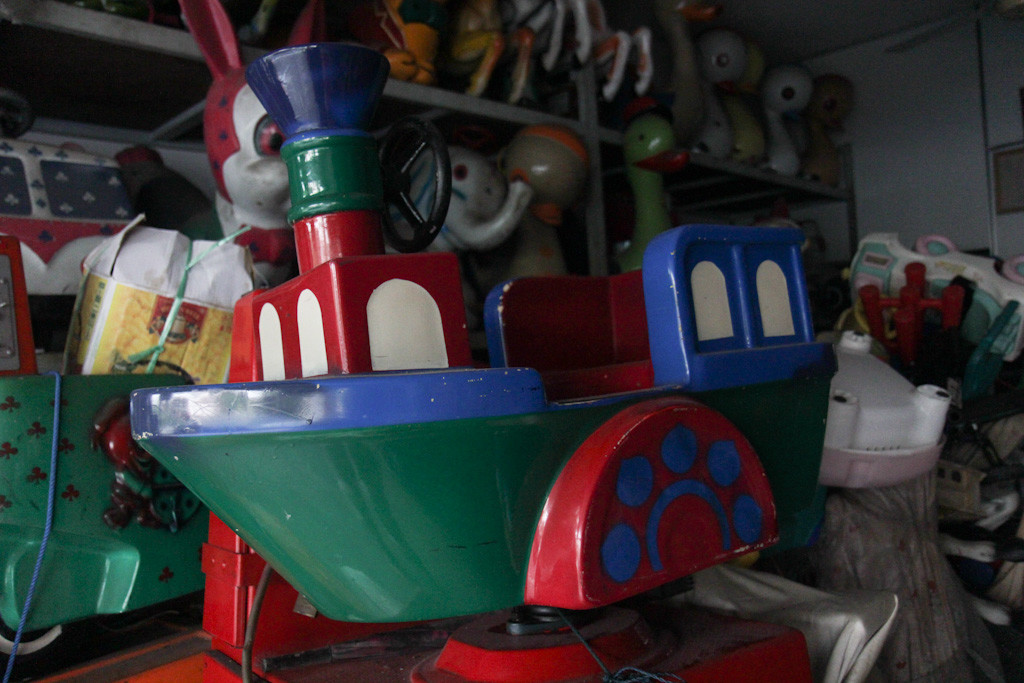
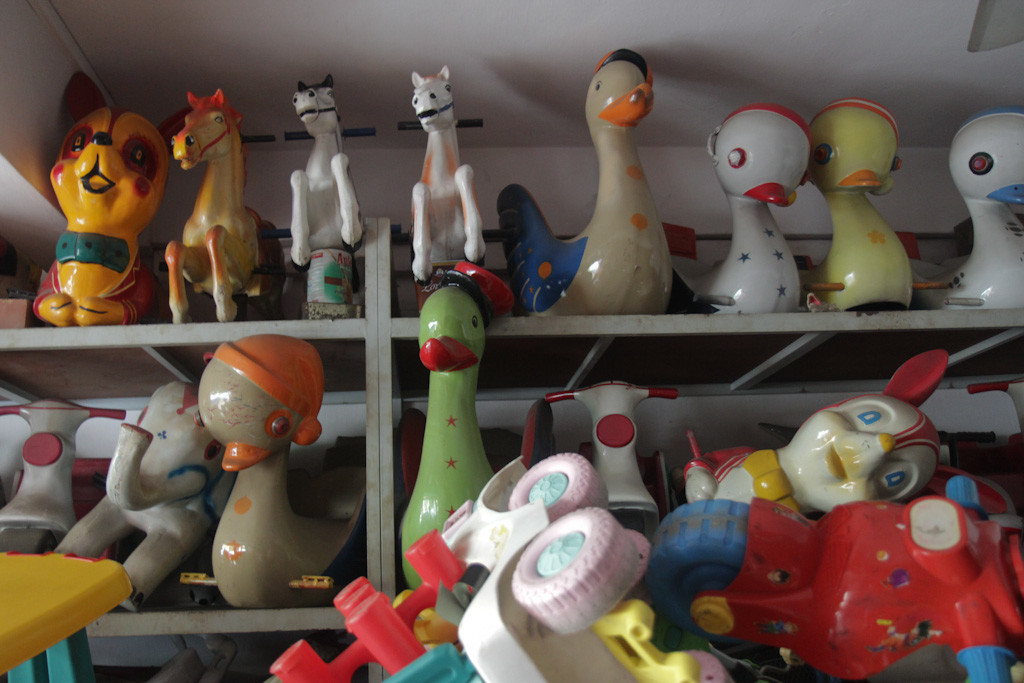
They come in all shapes and designs, but whether it is a swan, a horse, an elephant, a car, a boat, a scooter, or a spaceship, these machines offer children a ride of their lives. For a few minutes and a small fee, a child would be taken on a journey full of ups and downs (or lefts and rights) and cheerful music music as they made their way to… nowhere. This was the promise of a kiddy ride, a toy that brought joy to children, and relief for parents, as they went about the city.

For over three decades, Woo Hock Trading Co. has been supplying such kiddy rides to businesses in Singapore and the region. Mr Lee Kim Leng, started the business in 1980 after taking over six machines from a previous owner. Starting from a space outside a shop in Toa Payoh, he built up a fleet of over one thousand kiddy rides all across Singapore. Mr Lee’s daughter, Catherine, began helping her father when she turned 20, and over the last two decades, has witnessed the family business ride through the good times and the bad.

“During the golden age, each machine could make a 4-digit sum a month. Now one whole year, maybe I’ll only get fifty dollars,” says Catherine, who is certain the business will end with her.

The iconic round-headed swans on the top right were designed by Woo Hock, according to its owner.

According to Catherine, the first half of the ‘90s was the heydays for kiddy rides. Before the 1997 Asian financial crisis, Woo Hock’s rides were commonly seen outside neighbourhood stores and supermarkets such as NTUC FairPrice, Sheng Siong, and Oriental Emporium. Many also found their way to Indonesia, Hong Kong and even Mauritius. Businesses either bought these rides for a few thousand dollars or let Woo Hock place one outside their storefronts and shared the profits.

As the industry was very competitive then, Woo Hock started designing its own rides to stand out from those usually imported from Britain, Germany, Taiwan and Japan. One signature Woo Hock design is the duckling, which still appears on the company’s name card and its fading shop signage. However, this design was later copied by competitors who bought the mould from the manufacturer without their permission. Other rides designed by Woo Hock include models resembling a Vespa scooter and a boat, both which have been very popular with children.

Besides appealing to children, the rides also have to be designed to be safe. Woo Hock only supplies rides made of fibreglass, which last longer and are safer than those made of PVC. Catherine is proud to say that no accidents have happened on Woo Hock’s rides after all these years. Their designs have failed in other ways, however. Inside its shop, where the rides are serviced and stored, sits several rejected models. There is a race car so shallow a child may fall off, and there is a rabbit whose height is such that a child might hit its head on it during a ride. As we pass by another animal-shaped ride, Catherine asks if I could guess what it was.

A Merlion-shaped ride that looked more like a pig, turning away Muslim children especially.

“A Cow? A Pig?”

“Aiyoh, you cannot tell?” she said as she giggled embarrassingly. “It’s a Merlion! Don’t look like meh?”

This is one of Woo Hock’s design that failed. After investing S$30,000 to create the mould for manufacturing this ride, they found that nobody dared to ride it, especially the Muslim children, who thought it resembled a pig, an animal considered taboo in their religion.

Kiddie Rides Singapore 2
While Woo Hock kept on designing new rides to appeal to children, it did not stop its business from declining post-1997. Children had more alternatives for play, and clients also preferred rides featuring global cartoon stars like Mickey Mouse instead of Woo Hock’s designs. But what really killed the business was after an incident in 2007 when two siblings were killed in a fire at their public housing home in Hougang, says Catherine. When the brother and sister tried to escape, they were trapped by the stockpiles the businesses downstairs had left outside their shopfront overnight. The tragic incident led the authorities to clamp down on shopfront clutter, and as businesses found less space, kiddy rides no longer had a place in the neighbourhood.

Today, Woo Hock’s shop along Lichfield Road is a forgotten abode for its remaining kiddy rides. Once bustling with 6 workers and three vans, the shop floor has become the extended home of Mr Lee and his family who live upstairs this shophouse. A single van is now parked outside. While they used to work from morning to night with no holidays and off days, they struggle to find something to do now. Recently, Catherine even had to throw out some 300 pieces because there was not enough space for these rides, which used to call the city outside their home.

———————————
A feature written for FIVEFOOTWAY magazine’s issue on PLAY

2012 Graduation Shows Design

It’s that time of the year again when graduating design students get to show off their final-year projects. There’s always some gems to be found if you look hard enough. Here’s a round-up of upcoming exhibitions so far, will add more once they are announced:

Unit 2012: UNRATED
Nanyang Polytechnic
21-24 March
The Plaza, Level 1
National Library Board
100 Victoria Street

Birth 2012
Singapore Polytechnic
29 March – 1 April
Vivocity Central Court

The Design Show 2012
Temasek Polytechnic
5-7 April
VivoCity Level 1

The ADM Show 2012
School of Art, Design and Media, Nanyang Technological University
27 April – 6 May
11B Mount Sophia

The LASALLE Show ’12 Exhibition
LASALLE College of the Arts
25 May – 7 June
LASALLE College of the Arts
1 McNally Street