Category: Design

The return of political cartoons

“You cannot mock a great leader in an Asian Confucian society.
If he allows himself to be mocked, he is finished.”
Lee Kuan Yew commenting on how the media portrayed the Tiananmen demonstrations using cartoons and caricatures

Election fever and the lack of state regulation online saw a resurgence in a graphic form that has almost become extinct in Singapore: political cartoons.

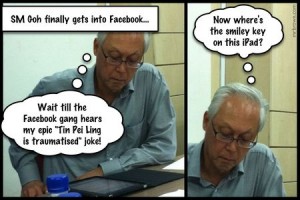
Throughout the 2011 General Election, several blogs published cartoons on how they saw the hustings, often poking fun at politicians and the remarks they made. Below is a list of some of them, click to check out their cartoons!

Except for Cartoon Press, the other five blogs have been around for  a while. Both My Sketchbook and Blinking Brink are the oldest, having been around since 2006.

While the cartoons may look amateurish, their content is much more hard-hitting that what you’ll find on the newspapers, where editorial cartoons like these have traditionally been found. The government’s tight control of the mass media over the last few decades had forced out similar work from pioneers like Kwan Sai Kheong, Tan Huay Peng and Morgan Chua.

The late Kwan freelanced for the Singapore Free Press and The Straits Timesbetween 1946 and 1951, before he eventually became a Permanent Secretary. He also designed the Merlion statue. Peng joined ST in 1955, and when he left in 1962 he was the paper’s Chief Artist. Even after his departure, the late Peng continued to contribute work to the paper till the ’80s. Finally, Morgan started out at the Singapore Herald, and after the newspaper got banned in the 1970s, he left for Hong Kong to draw for the Far Eastern Economic Review for the next 25 years.

The generation of editorial cartoonists that followed, like ST’s Dengcoy MielLee Chee ChewThe New Paper’s Lee Hup Kheng and Lianhe Zaobao’s Heng Kim Song did not draw their inspiration from politics, or at least local politics. The only exception, although his work was not published in newspapers, was George Nonis who published two cartoon books documenting the generational change in Singapore’s politics with his Hello Chok Tong, Goodbye Kuan Yew (1991) book, and a decade later, From Kuan Yew to Chok Tong And Beyond (2001).

If you’re interested to find out more about editorial cartoons and Singapore’s history, check out Lim Cheng Tju’s Singapore Comix. He has also been written well-researched pieces, including Lest We Forget: The importance of history in Singapore and Malaysia Comic Studies.

Infographics and GE 2011

Social media has been regarded by many as one of the most interesting and forceful expressions of Singapore’s General Elections (GE) 2011. This trend was predicted by several social media monitoring companies who used this once-in-five-years event to showcase their abilities to harness this internet chatter and make sense of it all. Their medium of choice for expressing the deluge of Facebook postings, tweets and blog posts and Foursquare check-ins? Information Visualisation. Here’s a quick run-down on three projects that ran during this GE.

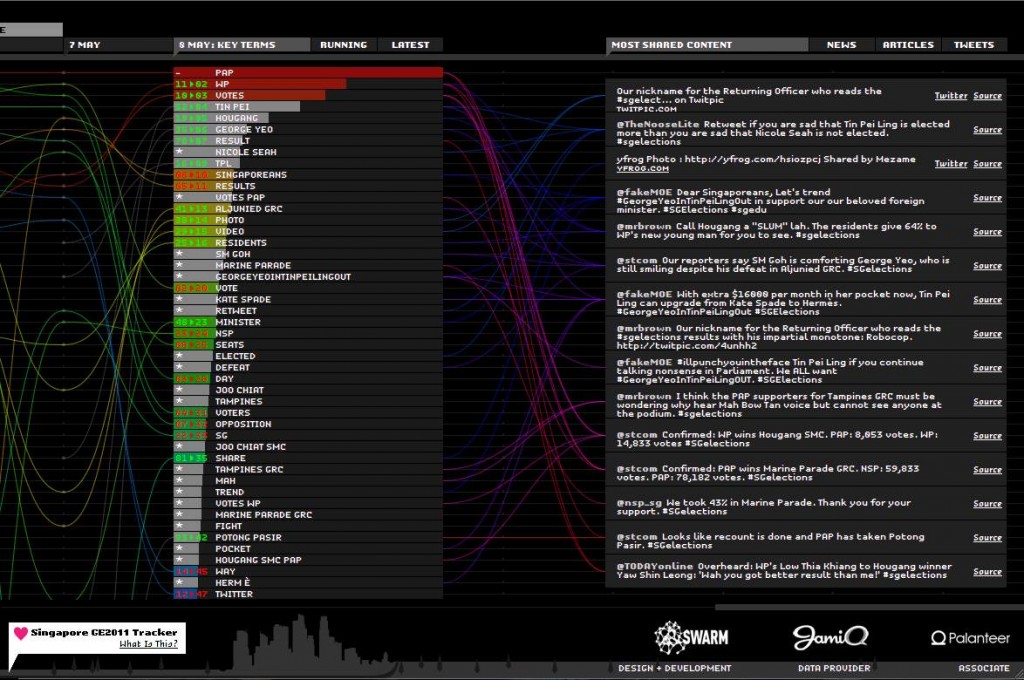
Singapore GE2011 Tracker by Swarm and JamiQ

The infographic uses one of its most common elements — bars and charts — to track the rise and fall of what was “trending” during each day since elections campaigning began. If you actually match the infographic against a blow-by-blow account of the elections, I think you’ll probably get to see how certain topics played out on social media. The infographic also points you to the link that generated all the buzz. It was confusing to navigate at first because there was so much going on, but the amount of information it contains is also why it is the most useful amongst the three.

— — —

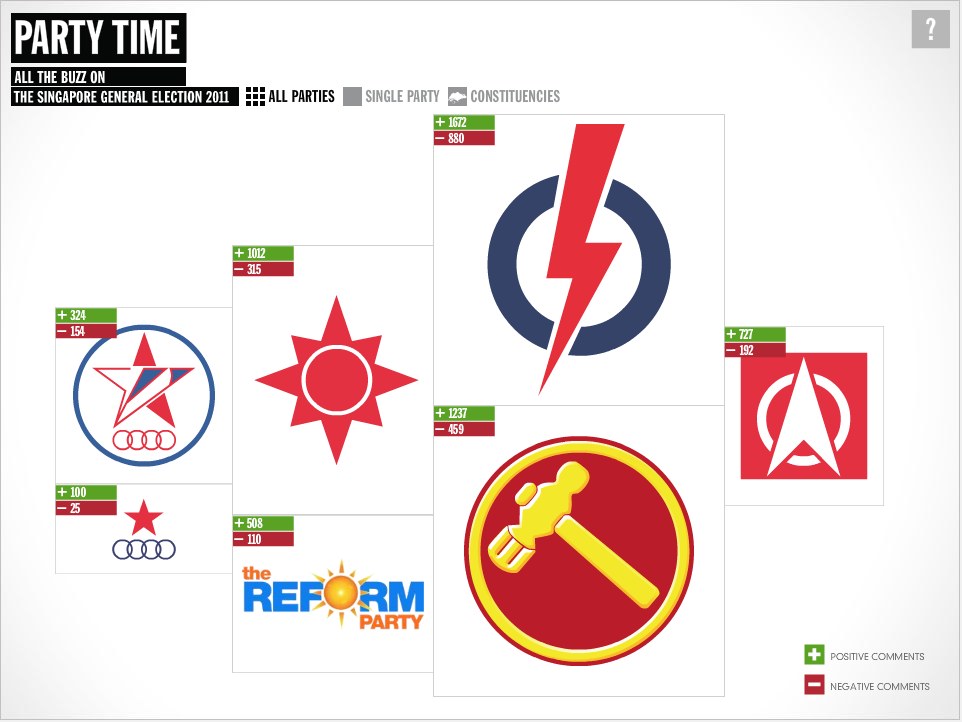
It’s Party Time! by Tribal DDB and Brandtology

Clearly more irreverent and reader-friendly, this infographic attempted to track the ‘positive’ and ‘negative’ comments about the various parties as well as how much talk was going on about them online. This one also points you to the links generating the buzz. While it’s highly interactive and was fun to click around, there have been some concerns expressed as to how accurate it was to place a value on the data — as positive or negative — since this is done automatically.

— — —

onefiveseven by Thoughtbuzz and The Blue Bridge

The most straightforward of the three projects. This infographic provides you a directory to all social media related to parties, candidates and constituencies. This site also tracked location-based data, integrating the use of Four Square check-in during the rallies.

— — —

These three projects are the few major information visualisation projects that have appeared on the local scene, and it’ll be interesting to see if the medium is adopted to play a bigger role in understanding life in Singapore. I see this medium as an extension of infographics, which is playing an increasing role in our newspapers, especially seen in The New Paper. A more recent print project that uses has made use of this medium to look at this country is Singapore Transcripts, which graphically expresses data pertaining to the landscape here. This age of the information explosion calls for us to get a better grasp of all the data that’s flying at us, and information visualisation is a very useful tool to easily communicate to the masses important trends and forecasts.

Elections Posters: The People’s Version

With the advent of image-editing tools like Photoshop and the ease of finding images online, Singaporeans have created some very interesting visuals to express their views on the General Elections this year. Here’s a sample of some I’ve found so far:

Remiser Tan has retold the elections via the Chinese wuxia classic《倚天屠龙记》The Heaven Sword and Dragon Saber:

Nicholas Lim has remade Hollywood and Chinese blockbuster movies to dramatise the opposition’s cause, very apt choices, I must say.

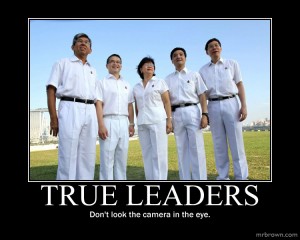
Mr Brown has also translated his satirical voice into visuals, making use of the form of motivational posters and comics (click to see the actual posts)

So far, I’ve yet to find any self made posters supporting the PAP’s cause. I suppose most people think the party has more than enough resources, so why bother?

Here are also two websites that have been producing a body of political cartoons about Singapore, a rare find these days. Check out Joshua Chiang’s The Dunno Cartoons and Ben Soon’s Spore Says Political Cartoon.

Finally, if you’ve come across any self made election visuals that I’ve yet to feature, do share them here!