Category: History

Of places and spaces

CRANES — not those of nature, but the industrial mammoths — are taking over this island.

On my daily travels on the MRT from Redhill to Boon Lay, as I watched new buildings grow, it struck me that these cranes were not just constructing but also de-constructing the space that used to be. What if I don’t recognise Singapore anymore one day?

I still remember my grandmother’s rants about how a space used to be something else. It is one of those things that you associate with ageing — you know you are old when you start talking like that. Yet, recently, I found myself talking just like that with my friends one day as we returned to Junction 8, a shopping mall at Bishan  that was our favourite after-school joint recently.

And, I’m only 23.

Junction 8 today has a new extension wing, more shops, a renovated food court and so much more. It felt surreal when I first stepped into it — familiar and alien all at the same time. I knew the place but not the space. My map of it no longer made sense.

Increasingly a lot of Singapore evokes similar sentiments. If there is anything symbolic of the agent of such a revolution, it has got to be those cranes that have overtaken Singapore’s skyline. Quiet, efficient at times and even graceful to watch, they seem virtually unstoppable.

Some say that their presence has griped the Singapore cityscape because its planners see it simply as a tabula rasa, a clean slate for it to construct its pragmatic ideals. Nothing will be spared from the crane—it is only a matter of time.

As Singapore greys, I think it becomes even more important that the burgeoning elderly community have spaces they can still remember. What use is it for the elderly to have money to retire or a job to survive if they exist in a space they cannot “navigate”?

The deputy chairman of the Preservation of Monuments Board in 1978, Professor Seow Eu Jin, once wrote that, “The purpose of preservation is to sustain life and to link the past with the present and with the future.” Thus, retaining these spaces shows a clear signal that we don’t just look towards the young, the new and the future but want to include the elderly too. Their memories of Singapore matter too.

Much of what has been preserved largely only reflects the desire to keep our memories of the colonial legacy and our religious identities. What seem missing are post-independence spaces for instance the old National Library or the Hilltop Apartments.

Yet, it is important for the people and not just the government who have to show a better understanding and appreciation of the space we’re living in. Must we always seek a spanking new development? Is the monetary value of a space worth more than the memories of a place?

Architect Timothy Seow, who designed many Singapore spaces in its formative years after independence felt that a lot of architecture projects designed then reflected a “Singapore built by Singaporeans” as many of them were undertaken by local architects.

However, many of them have been lost in the battle against the crane. Could these spaces not be essential to the Singapore story? Were these spaces taken away because they were tainted with post-independence stories of turbulence, poverty and upheavals that need eradicating?

That a space lacks popularity with Singaporeans does not make it less valuable to us. One instance of this is the Golden Mile Complex in Bras Brasah, a project of local architect William Lim. It was an experiment in mixed-used development, the idea of working, playing and living in one big space that had failed to take root. Shunned by locals, it has become a little Thailand, adding cultural flavour to a landscape increasingly dotted with corporate buildings and entertainment structures.

My worry lies with the rapid pace of change of the spaces I grew up in. Will I feel alienated to places I call home, and a city that is renewing faster than I age?

When I live past 85, I cannot be sure that I will remember this place or even what it used to be. But maybe, I’ll remember the cranes.

The Nanyang Chronicle, 29th Oct 2007

Classy Classifieds!

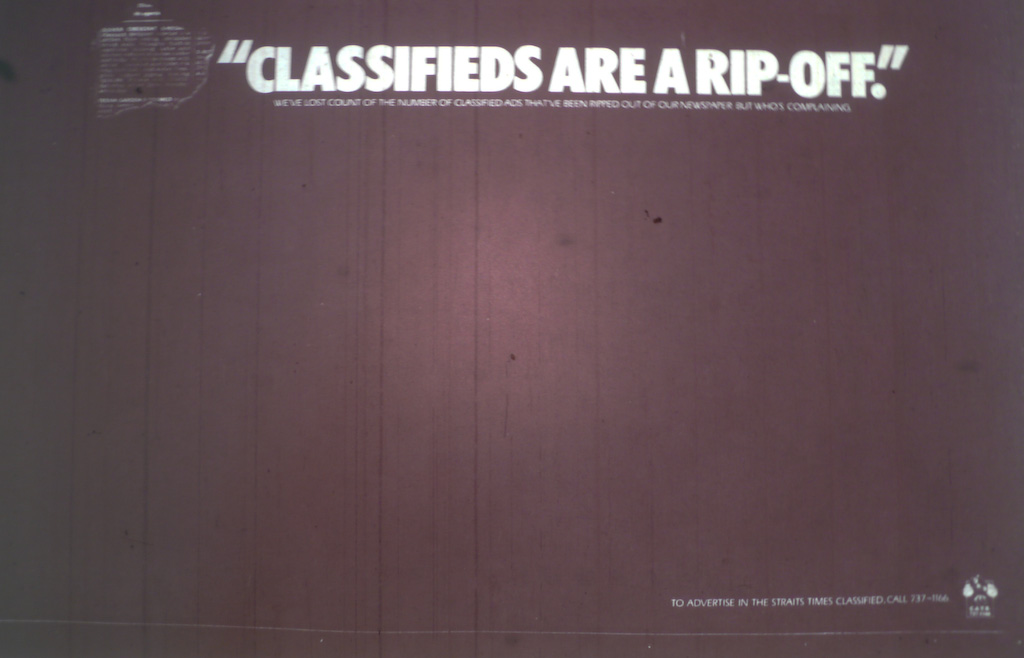
Been looking at some old newspapers for a research project and this issue of The Straits Times Classifieds section in 1989 caught my attention! The colours are like that because I took photos straight off the microfilm reader.

L1000986

And here is a house-ad for the Classifieds

L1000985

After the catchy headline, it actually goes on to read

“We lost count of the number of Classified ads that have been ripped out of our newspaper but who’s complaining.”

Filament ’09: A look at this home

black-logo-2-webThe home, where we are most honest with ourselves, a place where we start and end our day, and a site where society’s larger issues play out in the most intimate of ways. This was what Filament ‘09: A Site For Home brought home with its collection of final-year films from the students of the Wee Kim Wee School of Communication and Information (WKWSCI).

WELCOME HOME
For Rent, The Same Ties That Bind, The Funeral, 無蟹可擊 Crab! and The Healing Touch
 

The documentary For Rent brought us into the homes of the lesser known population of Singapore that live in rental flats. Over 80 per cent of Singaporeans live in public housing and this has always been touted as a success of the state in providing a roof and an asset for its citizens. But behind every gleaming upgraded facade in these featured Boon Keng flats we see how less fortunate Singaporeans squeeze themselves into one-room flats to enjoy public housing. Indeed, the image of home as a place of comfort is questioned when one sees how a family of twelve people into an apartment built for two and one is left to wonder what other stories could lie in the neighbouring units.

But a home is not just a physical entity, it is also a collection of relations between people. This is explored in The Same Ties That Bind, a documentary about the acceptance of gays by families. It advances the discourse about the controversial place of gays in Singapore right to the heart of things: family and religion. The interviewee’s frankness in front of the cameras makes it almost like post-dinner conversation, although in reality, would talking about gays in the family make it palatable? While the documentary take on religion is solely from the Christians’ perspective, with the recent AWARE saga it does gives this part of the film heightened relevance.

The issue of religion in family is also taken on by the drama, The FuneralThe death of a little brother prompts a debate between a Christian sister and a Taoist brother over how to settle the rites for his funeral. This piece is loaded with references for the film aficionado and its production is stellar, coming especially from students. It shows how a good drama can convey so much more than an objective documentary, but to do so, one has to be able to read the depth this film tries to provide. But in each scene, one can easily be overwhelmed with either how good the shot looks or what is going on. It felt like this was the “best of” compilation of a hour-long film and one just longed to have some dead space in between to reflect.

無蟹可擊 Crab!, is also another family drama, but a much more light-hearted one. Reminiscent of Channel 8 dramas, it follows the journey of how a son is tricked into taking over his family’s crab bee hoon business. The cast for the film are a host of familiar faces from television commercials and dramas that provide comfort for the viewer but they struggle to hold together a film whose script becomes predictable after a while. Like the crab bee hoon the lead cooks at the beginning, it’s a potentially great dish with good ingredients, but the chef still needs to improve on its cooking.

The same might be said of The Healing Touch, a documentary about Reiki healing, a spiritual approach to health. The film comes across as a very objective informercial rather than a partisan documentary. Ironically, the soothing voice-over and background track may only further discomfort the viewer who for most part of the film is extolled the benefits of this healing by Reiki practitioners. It becomes almost an afterthought when the documentary ends with a medical doctor and an academic weigingh in on the potential placebo effects of such healing.

MOVING OUT OF THE HOME
做到老 Live. Work. Die., Trust, Make.Shift, LOL.SG and 家,不家 Home

Taking us out of the family and into the larger home of society, 做到老 Live. Work. Die., documents the quest of one elderly man to find a job in Singapore. This documentary takes on a Michael Moore-esque style where the filmmakers are very much visible — one of the producers stars in the film and there are scenes where the filmmakers sit together to discuss what to do next. Perhaps it was out of one of such discussions that this film was conceived and they set out to do it all in one day. The documentary does have the feel of a Michael Moore film but it lacks the thought. The former is professionally amateur but the latter is just amateur. Still, kudos should be given to a documentary that challenges the way this form is done locally.

The drama, Trust, touches on an issue that has only been recently introduced in Singapore: terrorism. This piece is heavily dependent on its actors carrying out a dialogue driven script but alas the actors do just a decent job and the film fails to live up to its potential. The camera work and the props in the film do little to mask this too. The ending may surprise some but by the time one gets there, the initial question of, what would you do, gets lost in a plot that tries to take on world domination but is just too big for it. 

While home is a permanent place for most of us, in Make.Shift we see how the business of night markets, popularly known as pasar malams in Singapore, are always on the move for a home. At 17 mins, one of the shortest films of the night, this documentary highlights a community that is well-known in the Singapore cityscape but just doesn’t bring it home. We hear a lot about the economic struggle of this industry, including an interesting juxtaposition of the in-fighting between the big players but one was left wondering: why should I care? Perhaps by overly-focusing on the economics of things, the soul of the pasar malam space, it’s myriad offerings of ordinary things, the sights, sounds and smells just got lost.

Similarly, LOL.SG, a documentary about the local comedy scene begs the question of why should I care. From start to almost end, one chuckles through the film and realises how difficult it is to do comedy here, but so what? This was enjoyable and novel because no one has taken a serious look at what’s funny here but one might just laugh it off without the context to make this an issue. What might also be worth looking at is non-English funny people too, after all, how many Singaporeans actually watch Channel 5 or stand-up comedy?

The search for home is taken to China in 家,不家 Home? where this documentary looks at the rebuilding efforts of survivors in Jinlong, Sichuan after the May 12 Earthquake last year. The stories are touching and what one would expect — uncertainty, red tape and struggles — but these are told to us by the survivors straight onto the camera. That is where one might lose the connect as one wished to see more of the disaster site to see how things were and could become.

HOME COMING

The audience were also entertained at the beginning and intermission of the screening by post-, an audio project inspired by the students’ time at WKWSCI. A track that stuck was Everything At Once that seems like a perfect track to accompany a drive across the expressway on a rainy day — perhaps an ode to the long journey many of us take to school?

So for two nights, the Singapore Art Museum became a temporary home for the different generations of WKWSCI students: juniors awaiting to start on their final-year projects, current final-year students and seniors who returned to see how things were changing. An interesting note was that the theme, “A Site For Home” was never set out when the students began work on these final-year projects in August last year, but when they got together to organise Filament ‘09, it became apparent that almost all the films had, literally, come home.

DISCLAIMER: I am also a final-year student at WKWSCI and my group’s project Reclaim Land: The fight for space in Singapore was also featured in Filament ‘09. For objectivity sake I have left it out in this review.