 How else can Singapore look like today?
This is a question lacking in the Singaporean psyche today. The Peoples’ Action Party’s version of the Singapore success story has been so entrenched as the only possibility that such a question often paralyses us. A nation that was not meant to be yet enjoying such stellar success today is such a amazing tale that we often see no need to revisit the what ifs. Even when we did try to re-imagine our present, we tend to fear a lack of success than imagine other possibilities of success.
Yet, if we look back at our history, there were choices and possibilities that could have led to a very different Singapore today. It was not simply just a choice between a communist or the democratic socialist one today as is so often told.
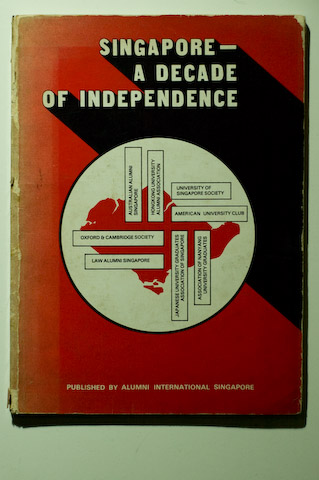
“Singapore – A Decade of Independence” is one book (left) that gives us a peek into these possibilities. It was published in 1975 by the Alumni International Singapore, an organization representing the old boys of tertiary educational institutions from eleven countries. In it are various essays written by figures such as Robert Yeo, Francis Thomas, Professor S.S. Ratnam and William Lim that propose alternatives to government policies then. These include the criticism on policies to control the growth of the population as well as calls for more support for the arts, raising the standards of the public transport and encouraging citizenship participation in policy-formulation. If anything, it shows that these issues, which are as pertinent today, have been a problem since ten years into our independence.
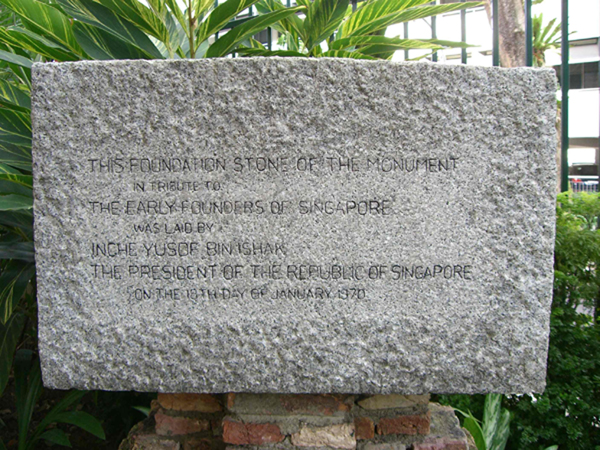 An interesting point to note was how this book was meant to raise funds for the organisation to built a “Monument to the Early Pioneers” that never came true. All that is left of this effort is a foundation stone (right) that is found in the National Archives today. It was originally located at the waterfront side of Collyer Quay and was relocated to its present location because of road works there.
 Another group that proposed an alternative vision of urban Singapore was the Singapore Planning and Urban Research Group (S.P.U.R.) that was set up in 1965 by a group of architects and planners. Its more prominent members include William Lim and Tay Kheng Soon. Its ideas and works can be found in “SPUR 1965-1967” (left), a self-published report and you can still purchase limited copies of it at Select Books. The proposals of this group are a clear alternative to Singapore’s urban renewal strategy that if implemented would have given a very different-looking city. For instance, they made calls for HDB neighbourhoods to have more distinct identities to better foster community-bonding, something that has only been implemented in recent times. Other more radical suggestions included questioning the plan to build distinct areas of work and living. S.P.U.R. pushed for the idea of housing work, living and play all in one mega structure so as to avoid transport congestion issues that we face today. For a sense of these structures, think of mixed-use buildings like People’s Park Complex and Golden Mile. The ability to do all three in one place eliminated the need for travel to a city centre for work and out of it to go home.
These books are but two examples of alternative visions of Singapore. I think the ability to imagine another Singapore is something fundamentally lacking in many of us. This apathy in imagination is probably because Singapore is so well run that it doesn’t need its people. Add to that, the fact that we can export our public sector expertise to other countries like Dubai and China shows how little Singaporeans can factor in the policy-making process. It is important to have alternatives in case things fail, and the seeming lack of it today is probably because Singaporeans have forgotten how to imagine.