Tag: Graphic Design

How Singapore Became the Unlikely Poster Child for Good Government Design

Save precious water. Floss your teeth. Buckle up for safety. Those are just some of the truisms familiar to generations of Singaporeans. Since gaining independence five decades ago, the Southeast Asian city-state has seen countless government campaigns aimed to mold citizens who could live up to the nation’s leap from Third World to First. Design has played a central role in these efforts, as evident in the 6,000+ posters preserved in the National Archives of Singapore.

Since its establishment in 1968, this state institution has archived posters as part of its collection of material culture—including government records, maps, photographs, oral history interviews, audiovisual, and sound recordings—that are significant to Singapore’s history. Most of its posters come from government campaigns, with a small number created for cultural events, movies, and corporations.

Read the rest at AIGA’s Eye on Design 

Why Branding + Interior Studio The Strangely Good Judge a Place by Its Toilet + Other Design Lessons

The toilet is the last place you expect to see on a studio visit. But that’s one of the first things Michelle Lin points out after I stepped into the office of Singapore branding studio The Strangely Good.

Taking a bathroom break here is to board a train carriage inspired byThe Darjeeling Limited. Like the set in Wes Anderson’s film, The Strangely Good toilet is plastered with Art Nouveau wallpaper and floor tiles, as well as a window to another world—the perfect getaway for the graphic designer who confesses to dreaming up ideas while handling her other business. This interior also weirdly epitomizes the work and design philosophy of The Strangely Good.

Read the rest at AIGA’s Eye on Design 

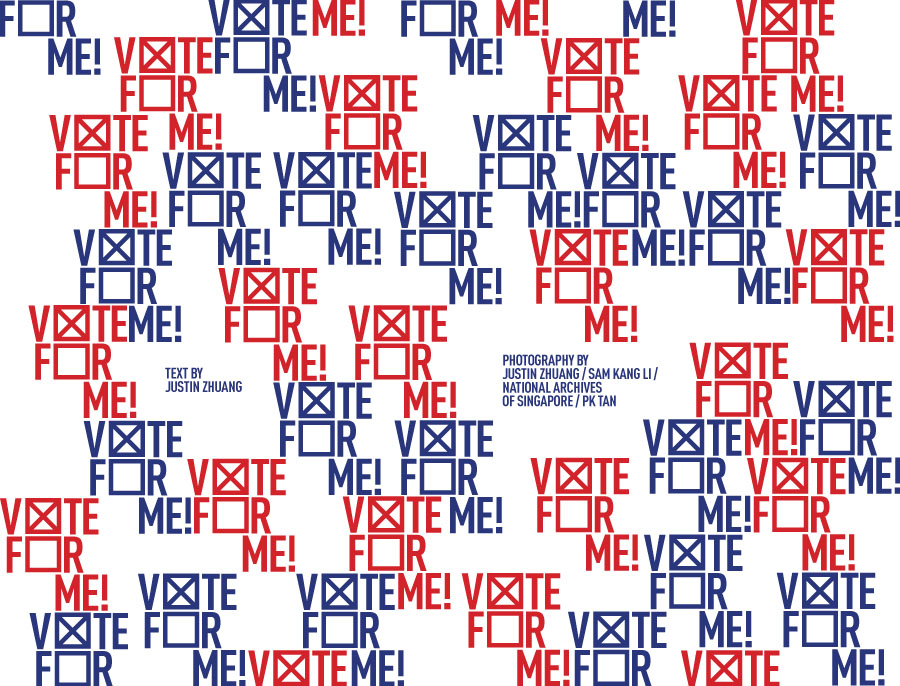
Vote For Me! Singapore Elections Ephemera

TDSJ-Vote-For-Me

Singapore’s 11th General Elections since independence marks the beginning of a design-conscious politics—a 2011 essay I wrote for The Design Society Journal No. 03.

The day after Nicole Seah was officially presented as an election candidate for the National Solidarity Party (NSP), The New Paper asked on its cover: “Do looks matter in elections?” It was directed at the online buzz generated after the 24 year-old Seah first announced over Facebook that she was standing for elections. Netizens were clearly taken in by her profile picture—what the paper described as “lovely flowing hair, make-up and her good side showing”—so much so that nobody bothered who she was contesting with in Marine Parade Group Representation Constituency (GRC). Some even began dubbing NSP as the “Nicole Seah Party”. Soon, digitally edited pictures of her as Wonder Woman and Scarlett in the upcoming G.I. Joe movie also began making their rounds online.

However, Seah, in her own words, was not just “another pretty face”. She was confident and articulate, making astute remarks during her campaign trail. This, plus her good looks, projected the image of an attractive and credible candidate to voters. Just over a fortnight after starting her Facebook page, Seah received even more ‘Likes’ than the nation’s founding father Lee Kuan Yew, earning her the title of Singapore’s most popular politician. Despite this, her NSP team did not win the election battle at Marine Parade. Yet, by garnering so much attention and winning 43.36 per cent of the votes against a People’s Action Party team led by former prime minister Goh Chok Tong, Seah’s campaign demonstrated how image played a part in helping a young unknown like her win votes.

This echoes the 2008 presidential election in the United States, when a relatively newcomer Barack Obama “crafted a meticulous visual strategy”, that helped propel him to victory. While Seah and the other candidates of Singapore’s 11th General Election did not display the sophistication of Obama’s visual campaign—right down to choosing an appropriate typeface—they produced one of the most visually-driven election in recent Singapore history, heralding the beginnings of Obama-style politics in the future.

Read more