Category: History

Singaplural: Perspectives on an Island (2007)

singaplural

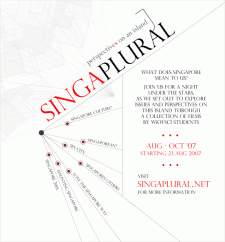
singaplural-poster-eflyer

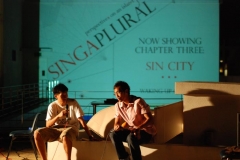
4-daniel-and-justin1


What does Singapore mean to us?

Through a series of seven film screenings at the rooftop of the Wee Kim Wee School Of Communication and Information held in 2007, my friends and I challenged viewers to think about this island by looking at it from different perspectives provided by the films.

All the films screened were past final-year projects by former students and we also managed to invite some of the directors back for a question-and-answer session. You can hear some of the interviews here.

As part of the screenings, the following films were shown:

Singaporean?
We explore what it means to be Singaporean 
Radio Station Forgot to Play My Favourite Song (2003)
In a Spo[r]t (2007)

Sin City 
We ask if Singapore is really such a “clean” city 
Waking Up  (2005)
The Last Flight of the Red Butterflies (2003)

Singapore’s Others 
We seek out the “unwelcome” people in Singapore 

Spaces (2004)
Going Glocal (2007) (24mins)

Singapore Culture? 
We examine the culture product of our Singaporean way of life 
Singapore Standard Time (2006)
Love in the Making (2005)

Love the Singapore way 
Romance in Singapore 
九月 (aka September) (2006)
Clean (2006)

Haunting Singapore 
Spooking ourselves out Singapore style 
Grey (2004)
Suicide Symphony (2007)

Singapore 201X 
Projecting the future of Singapore 
Merry Morticians! (2006)
Inspector X and the Eternal City (2006)

When Questions Are Answers

“We do not have to stand in the position of the one who knows,
but perhaps stand in the position of one who questions.”
— Robert Blake

In a time of information explosion, it seems the best answer to any question is really more questions. From the perspective of the one being asked, the concern is how does one dare to be definitive when there is so much information out there? More importantly, a question opens up possibilities by continuing the questioner’s quest to learn instead of ending it, and also opens up a dialogue between the two.

This was the form of curation that Robert Blake, a former Chair of the International Centre of Photography’s General Studies Program, advocated at the Singapore International Photography Festival’s Curatorial Forum, one that was inviting and open rather than one that purely informs.

Such a stand can be extended to all works of expressions. After all, a question prods the minds of the audience to actively seek an answer instead of simply being a passive receiver. This engages the audience by giving them the space to create their own conclusions. It is this act of creation, of allowing the reader to decide, that makes a work gets “owned” and is more lasting because it creates a dialogue that could go anywhere. And it is also not forestalling the possibilities, the lack of definiteness in answers, that is the most exciting product of a great work.

This approach is grounded in one solution to the dilemma of representation today: that is how to embrace plurality. As Blake postulated, how does one look at history in less narrow terms so as to recognise the multitude of frames — colonialism, nationalism — that can and has been placed over it.

While the energy represented by such a vision is truly uplifting, one wonders how this could be abused as an excuse for vague works, the fear of engaging an issue head-on, or simply encourage an atmosphere of anything goes. That is the problem when one widens gates that were once narrow, you let in the good and also the bad.