Category: Cities

Reclaim Land: The fight for space in Singapore

BY SAM KANG LI

Singapore is just over 700 square kilometers in size and the government has often raised the specter of limited land to justify its tight control over urban planning. Every inch of the city’s development is prescribed to maintain order and efficient use.

This double-exposure image (above) juxtaposes two scenes at a the open lobby of a building in Singapore: on weekdays, office workers pass here on the way to work, but on weekends, it becomes a studio space for line dancers. This is part of a set of images from Reclaim Land: The fight for space in Singapore, a website my friends and I created for our graduation project in journalism school. We were interested in how people (consciously or not) “reclaimed land” from the state by using space in ways not originally intended for. 

Just as how Simone concludes by suggesting the “messed up city then is not simply a mess” and the need to stay open-minded, we also realised that rules on using land maintained a sense of order in the city but also prohibited the emergence of new and unexpected possibilities. This is particularly crucial for a small city like Singapore as the population is expected to grow from 5 million to 6.9 million in the coming years. How can Singapore balance a need to use land efficiently while accommodating a growing diversity of land users and users? It’s not just a question crucial to the city’s economic progress, but the cohesion of its society too.

———–
Written for Anooradha Iyer Siddiqi’s
 Cultural Theory class at D-Crit in response to “Introduction: Enacting Modernity” by AbdouMaliq Simone

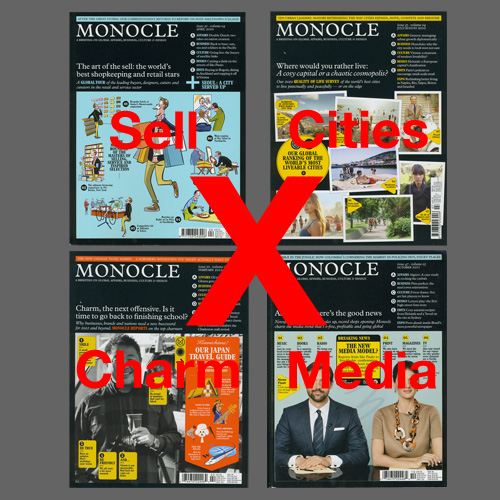
Monocle magazine: Advertising its singular view of the city

Monocle-SCCM2

A monocle is a single eyeglass kept in position by the muscles around the eye. The same can be said of Monocle magazine, a publication fixated on how cities should all be built in style and for conspicuous consumption.

Since launching in 2007, this publication by journalist-turned-media entrepreneur Tyler Brûlé has become a celebrated design bible for urban planners and the elite. Before Monocle, creating an attractive city worth living in never seemed so simple and stylish.

From its format down to design and content, Monocle smoothens over the complex subject of urbanism in a smart and attractive-looking publication. It’s Brûlé’s vision of a cross between the The Economist and GQ, a perfect status accessory for the modern executive—best displayed when one is dressed in tailored suits and leather shoes.

Monocle calls itself “A briefing on global affairs, business, culture & design”, but each issue reads more like Brûlé’s personal travel blog (he is known to travel more than 250 days in a year) printed on uncoated stock — all 300 pages of it, including booklet inserts and advertisements. A glossy spirit of optimism pervades throughout this magazine stuffed with informative blurbs, clever lists, one-page profiles, as well as question-and-answer interviews. Whether it is a survey on the world’s most livable cities, an interview with a politician or a shopkeeper, or an advertorial on Samsung’s latest phone, there is little difference. Everyone and everything on Monocle is selling their suggestions in creating a better city. Nothing seems problematic, not even the fact that almost everything Monocle features as good examples of city living are unaffordable to the rest of the 99%.

Despite its marketing stance, Monocle tries to look like it is delivering on its promise of “quality journalism” through design and art direction. Its commissioned photography borrow the visual language of objectivity, while its illustrations project a sense of simplicity. Documentary style photos of places run alongside straight-up style portraits of business owners, shops and products, creating a veneer of honesty over the fact that Monocle is promoting them to readers. Many of the magazine’s illustrations of city life display a charming LEGO-like simplicity, rendered in a uncomplicated style of elemental forms reminiscent of Isotype. Like this international picture language, Monocle’s illustrations smoothen out differences and diversity within and across cities, falling back on outmoded national costumes and stereotypes to fit a trans-national universe the magazine is building. From page to page, the images and short texts are packed into a three-column grid creating a sense of sameness regardless of who, what or where, which only encourages reader to skim rather than read seriously.

Most telling of Monocle’s journalistic aspirations is the typeface the magazine and brand has chosen to be set in: Plantin. The magazine’s creative director Richard Spencer Powell wanted a nod to “old journalistic values”, and this early 20th century typeface also gives the brand instant tradition, reinforcing why Brûlé had picked the archaic object of the monocle as its name. Despite establishing such origins, Monocle is uninterested in practicing journalism the old school way. The profession’s cardinal rule of separating editorial from advertising is discarded because Brûlé once said that “all good journalists are good salespeople too”, and Monocle’s editors often accompany ad directors to sales calls. It shows. This magazine’s advertorials are difficult to distinguish from editorial content. The only indication is a “(Brand name) X MONOCLE” tag at the bottom of the page, an ambiguous line that could also read as endorsed by Monocle.

But this magazine has no qualms about mixing the two. It is good business for Brûlé, who is also chairman of the branding and design agency, Winkreative. Monocle is a great advertising platform for the agency, as editorial subjects such as the government of Thailand have become clients too. In Monocle, Brûlé has created a marketing darling that has been recognized by Advertising Age which awarded him “Editor of the Year” in 2011, as well as, Adweek which named Monocle the “Best brand for living the good life” in 2012.

This commercial success is undoubtedly Monocle’s great achievement in a print media industry puzzling over how to survive in the digital age and has made it a model for many publications to follow since. But it comes at a cost: real quality journalism that helps us understand cities as citizens and not just consumers. Unlike those who live in Monocle city, these are ideals most of us cannot afford to buy nor lose.

———–
Written for Rick Poynor’s Critical Takedown workshop at D-Crit. This essay was later published on Design Observer.

445 Park Avenue: Architecture from the Inside-Out

445 Park AveAt just 22-stories tall, nondescript, and boxy, 445 Park Avenue is easily passed over when talking about architecture along its avenue. It neither has the intricate classical ornamentation of its next door Ritz Tower or the spectacular transparency of the glass-walled 450 Park Avenue across it. And built right up to the street, this office building offers pedestrians nothing more than a shadow of its presence.

But it would be wrong to equate 445 Park Avenue’s lack of distinction to a building that writer Ada Louise Huxtable might regard as “economically styled” rather than “architecturally designed” . Far from a result of “accident, expediency, economics and the inevitable march of industrial advance”, this building designed by Kahn & Jacobs for developer Paul Tishman is a highly functional product that demonstrated how modern office buildings could work in Park Avenue.

As one of its architects Ely Jacques Kahn once said, a building must first and foremost work for its inhabitants. “The architect’s first objective should be the study of the use of materials and the designing of a building that works — something that works from the inside out. What we should do is to consider function and let style follow as a corollary,” he said. Similarly, 445 Park Avenue has an interior substance deserving of more attention than what its undistinguished exterior presents.

That this office could be built so soon after the second World War — it was the first such development — and was completely filled in just over a year , is in a part, due to Kahn & Jacobs’ design. Their modernist approach of using standardized modules allowed for faster and easier construction compared to traditional methods, and would have helped convince the government to approve its building in 1946, even though construction was then heavily regulated as New York City transited to a peace-time economy after the war . The building design was also attractive to businesses because of its large spaces that could be easily partitioned, a feature made possible by the elimination of heavy columns on the exterior of its design. In addition, the standardized windows were of a ratio convenient for office layouts , and its horizontal system of arrangement lit up the building’s interiors such that workers did not feel trapped like in pre-war buildings with heavy masonry . Such a highly functional interior was enhanced by being fully air-conditioned, a first in New York City, and the combination was then regarded by architecture critic Lewis Mumford as “the best answer to the year-round problem of lighting and heating” . It is no wonder Tishman regarded his building as the office space of tomorrow, and 445 Park Avenue played a significant role in ushering the modern offices that followed after it.

But instead of taking the building’s modernist interior to its logical conclusion, as in the entirely glass International Style buildings that followed after 445 Park Avenue, Kahn & Jacobs designed an architecture sensible to its context. It is harder to appreciate now, but the building’s alternating masonry bands, would have fit into a street lined with ornamented masonry-clad buildings then. Its ziggurat top — Kahn’s signature response to the setback requirements of the 1916 Zoning Resolution — also echoed an evolution, rather than a disruption of the avenue’s architecture. These features gave 445 Park Avenue a sense of place, or what Kahn once called a “New York Style” of architecture. By “localizing” the International Style, 445 Park Avenue was unique to the city, familiar to the public, yet still took half a step towards the impending modernist future.

Perhaps, it is also this conservative stance that prevented 445 Park Avenue from looking beyond itself. While the pragmatic building achieves the maximum function for its developer and inhabitants, and fits into its urban context, it does not go beyond, unlike the nearby Lever House and Seagram buildings which sacrificed functional space to build public plazas. Even so, it should not diminish too much from 445 Park Avenue’s commitment as an office building that simply functions, which was much more vital during the period of economic and political uncertainty when it was built. Instead of grand public gestures and seeking an iconic exterior, Kahn and Jacobs created a building that became a backdrop for life in the city . Given how architecture today has become so much about the surface rather than function, 445 Park Avenue is a a reminder of why we build architecture: as a space that works “inside out” rather than “outside in”.

Bibliography

  • “Architects’ Rows ‘Silly,’ Kahn Says.” New York Times, 23 February 1932.
  • “Big Tishman Building on Park Ave. Filled.” New York Times, 8 Dec 1947, 45.
  • Huxtable, Ada Louise. “Park Avenue School of Architecture.” New York Times, 15 December 1957.
  • Mumford, Lewis. “The Sky Line.” The New Yorker, 13 December 1947, 85-92.
  • Stern, Jewel, and John A. Stuart. Ely Jacques Kahn, Architect: Beaux-Arts to Modernism in New York. New York: W.W. Norton & Company, 2006.
  • “Tishman Building Gets CPA Sanction.” New York Times, 17 July 1946, 37.


———–
Written for Karrie Jacobs’ 
Urban Curation class at D-Crit on a building in Park Avenue.