Category: Cities

This is Home

Forgive me for sounding a tad patriotic. Maybe it’s because National Day is just around the corner.

It’s just that, for some time now, I’ve been bugged by my fascination with discovering, documenting, and even, defining a “Singapore design”. It’s a topic most designers stumble over, several hate, and a category few like to be pigeon-holed in. And as I’ve dug deeper, I’ve been asking myself: “So what?”

What value is there in “Singapore design”?

It’s most probably not going to help designers win jobs or awards. No one out of Singapore will really understand, or even care.

But, maybe, that way of looking is missing the whole point.

As I watched Mr Bean perform during the Olympics opening ceremony in London this morning, it struck me that I could identify it as quintessentially British humour, and I actually felt proud for a community who found themselves and are so willing to show it off to the world.

Comparing Great Britain’s opening ceremony for the Olympics with what China put up four years ago when it held the event, the Chinese artist Ai Weiwei said:

“This was about Great Britain; it didn’t pretend it was trying to have global appeal. Because Great Britain has self-confidence, it doesn’t need a monumental Olympics. But for China that was the only imaginable kind of international event. Beijing’s Olympics were very grand – they were trying to throw a party for the world, but the hosts didn’t enjoy it. The government didn’t care about people’s feelings because it was trying to create an image.”

Self-confidence. Yes, that’s exactly what being able to define “Singapore Design” means to me. Being able to say with pride that Singapore has its own community of people here embarking on creative endeavors. And what matters is not how much they can impress the world out there, but the people whom they share their home with. That I can say the guy who designed this is my neighbour, a friend, someone whom understands this place that I live in, and not some star architect from a foreign land.

At the end of the day, I don’t need someone outside of my home to say that I am good, but it matters to know that I am doing good for someone at home.

Where are Singapore’s Goods of Desire?

Hong Kong retail store Goods of Desire opened in Singapore two weeks back and I finally checked it out last night. The label, founded in 1996, sells an eclectic collection of goods ranging from clothing to homeware that are designed to be “quintessentially Hong Kong”. One of their most distinctive design approaches has been to appropriate everyday things from the city to create goods that represent Hong Kong.

I walked out of the store wondering, where is Singapore’s Goods of Desire? It’s not a difficult concept to execute and many Singapore designers have used a similar approach to design an array of Singapore-inspired products. One of the early pioneers is Casey Chen, who created the Taxi Lamp (2002) and the DynaGlo Lamp (2005). There’s also &Larry, who has designed various “Objects” that express Singapore’s identity. More recently, we have Singapore Souvenirs (2009), where a group of industrial designers explored 37 new concepts of what a Singapore memento could be. This has become a permanent project of design group triggerhappy.

Besides representing Hong Kong, Goods of Desire also designs products “to live better”, promoting a certain lifestyle. Again, Singapore has a generation of young designers doing just that. Uyii produces bags by hand because “in this world of mass production, there is a place for special designs with handmade touch”. Similarly, local label wheniwasfour wants to “play a part of the demographic that enjoys ‘slow living’, simple happiness”.

What is missing in Singapore at this point is some kind of “super label” that connects all these creations. Currently, small shops such as S U P E R M A M A and little dröm store carry many of these products, and design studio FARM, also commissions, produces and sells such products via its online store. However, to take these designs to the mass market, and even internationally, there needs to be a certain volume and presence.

I don’t think what Singapore lacks now is creative talent — there are many more labels that those I’ve listed — but rather someone or an entity who can offer the commercial expertise and financial backing. Just as Hong Kong has its Goods of Desire and Japan has MUJI, it’s only a matter of time before such a concept store emerges from the shores of Singapore.

The Heartlands: Blk 230G, Hougang, Playgrounds

I’ve recently got myself involved in a series of work that revolved around the heartlands of Singapore.

At Our Doorsteps Cover

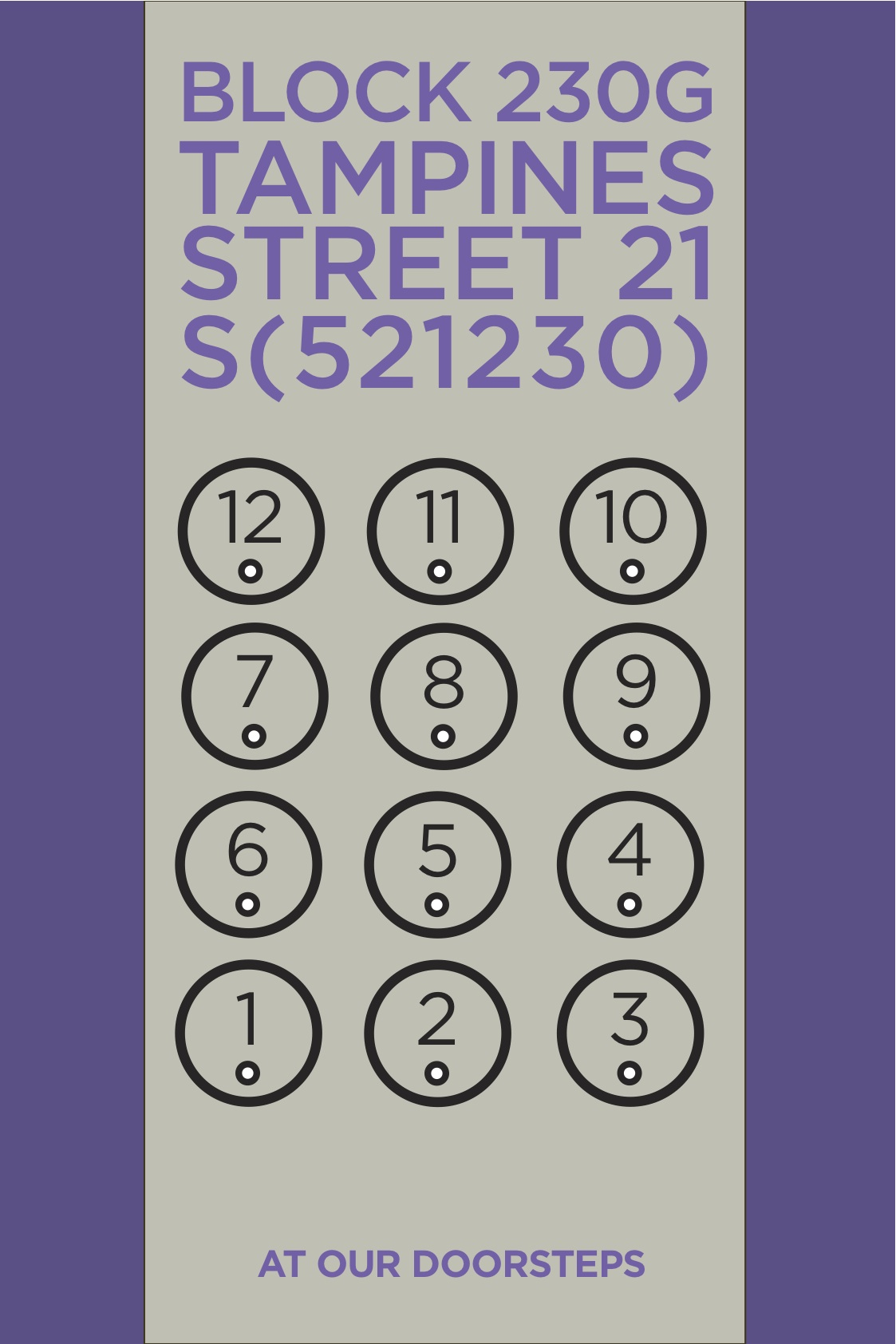
AT OUR DOORSTEPS is a community project photographer Sam Kang Li started to get to know his neighbours better. He knocked on the doors of all the 44 units of  the block he stayed in and photographed portraits of his neighbours at their doorstep. These portraits were exhibited in May at the void deck of his block and compiled to a block album I helped Kang Li put together.

On the left is the album cover, which took reference from the elements found in the block, including the distinct coloured tiles and the lift buttons.

Find out about At Our Doorsteps through this video he made in the midst of doing it, and another after the exhibition was held.

————

meet-the-people

MEET THE PEOPLE is a collection of videos that Samuel He put together over a few days in the run-up to the recent by-elections in Hougang. He wanted to reflect the voices of the people in the constituency by “eavesdropping” into their everyday conversations about the elections. During the hustings, he walked the constituency of Hougang, approaching residents to get them to talk about the elections, often putting his camera in front of them and letting it run till they forgot it was there.

Check out the videos here.

————

Mosaic Memories

MOSAIC MEMORIES: Remembering the playgrounds Singapore grew up in is an e-book I authored that contains stories of four Singaporeans, including the designer Mr Khor Ean Ghee, and their memories of old playgrounds in Singapore. Inside, you will also find portraits of the interviewees by Zakaria Zainal and an illustrated map by Wee Ho Gai of where the remaining old playgrounds are still standing today. This was a publication commissioned by the Singapore Memory Project as part of their “Drawn from Memory” series.

This e-book is the third time I’ve produced a piece related to my fascination with these old playgrounds that were designed and produced in Singapore. It began with an article I wrote for Singapore Architect in 2009, which was updated with even more details and reference in my most recent piece for FIVEFOOTWAY. Mosaic Memories comes from a very different angle, featuring the playground users instead of the designs.

You can download the e-book and read an interview I did with irememberSG!