Category: Culture

In Search of Provenance

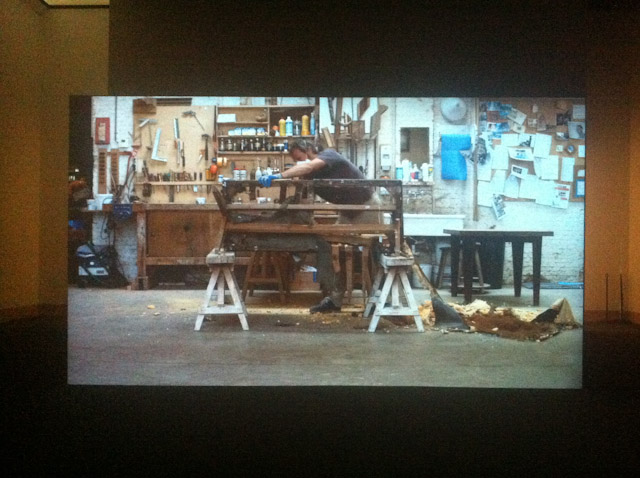
"Provenance" at The Metropolitan Museum of Art.
“Provenance” at The Metropolitan Museum of Art.

Watching the furniture restorer tear apart a Pierre Jeanneret chair to nothing more than its wooden skeletal frame, I was left with the question of what is an original design. That this eventually restored chair was auctioned off for tens of thousands of dollars as a collector’s item only made it more perplexing.

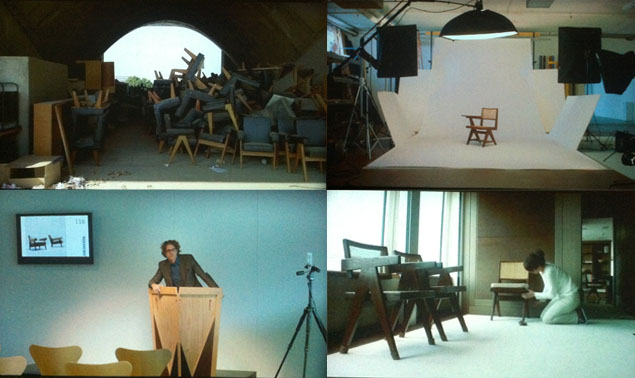
This hyper-inflation of mid-century modernist furniture is the subject of Amie Siegel’s “Provenance” (2013), a haunting 40-minute film that traces backwards the origins of a series of furniture designed by Swiss architect Jeanneret in the 1950s. Beginning from wealthy, stylish homes in the West where many of these furniture pieces now reside, Siegel takes us through the auction houses, furniture restorers, a cargo ship, and finally ends up in Chandigarh, the Indian city in which Jeanneret first conceived these utilitarian furniture for use in the modernist government buildings by his cousin, Le Corbusier. Amidst the now decaying buildings, we see these much sought after furniture pieces still being used as office furniture or even strewn in corners forgotten as they have been replaced by the generic wares of modern cubicle life.

Siegel’s cinematic journey — lingering tracking shots and without any dialogue — reveals the construction of “value” in such furniture today. Taken out of their original context, restored, glamorously photographed, and finally paraded at auction houses, these pieces of design are bestowed an aura of legitimacy and originality by what has become an industrial performance. Though beautifully shot, the film unveils an ugly truth: what do people really value in these pieces? The distance it has traveled? The restoration efforts? The myth of its origins?
ProvenanceClips

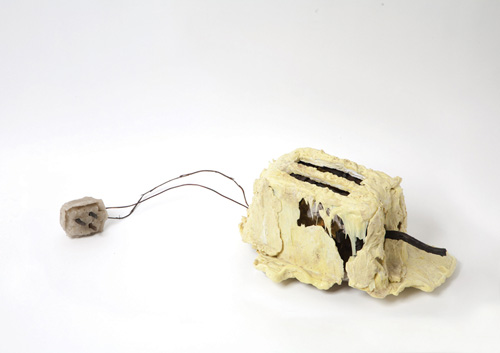
A separate journey to uncover the source of a design by Thomas Thwaites for The Toaster Project (2008), however, travels an entirely different route. The proposal is equally simple: to build a cheap chain-store toaster, costing just £3.49, from scratch — starting from acquiring the necessary raw materials. It turns out be both frustrating and hilarious, and the distance an individual in London has to travel to replicate what has essentially become a global industrial process today shows the hidden gap between a designed product and the world we live in. While Thwaites succeeds in building a barely functioning toaster eventually, it costs him £1187.54 and looks like a complete meltdown — all signs of the unseen external costs and environmental consequences created by the production of cheap consumer products.
DANIEL ALEXANDER
The toaster built by Thwaite. | DANIEL ALEXANDER

Despite the huge disparity in value between Jeanneret’s restored furniture and the chain-store toaster, they are but two endpoints on a continuum of the capitalistic global economy. Both have been designed for profit, but how they attain it differs. While auction houses play on scarcity and the original myth, big-chain stores flood the market with anonymous and cheap products. By traveling to the sources of these products, we open up what is often presented as complete and closed so as to take a critical look at the larger forces that shape and give form to these things we so easily call ‘designed’.

Book Review: Lesser Designs

Lesser Designs Cover

In cities across Asia, design is largely understood with a capital ‘D’. A professional service that raises the economic value of things through the language of style. A modern high-end product only for those who can afford it.

But what about traditional crafts and vernacular creations found in everyday life? Are these also not designed? In his delightful book, “lesser designs” (揦西設計) (2013), Siu King-chung calls the inclusion of everyday inventions of ordinary people in his city of Hong Kong as part of our understanding of contemporary design. From modified street trolleys to simple pamphlets advertising money-lending services, the professor at The Hong Kong Polytechnic University School of Design picks out ordinary things found around the city and unveils the design wisdom behind each through photographs and casual explanations written in Chinese and English. In all, close to 30 collections of objects are divided into four themes to illustrate what “lesser designs” are and where to find them.

Read the rest at art4d.asia

From now till then

What will Singapore look like in 2030? That is the question in the minds of many Singaporeans nowadays. The government made the nation sit up and reflect on its future when it released reports in January 2013 on how the city-state could possibly change in the next decade and a half: not only would there be more people, land use would also be more intensive.

For many, it was shocking to envision such a city. How could Singapore take anymore development when signs of aging are starting to show just two years before it turns 50 in 2015?

Over the last few years, its highly reliable infrastructure broke down several times, leading to flooded streets and disrupted train services. Last year, it witnessed its first industrial strike in decades, led by bus drivers recruited from China, who have become a common sight in a city increasingly reliant on migrant workers. The once squeaky clean government has also come under scrutiny with several of its honchos facing corruption accusations. Most recently, a Member of Parliament from the ruling People’s Action Party (PAP) resigned over an extra-marital affair. This triggered a by-election which saw the opposition party gain yet another seat in the government. While the PAP was the only party in power since independence for over two decades, there are now 7 elected from the opposition Workers’ Party — albeit a tiny fraction out of a total of 87 seats.

Such cases have led observers living in Singapore to go as far as to suggest that the city is living in a “new normal”. It may be premature, but it has certainly got Singaporeans thinking about possibilities. The government has even tried to harness this energy by recently initiating a “National Conversation”, promising to listen to what Singapore citizens wanted, so that it can shape its future policies.

As part of this new generation of Singaporeans who are in the 20s and 30s, I do hear murmurings from my peers who envision a different city from what we grew up in. While those before us may have emerged from the oft-told struggle in which Singapore went from Third World to First, we grew up in a city that became a global city in the ‘90s, renowned for its efficiency and roaring economic success. While we may have worshipped the Western world then and  were proud to have made English our language of choice,  the tides have changed two decades on. Singapore finds itself looking towards Asia for its future. We now find ourselves — grandchildren of immigrants from Asia — caught in-between our historical roots with the region and how comfortably assimilated we have become with the Western world.

The truth, perhaps, is we are rootless — disconnected from our ancestors with not much else in Singapore to latch on to either. It is perhaps why so many of my peers and I have started to mine our histories to find out who we are. Whether it is the love for all things retro or a kind of wide-eyed wonder towards anything from the past, we often seem trapped in a nostalgia for a past we never lived through, but yearn to have grown up in. Any news of the impending demolishing of an old place in Singapore becomes an opportunity for us to whip out cameras and video recorders to stake our ‘memory‘ of a city lost to the future.

This question of who we are and who is this city becomes even more pronounced as Singaporeans and Singapore become more cosmopolitan. Our insecurity and inability to say who we are shows in how xenophobic we are nowadays — a kind of refusal to reflect on who we are, but instead assert the claim that they are not us. 

In these uncertain times, I find comfort in seeing other Singaporeans getting their hands dirty to create change. This city guide is an attempt to map out some of these efforts, and help us navigate the possible Singapores that are emerging. From its people, places and phenomena, there are signs of what the future holds for this city.

Nguan’s Singapore sets the tone with his pictures that captures the mood of Singaporeans as they go about their everyday lives. Two interviews with The Thought Collective and studioKALEIDO give insights to the new values and ideas that are shaping the city’s future, while August 9 Portraits by Sam & Sam reflects the wishes its citizens have for the nation as recorded on its birthday last year.

A tour of spaces in Singapore captures how the city’s landscape is changing as well. In Wide Open Possibilities, experience up-and-coming neighbourhood Jalan Besar as mapped out by local independent travel guide alter:sg, while a fictional essay from the literary magazine Ceriph, shows an aspect of the city through the eyes of a young Singapore writer.

Finally, in Anew Singapore, we explore some of the ongoing trends in the city as well as its design, magazine, food, and music scenes that hint at the values that matter to young Singaporeans today what might define their tomorrows.

When one flips back at this guide in 2030, how much of Singapore will we recognise? The journey there starts now.

———–
Written in 2013 for The Alpine Review as part of a proposed city guide on Singapore. The section was never published. Thanks to Nguan, Dan Koh, Shin Lin, Rebecca Toh, Iliyas Ong, Samuel He, Sam Chin, Benjamin Koh, Winnie Wu, and Amanda Lee-Koe for their help on the guide.